Bulletin for March 15, 2026
Mar. 15 – 3rd Sunday of the Great Lent. Adoration of Cross. Tone 7
Hieromartyr Theodotus, bishop of Cyrenia (326). Virgin-martyr Euthalia (257). Martyr Troadius of Neo-Caesarea (3rd c.). St. Agatho of Egypt, monk (5th c.). 440 Martyrs slain by the Lombards (579).
Heb. 4:14–5:6; Mk. 8:34–9:1;
Liturgy of St. Basil the Great.
Mar. 22 – 4th Sunday of the Great Lent Tone 8
Venerable John Listvychnyk (movable holiday on the 4th Sunday of the Great Lent). The Holy Forty Martyrs of Sebaste: Cyrion (or Quirio), Candidus, Domnus, Hesychius and others (320). Urpasianus of Nicomedia (295). Righteous Caesarius, brother of St. Gregory the Theologian (369). St. Tarasius of Liconium.
Heb. 6:13-20; Mk. 9:17-31;
Heb. 12:1-10; Mt. 20:1-16;
Liturgy of St. Basil the Great.
Services & Other Events
15 March, Sunday:
- 9am – Confession / Hours
- 9:30am – Divine Liturgy - Бож. Літургія
16 March, Monday:
- 7pm – Parish Council Meeting
20 March, Friday:
- 6:30pm – Liturgy of Presanctified Gifts - Літургія Ранішосвячених Дарів
21 March, Saturday:
- 4:30pm – General Memorial Service - Поминальна Субота
- 5pm – Great Vespers - Велика Вечірня
22 March, Sunday:
- 9am – Confession / Hours
- 9:30am – Divine Liturgy - Бож. Літургія
25 March, Wednesday:
- 6:30pm – Liturgy of Presanctified Gifts - Літургія Ранішосвячених Дарів
28 March, Saturday:
- 10am – Deanery Divine Liturgy - Бож. Літургія деканату
- 5pm – Great Vespers - Велика Вечірня
29 March, Sunday:
- 9am – Confession / Hours
- 9:30am – Divine Liturgy - Бож. Літургія
31 March, Tuesday:
- 7pm – Building & Maintenance Meeting
Апостол і Євангеліє - Gospel and Epistle of the Day
CHRIST: Priest Forever According to the Order of Melchizedek
"Thou art a priest forever after the order of Melchizedek." — Psalm 110:4; Hebrews 5:6
Who Was Melchizedek?
Imagine walking through a story when suddenly a mysterious figure appears — a king and a priest at the same time — blesses someone very important, shares bread and wine, then disappears from the pages of history without a trace of his birth or death. That is Melchizedek.
His name appears only three times in all of Scripture — in Genesis 14, in Psalm 110, and throughout the Epistle to the Hebrews — yet his importance echoes across thousands of years of sacred history. He is one of the most profound mysteries of the Old Testament.
In Genesis 14, after the great patriarch Abraham returned victorious from battle, a figure came to meet him: Melchizedek, king of Salem and priest of the Most High God. He brought out bread and wine, blessed Abraham, and Abraham gave him a tenth of everything — a tithe — as an act of deep reverence.
His very name holds meaning. St. John Chrysostom and the Epistle to the Hebrews both explain it:
"Melchizedek" means King of Righteousness — for Melchi means "king" and Sedek means "righteousness."
"Salem" means Peace — so he is also the King of Peace.
He is therefore both King of Righteousness and King of Peace. These are not ordinary titles. The Church Fathers recognized in them a portrait of Christ Himself, who is our Righteousness (1 Corinthians 1:30) and our Peace (Ephesians 2:14).
The Great Mystery:
Without Beginning or End
What makes Melchizedek extraordinary is what the Scriptures do NOT say about him. In a world where every priest and king traced their identity through genealogy, Melchizedek has none. The Book of Genesis says nothing of his father, his mother, his ancestors, his birth, or his death.
The Epistle to the Hebrews describes him as "without father, without mother, without genealogy, having neither beginning of days nor end of life" (Hebrews 7:3). St. John Chrysostom carefully explains: this does not mean Melchizedek literally had no parents — it means the Holy Scriptures deliberately concealed them, so that through this silence, he might serve as a living image of the One who truly has no beginning and no end: Jesus Christ the Son of God.
The Orthodox Church teaches: "He must have been born, and he must have died, but the Scriptures deliberately conceal both events, assigning him neither beginning nor end, so that he might be called a priest forever."
Where Is Melchizedek Remembered?
Melchizedek is not forgotten. The Orthodox Church holds him in deep honor. Here are the places where he appears in our sacred life:
In Holy Scripture: Genesis 14:18–20 (his meeting with Abraham), Psalm 110:4 (the prophetic declaration of the eternal priest), and the Epistle to the Hebrews, chapters 5–7 (the full theological teaching).
In the Church Calendar: The Orthodox Church commemorates the Righteous Melchizedek on May 22. He is numbered among the holy ancestors and righteous ones of the Old Testament.
In the Great Canon of St. Andrew of Crete: During the First Week of Great Lent, this beloved hymn of repentance calls the faithful: "Imitate that Priest of God and solitary King, who was an image of the life of Christ in the world among men." Christians are invited to see in Melchizedek a mirror of Christ and a pattern for their own lives.
In the Divine Liturgy: Every time the Holy Eucharist is celebrated, the pattern of Melchizedek — who offered bread and wine to Abraham — is mystically fulfilled. The bread and wine on the altar become the Body and Blood of Christ, the eternal High Priest.
In the writings of the Church Fathers: St. Nikolai Velimirovich described Melchizedek as a "shining comet" in the starry heavens of sacred history — appearing suddenly, glorious, then hidden in the mystery of God.
Two Priesthoods: Levi and Melchizedek
To understand why Christ is called a priest after the order of Melchizedek, we must understand the difference between two kinds of priesthood.
The Levitical Priesthood was the priesthood of the Old Testament. The priests of Israel came from the tribe of Levi. They were born, grew old, and died. They offered sacrifices of animals — bulls, lambs, pigeons — again and again, day after day, year after year. These sacrifices were real and pleasing to God, but they were imperfect, because the priests themselves were imperfect men. They had to offer sacrifices first for their own sins before they could intercede for the people. And when a priest died, another took his place.
The Priesthood of Melchizedek was different. It had no beginning recorded in Scripture. It had no end. It was connected not to a tribe or bloodline, but to righteousness and peace. It was not passed on from father to son. And crucially, it was served not with the blood of animals, but with bread and wine.
St. Paul, writing to the Hebrews, shows that the Levitical priesthood was always meant to be temporary — a preparation pointing forward to something greater. Even Abraham, the ancestor of the Levites, bowed before Melchizedek and paid him tithes. The lesser bows to the greater. This means the priesthood of Melchizedek is greater than the priesthood of Levi.
And it is this greater priesthood — the priesthood of Melchizedek — that Christ has claimed and fulfilled forever.
Christ: The Eternal High Priest
Jesus Christ is not a priest in the Levitical sense. He was not born from the tribe of Levi — He was born from the tribe of Judah, the royal tribe of David. This is precisely why the prophecy of Psalm 110:4 is so remarkable: "The LORD has sworn, and will not repent: Thou art a priest forever after the order of Melchizedek."
God Himself swore an oath. Not according to an earthly lineage, not according to Aaron or Levi — but according to a new and eternal order, the order of Melchizedek.
St. Cyril of Alexandria teaches that because Christ is fully human and fully divine, He is the perfect mediator — the ideal High Priest. As human, He knows our sufferings, our fears, our temptations. He "was tempted in all ways as we are, yet without sin" (Hebrews 4:15). Because of this, we can come to Him with our prayers with confidence, knowing He understands us from within.
As divine, His intercession never fails. He lives forever. He prays for us forever. There is no death to interrupt His priesthood, no sin to disqualify Him, no weakness to limit Him.
Hebrews 7:25 declares: "He is able to save to the uttermost those who come to God through Him, since He always lives to make intercession for them."
The Crucifixion: The High Priest's Ultimate Offering
Here is the heart of the mystery. In the Orthodox Church, the Crucifixion of Christ is not seen merely as a historical tragedy or even only as a sacrifice — it is seen as the act of the Great High Priest.
Think about what a high priest does. He enters the Holy of Holies — the innermost sacred place — carrying the blood of the sacrifice, to offer it before God on behalf of the people. In ancient Israel, only the High Priest could enter the Holy of Holies, and only once a year, on the Day of Atonement.
Christ our High Priest did something infinitely greater. He did not carry the blood of bulls or goats. He carried His own Blood. He did not enter a temple made with human hands. He passed through the heavens themselves, into the very presence of God the Father. And He did not do this once a year — He did it once for all eternity.
As the icon tradition of the Orthodox Church expresses it in the Cherubic Hymn prayer of the Divine Liturgy: "For you are the One who offers and the One who is offered, the One who is given and the One who is received, O Christ our God."
On the Cross, Christ is simultaneously:
The Priest — who makes the offering.
The Victim — who is offered.
The Altar — upon which the sacrifice takes place.
The Temple — through which we enter God's presence.
This is what makes His sacrifice infinite in value. No animal could accomplish this. Only the Son of God made Man, the eternal High Priest after the order of Melchizedek, could offer Himself for the sins of the whole world and rise again, ascending to the right hand of the Father where He intercedes for us forever.
The Eucharist: Melchizedek Fulfilled Every Sunday
Every Divine Liturgy is a meeting with the eternal High Priest. When the priest stands at the altar, offers bread and wine, and these become the Body and Blood of Christ — we are standing in the lineage of that mysterious moment when Melchizedek brought bread and wine to Abraham.
The pattern is now fulfilled in its fullness. Melchizedek offered bread and wine — a foreshadowing. Christ offers His own Body and Blood — the eternal reality. As the Orthodox Church teaches, the Eucharist is not merely a symbol. It is a true sacrifice, offered by Christ Himself, the same sacrifice of the Cross, made present for us on the altar.
We offer our gifts. Christ, the eternal Priest, gives us His Body and Blood. And we receive His blessing — just as Abraham received the blessing of Melchizedek. The liturgical pattern hidden in Genesis 14 is alive in every Orthodox church, every Sunday, everywhere in the world.
For Children: A Simple Explanation
Have you ever wondered why we bring bread and wine to church? A very long time ago — even before Moses, before David — there was a mysterious holy man named Melchizedek. He was both a king and a priest. Nobody knows who his parents were, because the Bible doesn't tell us. He gave bread and wine to the great Abraham, and blessed him. Abraham bowed to him, because Melchizedek was very close to God.
The Bible tells us that Jesus is a priest just like Melchizedek — but even greater, because Jesus is the Son of God. When Jesus died on the Cross, He gave Himself as a gift to His Father in heaven, to take away all our sins. And He rose from the dead and lives forever! That means He never stops praying for us and loving us.
Every time we come to the Divine Liturgy and receive Holy Communion — the bread and wine that become His Body and Blood — it is Jesus, our eternal Priest, giving Himself to us, just as Melchizedek gave bread and wine to Abraham so long ago. We are part of this beautiful and endless story of God's love.
ХРИСТОС: Священик навіки за чином Мелхіседека
"Ти священик навіки за чином Мелхіседека." — Псалом 109:4; Євр. 5:6
Хто такий Мелхіседек?
Уявіть: серед священної розповіді раптово з'являється таємнича постать — одночасно цар і священик. Він благословляє одного з найвидатніших людей в історії, подає хліб і вино, а потім зникає зі сторінок Святого Письма — без жодної згадки про своє народження чи смерть. Це — Мелхіседек.
Його ім'я згадується лише тричі в усьому Святому Письмі: у Книзі Буття (Бут. 14), у Псалмі 109 (110) та в Посланні до Євреїв (розділи 5–7). Проте значення цієї постаті простирається через тисячоліття священної історії.
У Книзі Буття (14:18–20) після перемоги Авраама в битві назустріч йому виходить Мелхіседек, цар Салему та священик Бога Всевишнього. Він виносить хліб і вино, благословляє Авраама, а той, у знак глибокої пошани, віддає йому десятину — десяту частину від здобичі.
Саме ім'я несе глибоке значення. Святий Іван Золотоуст і Послання до Євреїв пояснюють:
"Мелхіседек" означає Цар Правди — від слів Малкі (цар) і Седек (правда).
"Салем" означає Мир — тобто він також є Царем Миру.
Отже, перед нами стоїть Цар Правди і Цар Миру. Святі Отці Церкви впізнали в цих титулах образ Самого Христа, Який є нашою Правдою (1 Кор. 1:30) і нашим Миром (Еф. 2:14).
Велика Таємниця: Без Початку і Кінця
Що робить Мелхіседека надзвичайним, так це те, чого Святе Письмо про нього НЕ каже. У світі, де кожен священик і цар доводив своє право через родовід, у Мелхіседека немає жодного. Книга Буття не говорить ні про його батька, ні про матір, ні про предків, ні про народження, ні про смерть.
Послання до Євреїв описує його як "без батька, без матері, без родоводу, не має ні початку днів, ні кінця життя" (Євр. 7:3). Святий Іван Золотоуст уважно пояснює: це не означає, що Мелхіседек буквально з'явився нізвідки — це означає, що Святе Письмо навмисно приховало ці відомості, щоб через цю тишу він міг слугувати живим образом Того, Хто воістину не має початку і кінця: Ісуса Христа, Сина Божого.
Православна Церква вчить: "Він, безперечно, народився і помер, але Святе Письмо навмисно приховує ці події, не вказуючи ні початку, ні кінця, щоб він міг зватися священиком навіки."
Де Згадують Мелхіседека?
Мелхіседек не забутий. Православна Церква вшановує його з великою пошаною. Ось де він присутній у нашому священному житті:
У Святому Письмі: Бут. 14:18–20 (зустріч з Авраамом), Псалом 109(110):4 (пророцтво про вічного священика), Послання до Євреїв, розділи 5–7 (повне богословське вчення).
У Церковному Календарі: Православна Церква вшановує Праведного Мелхіседека 22 травня. Він зарахований до святих праотців і праведних Старого Завіту.
У Великому Каноні Святого Андрія Критського: Під час першого тижня Великого Посту ця улюблена покаянна пісня закликає вірних: "Наслідуй того Бога-священика і самотнього царя, який був образом Христового життя в світі серед людей." Вірних запрошують побачити в Мелхіседеку дзеркало Христа і зразок для власного життя.
У Божественній Літургії: Кожного разу, коли відправляється Свята Євхаристія, образ Мелхіседека — який подав хліб і вино Авраамові — містично здійснюється. Хліб і вино на престолі стають Тілом і Кров'ю Христовими, вічного Первосвященика.
У писаннях Святих Отців: Святий Миколай Велимирович описав Мелхіседека як "сяючу комету" в зоряному небі священної історії — що з'явилась раптово, у всій своїй славі, а потім сховалась у таємниці Божій.
Два Священства: Левіїв і Мелхіседека
Щоб зрозуміти, чому Христос названий священиком за чином Мелхіседека, слід зрозуміти різницю між двома видами священства.
Левітське Священство — це священство Старого Завіту. Священики Ізраїлю походили з коліна Левія. Вони народжувались, старіли й помирали. Вони приносили жертви з тварин — биків, ягнят, голубів — знову і знову, день у день, рік у рік. Ці жертви були дійсними і угодними Богу, але недосконалими, бо самі священики були недосконалими людьми. Вони мусили приносити жертви спочатку за власні гріхи, а вже потім — за народ. І коли священик помирав, його місце займав інший.
Священство Мелхіседека було іншим. Воно не мало зафіксованого в Письмі початку. Воно не мало кінця. Воно не було пов'язане з коліном чи кровною спорідненістю, а з правдою і миром. Воно не передавалось від батька до сина. І, що найважливіше, воно відправлялось не з кров'ю тварин, а з хлібом і вином.
Апостол Павло, пишучи до Євреїв, показує, що Левітське священство завжди мало бути тимчасовим — приготуванням, що вказує на щось більше. Навіть Авраам, предок левітів, схилився перед Мелхіседеком і дав йому десятину. Менший кланяється більшому. Це означає, що священство Мелхіседека є вищим за священство Левія.
І саме це вище священство — священство Мелхіседека — Христос прийняв і здійснив навіки.
Христос: Вічний Первосвященик
Ісус Христос не є священиком у Левітському розумінні. Він народився не від коліна Левія — Він народився від коліна Юди, царського коліна Давидового. Саме тому пророцтво Псалма 109:4 таке вражаюче: "Клявся Господь і не покається: Ти священик навіки за чином Мелхіседека."
Сам Бог поклявся. Не за земним родоводом, не за Ааронівським чи Левітським чином — а за новим і вічним чином, чином Мелхіседека.
Святий Кирило Олександрійський вчить, що оскільки Христос є досконалою людиною і досконалим Богом, Він є ідеальним Посередником — досконалим Первосвящеником. Як людина, Він знає наші страждання, наші страхи, наші спокуси. Він "у всьому спокушений, як і ми, крім гріха" (Євр. 4:15). Тому ми можемо приходити до Нього з нашими молитвами з упевненістю, знаючи, що Він розуміє нас зсередини.
Як Бог, Його заступництво ніколи не зазнає невдачі. Він живе вічно. Він молиться за нас вічно. Жодна смерть не переривала Його священство, жоден гріх не позбавляє Його гідності, жодна слабкість не обмежує Його.
Євреїв 7:25 проголошує: "Тому й може досконало спасати тих, хто через Нього приходить до Бога, бо Він завжди живий, щоб заступатися за них."
Розп'яття: Найвища Жертва Первосвященика
Ось серцевина таємниці. У Православній Церкві Розп'яття Христове розглядається не просто як історична трагедія і не лише як жертва — воно розглядається як дія Великого Первосвященика.
Подумайте, що робить первосвященик. Він входить у Святе Святих — найсвятіше місце — несучи жертовну кров, щоб принести її перед Богом від імені народу. У стародавньому Ізраїлі лише первосвященик міг входити у Святе Святих, і лише раз на рік — у День Очищення.
Христос, наш Первосвященик, зробив щось незмірно більше. Він приніс не кров биків чи козлів. Він приніс Власну Кров. Він увійшов не до храму, збудованого руками людей. Він пройшов крізь самі небеса — у саму присутність Бога Отця. І зробив це не раз на рік — але раз і назавжди, на всю вічність.
Як висловлює іконна традиція Православної Церкви в молитві Херувимської Пісні Божественної Літургії: "Бо Ти єси Той, що приносиш жертву і принесений, що приймаєш і роздаєшся, Христе Боже наш."
На Хресті Христос є одночасно:
Священиком — Тим, Хто приносить жертву.
Жертвою — Тим, Кого приносять.
Вівтарем — на якому відбувається жертвоприношення.
Храмом — через який ми входимо у присутність Бога.
Саме це робить Його жертву безкінечно коштовною. Жодна тварина не могла цього виконати. Лише Син Божий, що став Людиною, вічний Первосвященик за чином Мелхіседека, міг принести Себе за гріхи всього світу, воскреснути й вознестись до Отця, де Він завжди заступається за нас.
Євхаристія: Мелхіседек Здійснюється Щонеділі
Кожна Божественна Літургія — це зустріч з вічним Первосвящеником. Коли священик стоїть при престолі, приносить хліб і вино, і вони стають Тілом і Кров'ю Христовою — ми стоїмо у спадщині тієї таємничої миті, коли Мелхіседек приніс хліб і вино Авраамові.
Образ нарешті здійснюється в усій повноті. Мелхіседек приносив хліб і вино — як передобраз. Христос приносить Своє Тіло і Кров — як вічну реальність. Як вчить Православна Церква, Євхаристія — це не просто символ. Це справжня жертва, принесена Самим Христом, та сама Голгофська жертва, що знову стає присутньою для нас на престолі.
Ми приносимо наші дари. Христос, вічний Священик, дає нам Своє Тіло і Кров. І ми отримуємо Його благословення — так само як Авраам отримав благословення Мелхіседека. Літургійний образ, прихований у 14-ому розділі Книги Буття, живе в кожному православному храмі, кожної неділі, по всьому світу.
Для Дітей: Проста Розповідь
Чи замислювались ви коли-небудь, чому до церкви приносять хліб і вино? Дуже давно — ще до Мойсея, до Давида — жив таємничий святий чоловік на ім'я Мелхіседек. Він був і царем, і священиком одночасно. Ніхто не знає, хто були його батьки, бо Біблія нам про це не розповідає. Він приніс хліб і вино великому Авраамові і благословив його. Авраам схилився перед ним, бо Мелхіседек був дуже близьким до Бога.
Біблія говорить нам, що Ісус є священиком, схожим на Мелхіседека, — але навіть більшим, адже Ісус — Син Божий. Коли Ісус помер на Хресті, Він подарував Себе Своєму Небесному Отцеві, щоб взяти на Себе всі наші гріхи. А потім Він воскрес із мертвих і живе вічно! Це означає, що Він ніколи не перестає молитись за нас і любити нас.
Щоразу, коли ми приходимо на Божественну Літургію і причащаємося — Тілом і Кров'ю, що були хлібом і вином — це Ісус, наш вічний Священик, дає Себе нам, так само як Мелхіседек колись давав хліб і вино Авраамові. Ми є частиною цієї прекрасної і нескінченної історії Божої любові.
The Orthodox Cross:
Meaning, Proper Use, and the Three Bars
The cross is the central symbol of Christianity and holds a place of profound reverence in Orthodox tradition. It is not merely a decorative emblem but a sacred object that carries the fullness of the Faith. The Orthodox Church teaches both how to honor the cross and what must be avoided in its use.
Why Does the Orthodox Cross Have Three Bars?
The Orthodox cross is distinguished by its three horizontal bars, each carrying deep theological meaning.
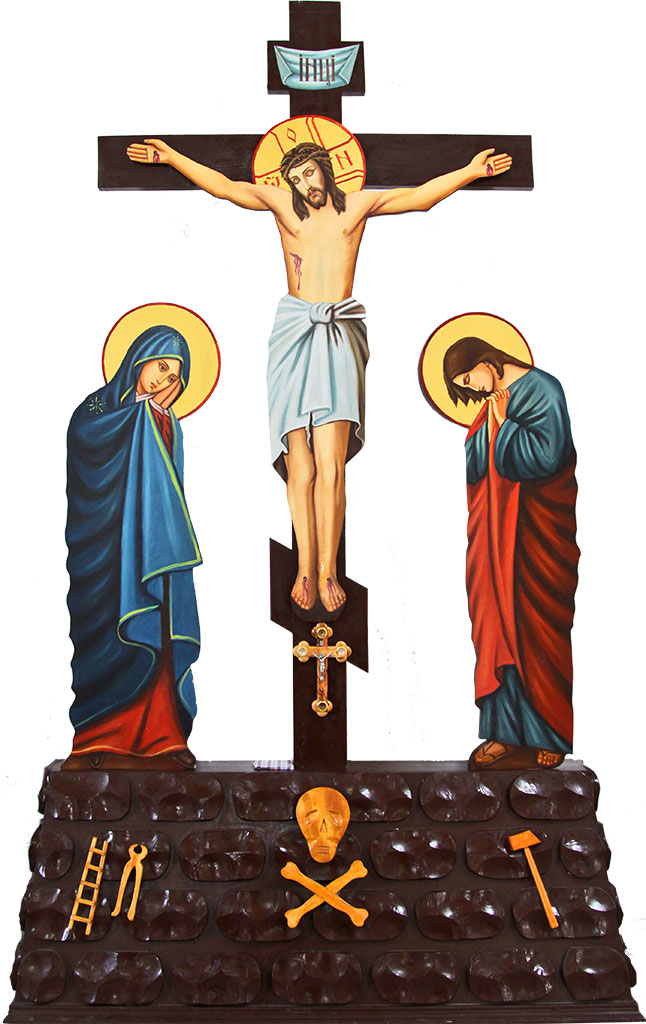
The top bar represents the inscription placed above Christ's head by Pilate's soldiers: "Jesus of Nazareth, King of the Jews" (INRI). It stands as a proclamation of Christ's identity and kingship.
The middle bar is the main crossbeam to which Christ's hands were nailed — the bar common to all Christian crosses. It symbolizes the Crucifixion itself and the redemptive sacrifice of the Lord.
The bottom bar is the footrest (suppedaneum) upon which Christ's feet were placed. It is depicted at an angle: tilted upward on the left side and downward on the right. This slant carries eschatological meaning — the left side rises toward heaven, symbolizing the repentant thief (St. Dismas) who was saved; the right side descends, symbolizing the unrepentant thief who rejected Christ. It is thus a symbol of judgment, mercy, and the two paths of human destiny.
How to Use the Cross Properly
According to Orthodox teaching, the cross should be treated with the utmost reverence. The baptismal cross (pectoral cross) is worn over the chest, close to the heart, as a constant reminder of one's faith and baptism. When making the Sign of the Cross, the faithful are to do so with full attention and devotion — not hastily or carelessly.
Crosses are placed in homes, churches, and at crossroads as a blessing and protection. An icon corner with a cross is considered especially sacred. The cross may be venerated by kissing it after a liturgical service, an act of love toward Christ's sacrifice.
What Must Be Avoided
The Orthodox Church firmly teaches that the cross must never be used as a fashion accessory or mere decoration. Wearing it without faith, or treating it as a good-luck charm, is considered disrespectful. The cross should not be placed on the floor, stepped on, or stored carelessly among ordinary items.
Crosses should not be sold for profit in a commercial manner that strips them of their sacred character. The Church also cautions against using cross imagery on clothing, shoes, or objects subject to degradation, as this dishonors the symbol of Christ's victory over death.
Above all, the cross is a symbol of love, self-sacrifice, and resurrection — and is to be approached always with reverence, prayer, and a living faith.
Православний Хрест:
Значення, Правильне Використання та Три Перекладини
Хрест є центральним символом християнства і займає місце глибокої шани в православній традиції. Це не просто декоративний знак, а священний предмет, що несе в собі повноту Віри. Православна Церква навчає, як шанувати хрест і чого слід уникати при поводженні з ним.
Чому Православний Хрест Має Три Перекладини?
Православний хрест вирізняється трьома горизонтальними перекладинами, кожна з яких має глибоке богословське значення.
Верхня перекладина символізує напис, розміщений над головою Христа воїнами Пилата: «Ісус Назарянин, Цар Іудейський» (ІНЦІ). Вона є проголошенням особи та царства Христа.
Середня перекладина — це основна перекладина, до якої були прибиті руки Христа. Вона спільна для всіх християнських хрестів і символізує саме Розп'яття та спокутну жертву Господа.
Нижня перекладина — це підніжжя (suppedaneum), на яке спиралися ноги Христа. Вона зображується похило: ліва сторона піднята вгору, права — опущена донизу. Цей нахил несе есхатологічне значення: ліва сторона спрямована до неба і символізує розкаяного розбійника (св. Дісмас), якого прийняв Христос; права — звернена донизу і символізує нерозкаяного розбійника, що відкинув Христа. Таким чином, вона є символом суду, милосердя та двох шляхів людської долі.
Як Правильно
Ставитись до Хреста
Згідно з православним вченням, до хреста слід ставитися з найвищою повагою. Хрест, отриманий при хрещенні, носять на грудях, близько до серця, як постійне нагадування про віру і хрещення. Здійснюючи хресне знамення, вірні повинні робити це з повною увагою та благоговінням — не поспішно й не недбало.
Хрести встановлюють у домівках, церквах і на перехрестях як благословення і захист. Куток з іконами та хрестом вважається особливо святим місцем. Хрест можна вшановувати, цілуючи його після богослужіння, — це вияв любові до жертви Христа.
Чого Слід Уникати
Православна Церква чітко вчить, що хрест ніколи не можна використовувати як модний аксесуар чи просто прикраса. Носіння його без віри або поводження з ним як із талісманом вважається неповагою. Хрест не можна класти на підлогу, наступати на нього або зберігати недбало серед звичайних речей.
Хрести не слід продавати заради комерційної вигоди у спосіб, що позбавляє їх священного характеру. Церква також застерігає від використання зображення хреста на одязі, взутті або предметах, які зазнають зносу, оскільки це ганьбить символ перемоги Христа над смертю.
Понад усе, хрест є символом любові, самопожертви та воскресіння — і до нього слід завжди підходити з благоговінням, молитвою та живою вірою.
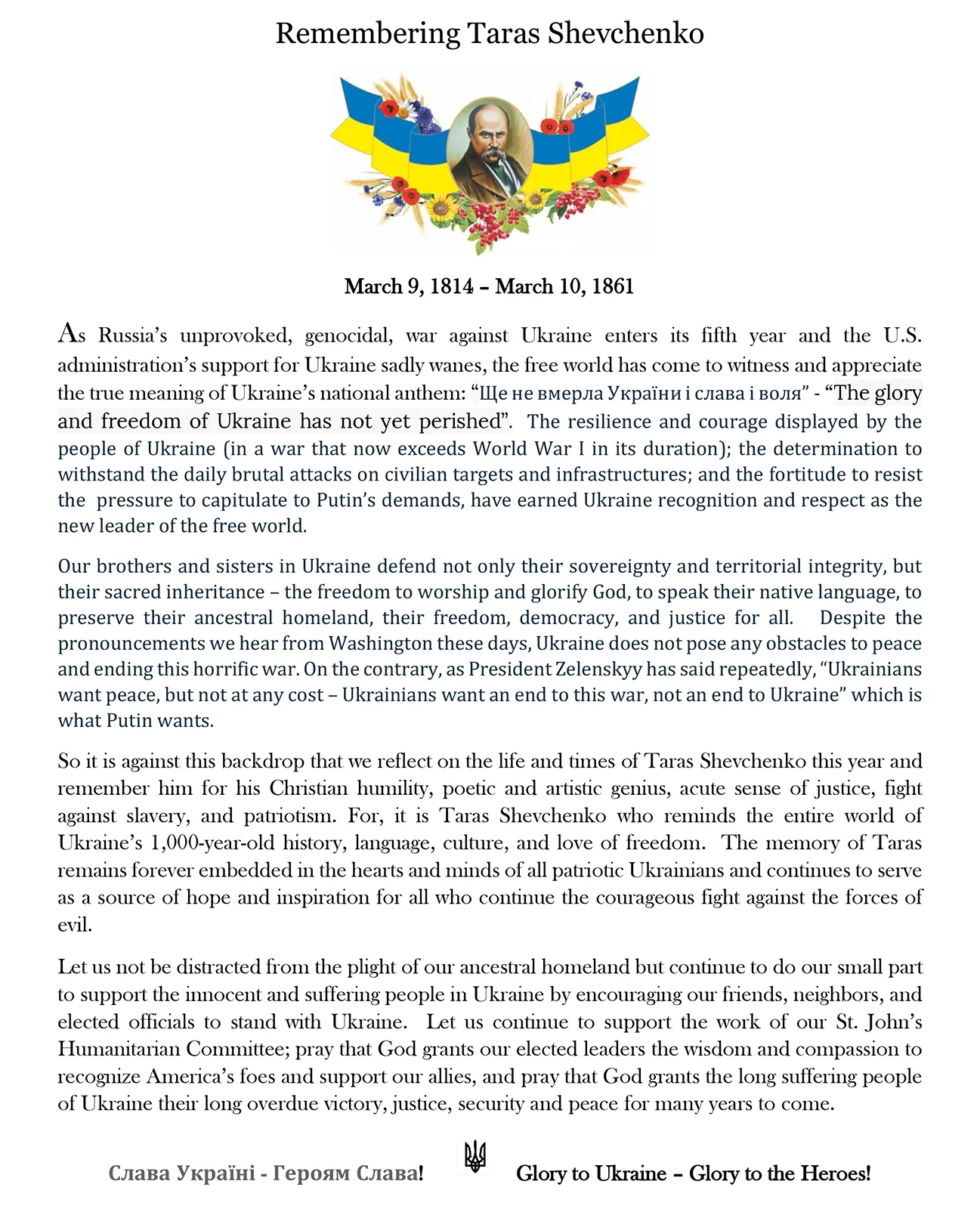
Remembering Taras Shevchenko
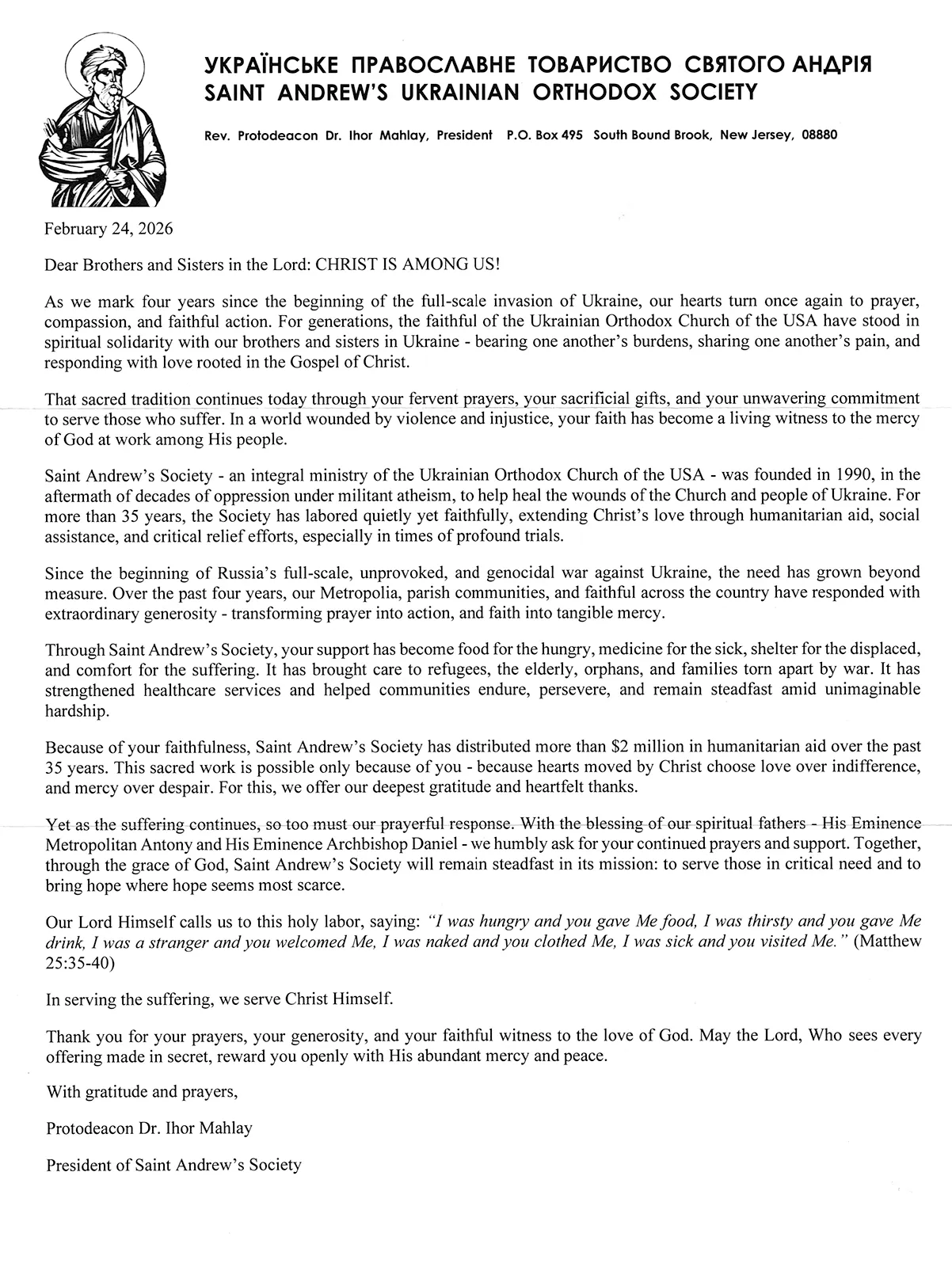
St. Andrew Ukrainian Orthodox Society
Variety Booth bakers needed!!!
Only 2 weeks until our Bake Sale and your specialty baked goods are needed to fulfill the high demand we have for our delicious cakes and cookies. Please bring them to the hall by 3pm Friday so we can cut and arrange. As always, thank you for your help!!
Pysanky Classes
Pysanky classes will start Mar. 4. Wednesdays instead of dancing (5:45-7) and Sunday after church school till 2pm. Last class is on April 5.
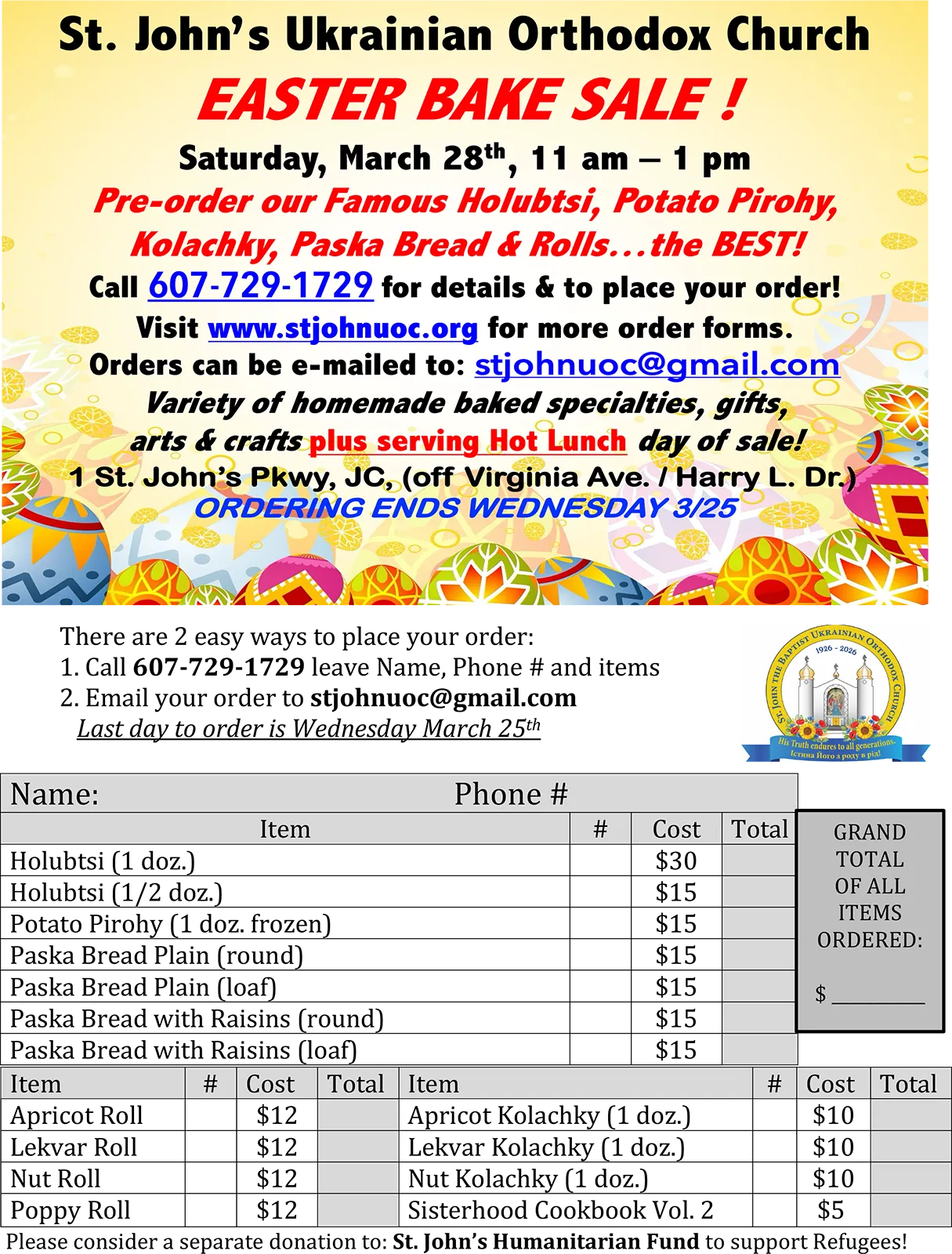
Easter Bake Sale - March 28, 11am - 1PM
Work Sessions
- Saturday, 3/21 8 AM - Kolachky Baking
Let's Help Ukraine!
St. John's Ukrainian Humanitarian Fund is accepting donations to help Ukrainians during war. Donations will go to provide food and other humanitarian needs.
To make donation online click here
We accept checks as well.
Please make the checks to St. John Ukrainian Humanitarian Fund
Mailing address:
1 Saint John's Parkway
Johnson City NY 13790
Cash is accepted in church
Pray for Ukraine!
Prayers for Ukraine are done during each service. To see the schedule click here.
Молитви за Україну проводяться під час кожної служби. За розкладом дивіться тут.
May God bless and protect Ukraine!
Please Note!
- Only Orthodox Christians may receive Holy Communion or other Sacraments.
- If you have not been to confession in over a month, please go to confession before receiving the Holy
Gifts.
- We fast from all food and drink (including water) from bedtime (the previous night) until we receive the Holy Gifts during morning Divine Liturgy. That also means no coffee, no cigarettes, no gum, candies in the morning and during Divine Liturgy.
Happy Birthday
- March 7: Eva Novak
- March 16: Daniel Matias
- March 16: James Kaspryk
- March 16: Gary Dobransky
* If your or someone else's birthday is missing or incorrect please let Fr. Ivan know right away.
Please Pray for the Servants of God
Benjamin, Rachel, John, Rose, Solomiia,
Bob, Melodye, Julie, John, Jane, Alla,
Fr. Andre, Mary, Zenna, Douglas, Ivan,
Daniel, Melanie, William, Marion, Helen,
Mariann, Robert, Jean, Ronald, Brian,
Fr. James, Scott, Andriy, James, William,
Fr. Gabriel and PM Susan, Vasyl, Olha
Upcoming Readings
| Mon. Mar. 16 | Is. 14:24-32; | Gen. 8:21–9:7; Prov. 11:19–12:6; |
| Tue. Mar. 17 | Is. 25:1-9; | Gen. 9:8-17; Prov. 12:8-22; |
| Wed. Mar. 18 | Is. 26:21–27:9; | Gen. 9:18–10:1; Prov. 12:23–13:9 ; |
| Thu. Mar. 19 | Is. 28:14-22; | Gen. 10:32–11:9; Prov. 13:20–14:6; |
| Fri. Mar. 20 | Is. 29:13-23; | Gen. 12:1-7; Prov. 14:15-26 ; |
| Sat. Mar. 21 | Heb. 6:9-12; | Mk. 7:31-37; |