
Bulletin for November 1, 2026
Nov. 1 – 22nd Sunday after Pentecost. Tone 5
Prophet Joel (800 B.C.). Martyr Warus and seven monk-martyrs in Egypt (307). Blessed Cleopatra (327) and her son John, in Egypt. Hieromartyr Sadoc (Sadoth), bishop of Persia, and 128 Martyrs with him (342). Ven. John Rylskyj
Gal. 6:11-18 ; Lk. 8:5-15;
Nov. 8 – 23rd Sunday after Pentecost. Tone 6
Holy and Glorious Great-martyr Demetrius the Myrrhgusher of Thessalonica (306). Martyr Luppos (306). Ven. Athanasius of Medikion Monastery (814). Ven. Theophilus of the Kyiv Caves, bishop of Novhorod (1482).
Eph. 2:4-10 ; Lk. 16:19-31;
2 Tim. 2:1-10; Jn. 15:17–16:2;
Services & Other Events
1 November, Sunday - Неділя:
- 9am – Confession / Hours
- 9:30am – Divine Liturgy - Бож. Літургія
- Fall Festival
- Daylight Saving Time is over
5 November, Thursday:
- 6:30pm – Building and Maintenance Committee Meeting
6 November, Friday:
- 8am – Rolls Baking Session
7 November, Saturday:
- 4:30pm – Memorial (Parastas) Service - Парастас за упокій
- 5pm – Great Vespers - Вел. Вечірня
8 November, Sunday - Неділя:
- 9am – Confession / Hours
- 9:30am – Divine Liturgy - Бож. Літургія
- Core Cabbage
11 November, Wednesday:
- 7pm – Finance Committee Meeting
16 November, Monday:
- 7pm – Parish Council Meeting
Апостол і Євангеліє - Gospel and Epistle of the Day
Good Soil and the Glorious Cross
Dear children, this Sunday the Church gives us two readings. In the Gospel, the Lord Jesus tells a story about a farmer who goes out to sow seeds. In the Epistle, the holy Apostle Paul finishes his letter to the Galatians by writing to them in big letters, with his own hand. Let us listen to these readings together with the holy Fathers of the Church, and with some saints who lived them out.
The Sower and the Seed
(Luke 8:5–15)
Jesus said that a sower went out to sow his seed. Some seed fell on the path, where people stepped on it and birds ate it. Some fell on rocks, where it sprouted fast but dried up, because it had no water. Some fell among thorns, and the thorns grew up and choked it. But some fell on good soil, and it grew and gave a harvest a hundred times bigger! Then Jesus called out: "He that hath ears to hear, let him hear" (Luke 8:8).
Later the disciples asked what the story meant. Jesus explained that the seed is the word of God, and the different kinds of ground are different kinds of hearts:
- The path is a heart that hears God's word but does not keep it. The devil quickly snatches it away, like a bird pecking up a seed.
- The rock is a heart that is happy to hear God's word, but gives up as soon as things become hard.
- The thorns are a heart so busy with worries, money and fun things that God's word gets squeezed out.
- The good soil is an honest and good heart that hears the word, holds on to it, and patiently bears fruit.
What the holy Fathers teach
St. John Chrysostom, the great preacher of Antioch and Constantinople, noticed something wonderful: the sower throws his seed everywhere, even on the path and on the rocks. A real farmer would never waste seed like that! But God is generous. He offers His word to every single person, and He never gives up on anyone.
St. John also points out a big difference between real fields and our hearts. A real rock can never turn into soft soil. But a stony heart can change! With prayer, repentance and God's help, a hard heart can become good soil, and a thorny heart can be weeded. So no one should ever say, "I am just a rock, I can't change."
Blessed Theophylact, Archbishop of Ohrid, explains that the most important word at the end of the parable is "patience." Good soil does not give fruit in one day. A seed grows slowly, through rain and sun, through winter and spring. In the same way, we grow in goodness little by little, day by day.
St. Paul's Big Letters
(Galatians 6:11–18)
In St. Paul's time, people usually spoke their letters aloud while a helper wrote them down. But at the end of his letter to the Galatians, St. Paul takes the pen himself and says: "See how large a letter I have written unto you with mine own hand" (Galatians 6:11).
St. John Chrysostom explains that Paul did this to show love and honesty. When you get a card that someone wrote by hand, you know it really comes from them, and that they truly care. Paul wanted the Galatians to know: "This is really me, and I mean every word."
Then Paul says the most important thing in the whole letter: "But God forbid that I should glory, save in the cross of our Lord Jesus Christ" (Galatians 6:14). To "glory" means to boast or to be proud of something. Some people boast about being strong, rich or famous. Paul says: the only thing I am proud of is the Cross of Jesus.
St. John Chrysostom reminds us that in Roman times the cross was the most shameful punishment there was. Nobody wanted to be near one. But Christ turned the cross into a sign of victory and love. Now Christians wear it, kiss it, and make its sign over themselves. What was a sign of shame became our greatest treasure!
Paul also says that what matters is being "a new creature" (Galatians 6:15). When we are baptized and live with Christ, God makes us new from the inside, the way spring makes the whole earth new. And at the very end, Paul says: "I bear in my body the marks of the Lord Jesus" (Galatians 6:17). Paul had been beaten and hurt many times for preaching about Jesus. Blessed Theophylact explains that Paul wore these scars like a soldier wears medals, because they showed that he belonged to Christ.
Stories from the Lives of the Saints
St. Anthony the Great: a heart of good soil
St. Anthony lived in Egypt about 1,700 years ago. When he was a young man, his parents died and left him a large farm. One day he walked into church just as the Gospel was being read, and he heard the words of Jesus: "If you want to be perfect, go and sell what you have, and give to the poor." Anthony felt as if Jesus were speaking right to him. He did not say, "Maybe later." He went out that very day, gave his land to the poor, and began to live for God alone. He became the father of all monks.
St. Athanasius of Alexandria, who wrote his life, tells us that Anthony listened so carefully in church that nothing he heard fell to the ground. His memory held everything. That is what good soil looks like: hearing God's word, keeping it, and doing it.
St. Spyridon of Cyprus: the gold that came from a snake
St. Spyridon was a simple shepherd who became a bishop on the island of Cyprus. Once there was a terrible famine. A rich grain merchant locked up his grain so that the price would go up. A poor farmer came to beg him for a little grain on loan, but the merchant refused unless the farmer could give him gold.
The farmer ran crying to St. Spyridon. The saint comforted him and sent him home. The next day, St. Spyridon brought him a piece of gold. Where did it come from? He had prayed over a snake, and God turned it into gold! The farmer used it to get grain. Later, when the farmer paid his debt, he gave the gold back to St. Spyridon, who prayed again and it turned back into a snake and crawled away.
The greedy merchant is like the seed among thorns: his love of money choked out love for his neighbor. But St. Spyridon was rich in love, and that is the best harvest of all.
St. Ignatius of Antioch: "I am the wheat of God"
St. Ignatius was a bishop in Antioch who knew the apostles. When he was an old man, the Romans arrested him and took him to Rome to be thrown to the lions. On the way, he wrote letters to the churches. He was not afraid. He wrote: "I am the wheat of God, and am ground by the teeth of wild beasts, that I may be found the pure bread of Christ."
St. Ignatius saw himself as a seed of wheat in God's field. Like St. Paul, he did not boast in anything except Christ and His Cross. He gladly carried "the marks of the Lord Jesus" all the way to the end.
St. Nektarios of Aegina: the bishop with the broom
St. Nektarios was a Greek bishop who lived not long ago, in the 1800s and early 1900s. Some jealous people spread lies about him, and he was sent away from his post. He did not complain. Later he became the director of a school for priests in Athens.
One day the school janitor became sick and was afraid he would lose his job. So every night, without telling anyone, St. Nektarios himself took a broom and a bucket and cleaned the school, even the bathrooms! When people finally found out, they were amazed. A bishop, cleaning toilets? But St. Nektarios was not ashamed. He had learned from St. Paul that the only thing worth boasting about is the humble, loving Cross of Christ.
Let's Remember
- God scatters the seed of His word generously, to everyone, every day.
- Our hearts can change. Even a rocky or thorny heart can become good soil.
- Good soil needs patience. Saints grow slowly, like wheat.
- The Cross is not a sign of shame but of Christ's love and victory.
- Our true treasure is not being strong or rich, but belonging to Jesus.
Activity: Plant a seed
Fill a small cup with soil and plant a bean or a sunflower seed. Put it by a window and water it a little every day. Each time you water it, say a short prayer. Watch how slowly and quietly it grows. That is how God's word grows in us when we take care of it!
A short prayer
Lord Jesus Christ, You are the good Sower. Make my heart soft and good soil for Your word. Pull out the thorns of worry and greed, and help me be patient. Teach me to love Your holy Cross and to belong to You always. Amen.
Two Processions
A person tells of two processions of people he watched one Sunday: one procession going to church, another procession leaving church to return home. They were the same people. They came to church wounded; they left healed. They came hopeless; they left with hope. They came weak; they left strong. They came as sinners; they left forgiven. They came in darkness; they left in light. They came hungry; they left filled. They came in sadness; they left in joy. For they had encountered the risen and living Christ, and He had performed a miracle.
According to a legend attributed to St. Basil, there are two angels at the entrance to each church. Their task is to write in their scrolls the names of those who come to worship God. In some Orthodox monasteries, one sees the two writing angels with their scrolls, painted on the walls of the church gate as one is about to enter. When God unfurls the scroll on the last day, how many times will your name be on it?
There is a beautiful story in the Philokalia that illustrates the importance of the Eucharist in the life of the Christian. A holy man, who possessed power over impure spirits, asked the demons who lived raging in some possessed maidens, saying, "What are the things you fear in Christians?" They answered: "Truly, you possess three great things: the first is what you wear around your neck; the second is what you wash with in church; the third is what you partake of in community." He then asked them: "Of these three which do you fear most?" They answered: "If you guarded well that of which you partake, none of us could ever offend a Christianian." These things which Satan fears most are: the cross, baptism, and Holy Communion.
Most of all, Holy Communion. St. John Chrysostom wrote: "Let us then come back from that table like lions breathing out fire, thus becoming terrifying to the devil."
Добра земля і славний Хрест
Дорогі діти, цієї неділі Церква дає нам два читання. У Євангелії Господь Ісус розповідає притчу про сіяча, який вийшов сіяти зерно. В Апостолі святий апостол Павло завершує своє послання до галатів, пишучи їм великими літерами власною рукою. Послухаймо ці читання разом зі святими Отцями Церкви та зі святими, які жили за ними.
Сіяч і зерно (Лк. 8:5–15)
Ісус сказав, що вийшов сіяч сіяти своє зерно. Одне зерно впало при дорозі, і люди його потоптали, а птахи визбирали. Друге впало на камінь: швидко зійшло, але засохло, бо не мало вологи. Третє впало між терен, і терен виріс та заглушив його. А ще інше впало на добру землю, виросло і дало врожай у сто разів більший! Тоді Ісус проголосив: «Хто має вуха, щоб слухати, нехай слухає!» (Лк. 8:8).
Згодом учні запитали, що означає ця притча. Ісус пояснив, що зерно — це Слово Боже, а різна земля — це різні людські серця:
- Дорога — це серце, яке чує Боже слово, але не береже його. Диявол швидко забирає його, як пташка склює зернятко.
- Камінь — це серце, яке радо слухає Боже слово, але здається, щойно стає важко.
- Терен — це серце, таке зайняте турботами, грошима й розвагами, що Боже слово в ньому задихається.
- Добра земля — це чесне й добре серце, яке слухає слово, береже його і терпеливо приносить плід.
Чого навчають святі Отці
Святитель Іоанн Золотоустий, великий проповідник Антіохії та Константинополя, помітив дивовижну річ: сіяч кидає зерно всюди, навіть на дорогу й на каміння. Справжній хлібороб ніколи б так не марнував зерна! Але Бог щедрий. Він дає Своє слово кожній людині й ніколи ні від кого не відступається.
Святитель Іоанн також показує велику різницю між справжнім полем і нашими серцями. Справжній камінь ніколи не стане м'якою землею. А кам'яне серце може змінитися! Молитвою, покаянням і з Божою допомогою тверде серце може стати доброю землею, а з серця, порослого тереном, можна вирвати бур'ян. Тож ніхто не повинен казати: «Я просто камінь, я не можу змінитися».
Блаженний Феофілакт, архієпископ Охридський (Болгарський), пояснює, що найважливіше слово наприкінці притчі — «терпіння». Добра земля не дає плоду за один день. Зерно росте повільно, під дощем і сонцем, крізь зиму й весну. Так і ми зростаємо в добрі потроху, день за днем.
Подумай
1. На яку землю сьогодні схоже твоє серце?
2. Який «терен» може заглушити Боже слово у твоєму житті? (Забагато екранів? Поганий настрій? Постійне бажання нових іграшок?)
3. Що ти можеш зробити цього тижня, щоб «полити» зерно Божого слова?
Великі літери святого Павла
(Гал. 6:11–18)
За часів святого Павла люди зазвичай диктували листи, а помічник їх записував. Але наприкінці послання до галатів святий Павло сам бере перо й каже: «Подивіться, якими великими буквами написав я вам своєю рукою» (Гал. 6:11).
Святитель Іоанн Золотоустий пояснює, що Павло зробив це з любові й щирості. Коли ти отримуєш листівку, написану від руки, ти знаєш, що вона справді від тієї людини і що ти їй справді небайдужий. Павло хотів, щоб галати знали: «Це справді я, і я вірю в кожне своє слово».
Потім Павло каже найголовніше в усьому посланні: «А я нехай не хвалюся, хіба хрестом Господа нашого Ісуса Христа» (Гал. 6:14). Хвалитися — означає гордитися чимось. Дехто хвалиться силою, багатством чи славою. А Павло каже: я гордий лише Хрестом Ісуса.
Святитель Іоанн Золотоустий нагадує, що за римських часів хрест був найганебнішою карою. Ніхто не хотів бути поруч із ним. Але Христос перетворив хрест на знак перемоги й любові. Тепер християни носять його, цілують і осіняють себе хресним знаменням. Те, що було знаком ганьби, стало нашим найбільшим скарбом!
Павло також каже, що головне — бути «новим створінням» (Гал. 6:15). Коли ми хрещені й живемо з Христом, Бог оновлює нас зсередини, як весна оновлює всю землю. А в самому кінці Павло говорить: «Я рани Господа Ісуса ношу на тілі своїм» (Гал. 6:17). Павла багато разів били й ранили за проповідь про Ісуса. Блаженний Феофілакт пояснює, що Павло носив ці рубці, як воїн носить нагороди, бо вони показували, що він належить Христу.
Розповіді із життя святих
Преподобний Антоній Великий: серце — добра земля
Преподобний Антоній жив у Єгипті приблизно 1700 років тому. Коли він був юнаком, його батьки померли й залишили йому велике господарство. Одного разу він увійшов до храму саме тоді, коли читали Євангеліє, і почув слова Ісуса: «Коли хочеш бути досконалим, піди, продай, що маєш, і роздай бідним». Антонію здалося, що Ісус говорить саме до нього. Він не сказав: «Може, пізніше». Того ж дня він роздав свою землю бідним і почав жити лише для Бога. Він став батьком усіх ченців.
Святитель Афанасій Олександрійський, який написав його житіє, розповідає, що Антоній так уважно слухав у храмі, що жодне почуте слово не падало на землю: пам'ять його все зберігала. Ось яка вона — добра земля: почути Боже слово, зберегти його і виконати.
Святитель Спиридон Триміфунтський: золото зі змії
Святитель Спиридон був простим пастухом, який став єпископом на острові Кіпр. Одного разу настав страшний голод. Багатий торговець зерном замкнув свої комори, щоб ціна зросла. Бідний хлібороб прийшов просити в нього трохи зерна в борг, але торговець відмовив, якщо той не дасть йому золота в заставу.
Хлібороб у сльозах прибіг до святого Спиридона. Святий утішив його й відпустив додому. Наступного дня святитель приніс йому шматок золота. Звідки воно взялося? Святий помолився над змією, і Бог перетворив її на золото! Хлібороб отримав за нього зерно. Згодом, коли він сплатив борг, то повернув золото святому Спиридону, той знову помолився, і золото знову стало змією та відповзло геть.
Жадібний торговець схожий на зерно між тереном: любов до грошей заглушила в ньому любов до ближнього. А святий Спиридон був багатий любов'ю, і це найкращий урожай.
Священномученик Ігнатій Богоносець: «Я — пшениця Божа»
Святий Ігнатій був єпископом Антіохії й знав апостолів. Коли він був уже старцем, римляни заарештували його й повезли до Риму, щоб кинути левам. Дорогою він писав листи до Церков. Він не боявся. Він написав: «Я — пшениця Божа, і зуби звірів мелють мене, щоб я став чистим хлібом Христовим».
Святий Ігнатій бачив себе зерном пшениці на Божій ниві. Як і святий Павло, він не хвалився нічим, окрім Христа та Його Хреста. Він радо ніс «рани Господа Ісуса» аж до кінця.
Святитель Нектарій Егінський: єпископ із мітлою
Святитель Нектарій був грецьким єпископом, який жив не так давно — у XIX та на початку XX століття. Заздрісні люди поширювали про нього неправду, і його відсторонили від служіння. Він не нарікав. Згодом він став директором школи для майбутніх священиків в Афінах.
Одного разу шкільний прибиральник захворів і боявся втратити роботу. Тож щоночі, нікому не кажучи, святитель Нектарій сам брав мітлу й відро і прибирав школу, навіть туалети! Коли люди нарешті про це дізналися, вони були вражені. Єпископ миє туалети? Але святий Нектарій не соромився. Він навчився від святого Павла, що хвалитися варто лише смиренним і люблячим Хрестом Христовим.
Запам'ятаймо
- Бог щедро розсіює зерно Свого слова — для всіх і щодня.
- Наші серця можуть змінюватися. Навіть кам'янисте чи тернисте серце може стати доброю землею.
- Добрій землі потрібне терпіння. Святі зростають повільно, як пшениця.
- Хрест — не знак ганьби, а знак Христової любові й перемоги.
- Наш справжній скарб — не сила чи багатство, а те, що ми належимо Ісусу.
Завдання: посади зернятко
Наповни невеличкий стаканчик землею й посади квасолину або насінину соняшника. Постав біля вікна й щодня трохи поливай. Щоразу, коли поливаєш, промов коротку молитву. Подивись, як повільно й тихо воно росте. Так само росте в нас Боже слово, коли ми про нього дбаємо!
Коротка молитва
Господи Ісусе Христе, Ти — добрий Сіяч. Зроби моє серце м'якою й доброю землею для Твого слова. Вирви з нього терен турбот і жадібності та навчи мене терпіння. Навчи мене любити Твій святий Хрест і завжди належати Тобі. Амінь.
З «Добротолюбія»
У «Добротолюбії» є прекрасна розповідь, яка показує, наскільки важлива Євхаристія в житті християнина. Один святий чоловік, що мав владу над нечистими духами, запитав бісів, які лютували в кількох одержимих дівчатах: «Чого ви боїтеся у християнах?» Вони відповіли: «Воістину, ви маєте три великі речі: перше — те, що ви носите на шиї; друге — те, чим ви омиваєтеся в церкві; третє — те, чого ви причащаєтеся у спільноті». Тоді він запитав їх: «З цих трьох чого ви боїтеся найбільше?» Вони відповіли: «Якби ви добре берегли те, чого причащаєтеся, жоден із нас ніколи не зміг би зашкодити християнинові». Отже, найбільше сатана боїться хреста, хрещення і Святого Причастя.
А понад усе — Святого Причастя. Святий Іван Золотоустий писав: «Тож відходьмо від тієї трапези, наче леви, що дихають вогнем, і станьмо страшними для диявола».
Special parish collection
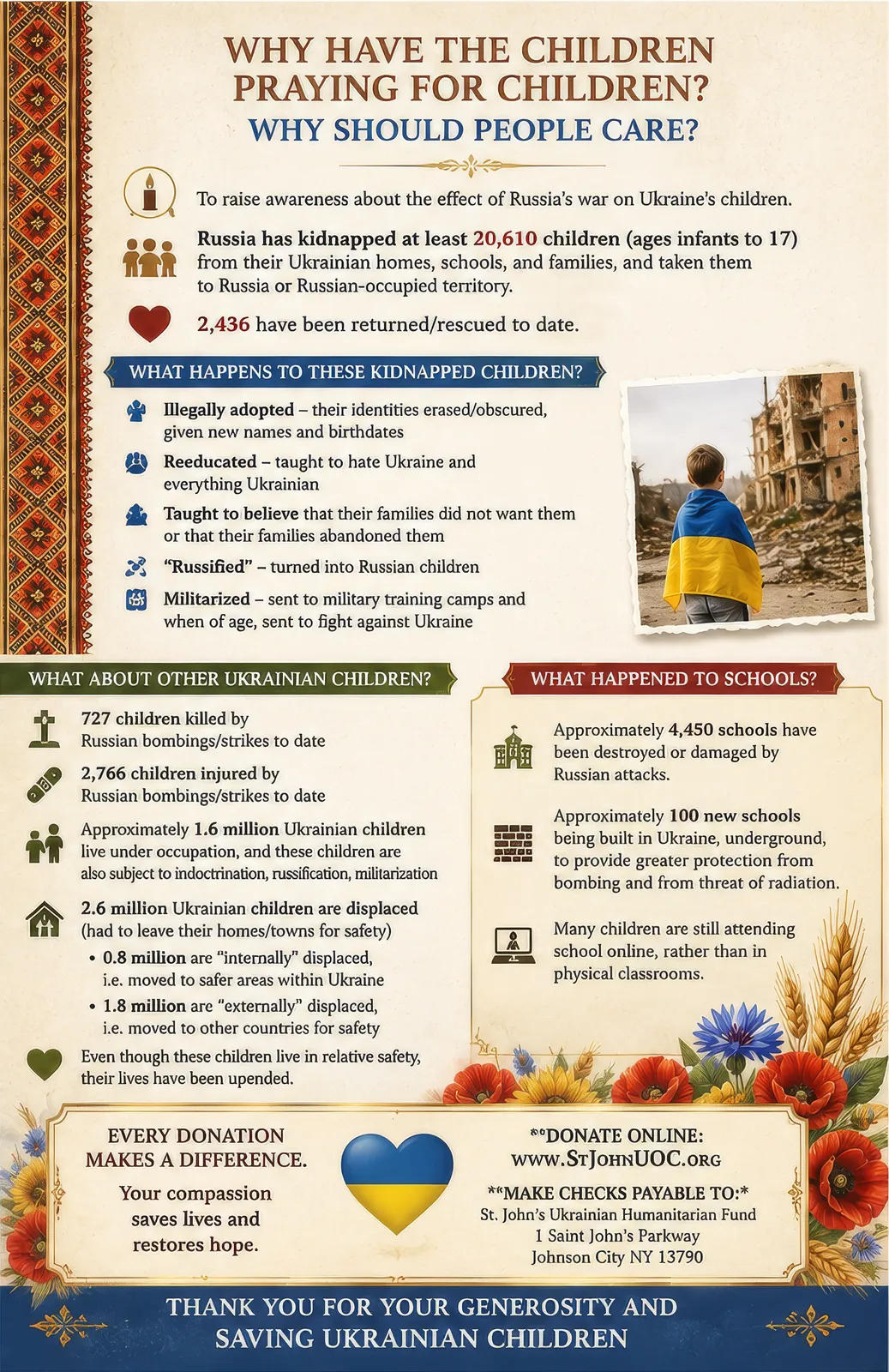
Special parish collection on Sunday, November 15 to support our "Children Praying for Children" campaign and raise money to bring our kidnapped children home to Ukraine. Russia has kidnapped at least 20,610 children (ages infants to 17) from their Ukrainian homes, schools, and families, and taken them to Russia or Russian-occupied territory. We desperately want to reunite them with their families. Please donate.
BAKERS-BAKERS-BAKERS
Please prepare your delicious specialties for the variety booth big sale! Drop them off by Friday, November 20, 3 PM. Thank you for supporting St. Mary's sisterhood.
Children Praying for Children
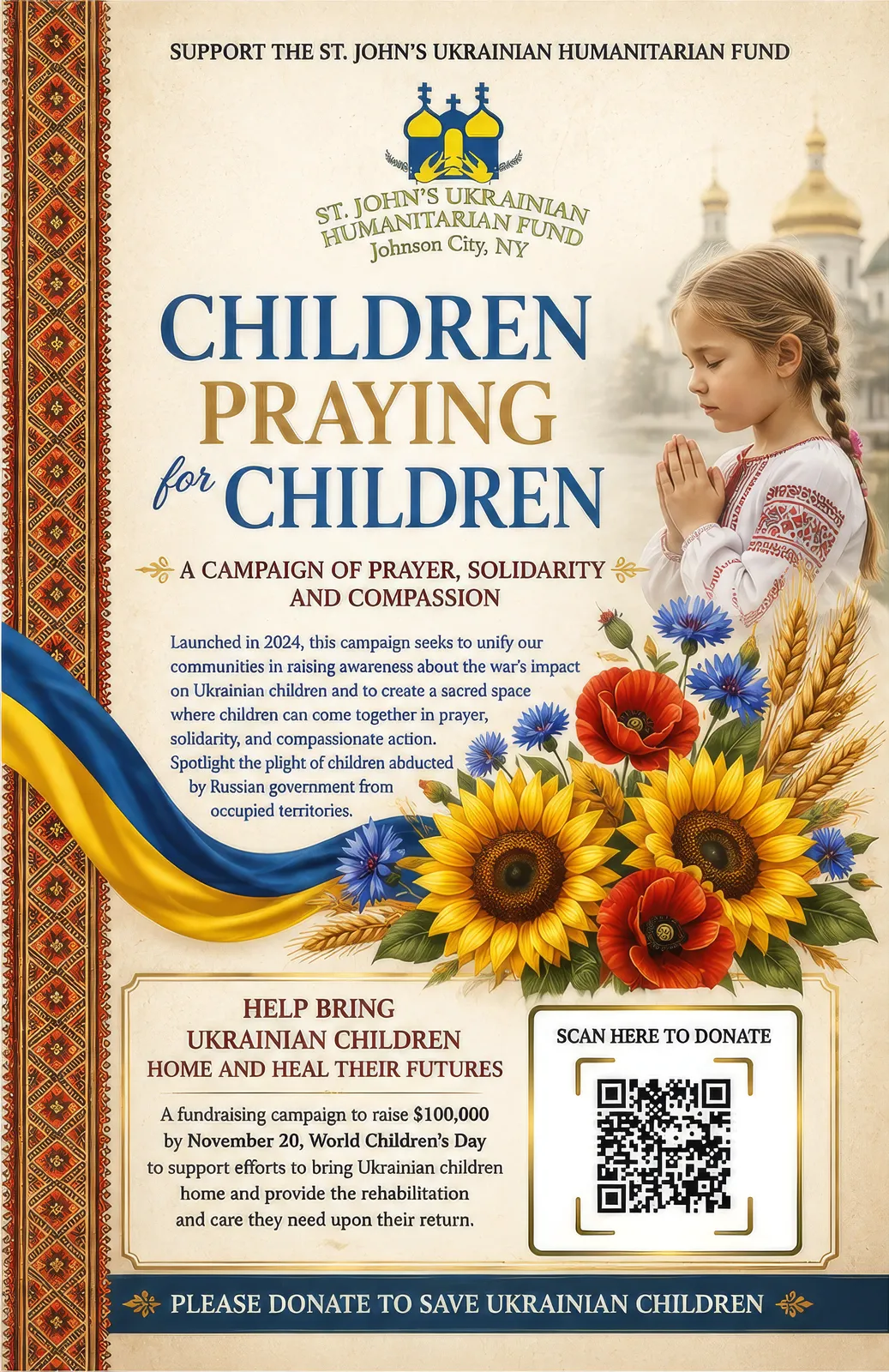
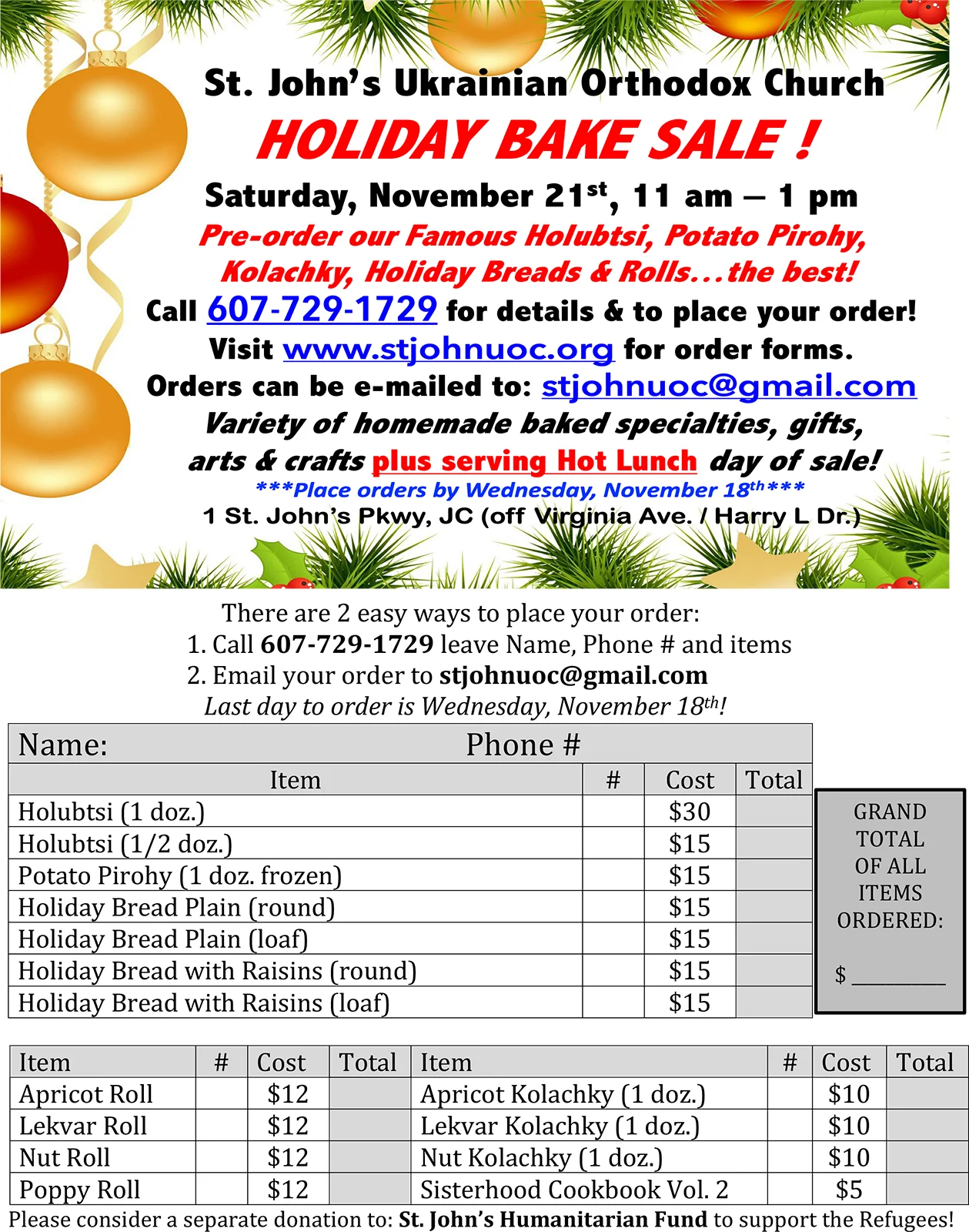
Holiday Bake Sale - November 21, 11am - 1pm
Let's Help Ukraine!

St. John's Ukrainian Humanitarian Fund is accepting donations to help Ukrainians during war. Donations will go to provide food and other humanitarian needs.
To make donation online click here
We accept checks as well.
Please make the checks to St. John Ukrainian Humanitarian Fund
Mailing address:
1 Saint John's Parkway
Johnson City NY 13790
Cash is accepted in church
Pray for Ukraine!

Prayers for Ukraine are done during each service. To see the schedule click here.
Молитви за Україну проводяться під час кожної служби. За розкладом дивіться тут.
May God bless and protect Ukraine!
Happy Birthday
- November 02: Elijah Holicky
- November 02: Dr. Peter A Hatala
- November 03: Gary Williams
- November 06: Sofia Moroz
* If your or someone else's birthday is missing or incorrect please let Fr. Ivan know right away.
Зверніть увагу!
- Святе Причастя та інші Таїнства можуть приймати лише православні християни.
- Якщо ви не сповідалися понад місяць, будь ласка, посповідайтеся перед прийняттям Святих Дарів.
- Ми утримуємось від будь-якої їжі та пиття (включно з водою) від часу сну (напередодні ввечері) до прийняття Святих Дарів під час ранкової Божественної Літургії. Це також означає відмову від кави, цигарок, жувальної гумки та цукерок вранці та під час Божественної Літургії.
- Піст перед Святим Причастям обов'язковий для всіх, кому виповнилося сім років (вік сповіді).
Please Pray for the Servants of God
Metropolitan Antony, PM Kelly,
Peter John, John, Rose, Solomiia,
Bob, John, Jane, Alla,
Fr. Andre, Mary, Zenna, Douglas,
Melanie, William, Mariann,
Robert, Jean, Ronald, Brian,
Fr. James, Scott, Andriy, James, William,
Olha, Solder Olexiy, Tamara
Upcoming Readings
| Mon. Nov. 2 – | 1 Thess. 1:1-5; | Lk. 9:18-22; |
| Tue. Nov. 3 – | 1 Thess. 1:6-10 ; | Lk. 9:23-27; |
| Wed. Nov. 4 – | 1 Thess. 2:1-8; | Lk. 9:44-50; |
| Thu. Nov. 5 – | 1 Thess. 2:9-14 ; | Lk. 9:46-56; |
| Fri. Nov. 6 – | 1 Thess. 2:14-19 ; | Lk. 10:1-15; |
| Sat. Nov. 7 – | 2 Cor. 8:1-5 ; | Lk. 7:1-10; |