Bulletin for March 8, 2026
Mar. 8 – Second Sunday of the Great Lent Tone 6
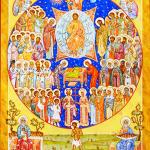
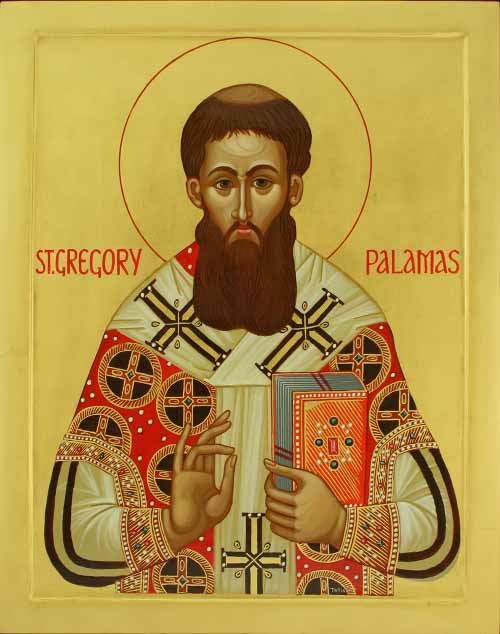
St. Gregory Palamas the Archbishop of Thessalonica. Synaxis of all Venerable Fathers of the Kyiv Caves. Hieromartyr Polycarp, bishop of Smyrna (167). Sts. John, Antioch, Antoninus, Moses, Zebinas, Polychronius, Moses, and Damian, ascetics of the Syrian desert (5th c.). St. Alexander, founder of the order of the Unsleeping Ones (430).
Heb. 1:10–2:3; Mk. 2:1-12;
Heb. 7:26 - 8:2; Jn. 10:9-16;
Liturgy of St. Basil the Great.
Mar. 15 – 3rd Sunday of the Great Lent. Adoration of Cross. Tone 7
Hieromartyr Theodotus, bishop of Cyrenia (326). Virgin-martyr Euthalia (257). Martyr Troadius of Neo-Caesarea (3rd c.). St. Agatho of Egypt, monk (5th c.). 440 Martyrs slain by the Lombards (579).
Heb. 4:14–5:6; Mk. 8:34–9:1;
Liturgy of St. Basil the Great.
Services & Other Events
8 March, Sunday:
- 9am – Confession / Hours
- 9:30am – Divine Liturgy - Бож. Літургія
- Oath of Office
- Memorial Service for Dr. Peter and Phyllis Hatala
- Centennial Committee Meeting
- Investment Committee Meeting
11 March, Wednesday:
- 7pm – Finance Committee Meeting
13 March, Friday:
- 6:30pm – Liturgy of Presanctified Gifts - Літургія Ранішосвячених Дарів
14 March, Saturday:
- 4:30pm – General Memorial Service - Поминальна Субота
- 5pm – Great Vespers - Велика Вечірня
15 March, Sunday:
- 9am – Confession / Hours
- 9:30am – Divine Liturgy - Бож. Літургія
16 March, Monday:
- 7pm – Parish Council Meeting
20 March, Friday:
- 6:30pm – Liturgy of Presanctified Gifts - Літургія Ранішосвячених Дарів
Апостол і Євангеліє - Gospel and Epistle of the Day
The Wings of the Soul
Prayer and Fasting in the Tradition of St. Gregory Palamas
Prayer and Fasting in the Tradition of St. Gregory Palamas
There is a hunger that no bread can satisfy, and a silence that is fuller than any sound. Every person, whether young or old, carries within them a longing for something beyond what the eyes can see — a longing for God. The Church has always taught that two ancient and holy practices can feed this hunger and fill that silence: prayer and fasting.
St. Gregory Palamas, the great fourteenth-century Archbishop of Thessaloniki and one of Orthodoxy's most luminous theologians, taught that these two disciplines are not burdens laid upon us, but wings given to lift us toward heaven. His writings open to us a world where the body and the soul are not enemies, but partners — together seeking the living God.
Two Friends Who Travel Together
Imagine prayer and fasting as two friends who never travel alone. St. Gregory often spoke of them together because he understood that they accomplish in harmony what neither can accomplish alone. "Fasting and prayer," he wrote, "are as a pair of wings by which the soul may soar upward to God."
Prayer is the conversation of the soul with its Creator — not merely the recitation of words, but the lifting of the whole heart toward the One who made it. Fasting is the quieting of the body's loudest demands so that the heart can hear more clearly. When the stomach is still, the spirit speaks. When the appetites are gently restrained, the inner person grows stronger.
This is not a strange teaching. Even children know that when the room is noisy, it is hard to listen. Fasting is a way of asking the body to be quiet so that the soul can listen to God.
The Light Within —
What St. Gregory Saw
St. Gregory Palamas was not only a scholar who wrote about God — he was a man who encountered God. For many years he lived as a monk on the Holy Mountain of Athos, spending entire nights in prayer, fasting strictly, and seeking with all his heart the presence of the living God.
His great teaching was about the divine light — the very same uncreated light that shone from Christ on Mount Tabor at the Transfiguration. Gregory taught that this light is not merely a story from the past. It is real, it is present, and through prayer and fasting, through purifying the heart, a person can come to experience God Himself — not His essence, which remains beyond all creaturely knowing, but His energies, His living presence, His grace.
He wrote that the human body is not an obstacle to this encounter with God. The body, when it is disciplined and offered to God through fasting, becomes a participant in holiness. The saints do not escape from their bodies to find God — they bring their whole selves, body and soul, into His light.
"Let us fast, beloved, with a fast acceptable and pleasing to the Lord. The true fast is the estrangement from evil, the bridling of the tongue, the laying aside of anger, the separation from lusts, evil speaking, falsehood, and perjury." — St. John Chrysostom
A Story from the Life of St. Gregory
There is a beautiful story told of Gregory during his years on Mount Athos. A young monk came to him, discouraged because his prayers felt empty, as if his words rose no higher than the ceiling. He had been fasting, he had been praying, and yet he felt nothing.
Gregory listened with great kindness. Then he said something the young monk did not expect: "Do not seek feelings. Seek faithfulness." He told him that the sun does not stop shining simply because clouds cover it — and God does not withdraw simply because we cannot feel His presence. Our task is to remain at the window, looking. The clouds will part.
Gregory instructed him to persevere in small, humble, daily prayer — not seeking great spiritual experiences, but simply remaining present before God with a quiet and fasting heart. Months later, the young monk returned. His face had changed. Something in him had become still and radiant. He had learned what all the saints learn: that prayer and fasting are not techniques to produce experiences, but acts of love given to a God who always receives them.
St. Anthony of the Kyiv Caves — The Father of Ukrainian Monasticism
The tradition of prayer and fasting burns with particular brilliance in the life of St. Anthony of the Kyiv Caves, the founder of monastic life in Ukraine. Born around the year 983, Anthony felt from his youth a longing for something the world could not give him. He traveled to the Holy Mountain of Athos — the same mountain where St. Gregory Palamas would later pray — and there he learned the full rigor of Orthodox fasting and unceasing prayer.
When he returned to Kyiv, he did not seek comfort or recognition. He found a small cave cut into the hills above the Dnipro River and made it his home. There, in darkness and silence, he prayed and fasted with extraordinary intensity — eating almost nothing, sleeping only briefly, spending the greater part of each day and night in the Jesus Prayer. He did not do this to punish himself. He did it because he had tasted the sweetness of God's presence and wanted more.
One by one, others came to him. They had heard of the man in the cave, and they wanted what he had. From that small, dark hollow in the earth grew the great Kyiv Pechersk Lavra — the Monastery of the Caves — one of the most sacred places in all of Orthodox Christianity. An entire civilization of prayer was born from one man's faithful fasting and ceaseless cry to God. The cave that Anthony chose as his cell still exists, and pilgrims descend into it to this day — to pray in the very place where Ukrainian monasticism was born.
St. Mary of Egypt —
The Desert Speaks
Perhaps no story in the Orthodox tradition more powerfully illustrates the transformation that prayer and fasting can bring than the life of St. Mary of Egypt. She had lived, by her own confession, a life of great sin — surrendering herself entirely to pleasure and appetite. Then, at the door of a church in Jerusalem, she found herself mysteriously unable to enter. An unseen force held her back.
In that moment, she fell to her knees before an icon of the Theotokos and wept. Something broke open inside her. She heard an interior voice directing her to cross the Jordan River and go into the desert. She went — and she stayed for forty-seven years.
When the elder Zosimas found her at the end of her life, she had been transformed entirely. She subsisted on almost nothing, endured terrible physical hardship, and prayed without ceasing. She could not be mistaken for the woman she had once been. Yet she said that the first seventeen years in the desert were agony — the memories and cravings of her former life fought fiercely against her. It was only by unceasing prayer and absolute fasting that she overcame them.
Her story is not told to terrify us, but to encourage us. The same God who received her — who received every desperate, tearful, broken prayer she offered in that desert — receives ours. The fast does not need to be heroic. The prayer does not need to be eloquent. They need only to be honest, and repeated.
How Prayer and Fasting Work in Us
St. Gregory Palamas understood something profound about the human person: we are unified beings. Our thoughts affect our bodies. Our bodies affect our souls. When we eat without restraint, something in the inner life grows sluggish. When we pray without fasting, we sometimes find that the body's demands interrupt and distract.
But when fasting and prayer work together, a kind of holy integration happens. The person becomes more whole, more themselves. Distractions diminish. Clarity grows. The small, anxious voice of appetite grows quieter, and in that quiet, another voice becomes more audible — the still, small voice of God, the same voice Elijah heard after the wind and the fire.
Fasting does not have to mean eating nothing. For children and those with health needs, it might mean giving up something sweet, or a favorite snack, or time in front of a screen. The principle is the same: choosing to go without something we desire, as a way of saying to God, "I desire You more."
Prayer does not have to be long or complicated. The great prayer of the Orthodox tradition — "Lord Jesus Christ, Son of God, have mercy on me, a sinner" — is only twelve words. St. Gregory himself taught extensively on this prayer. It can be said while walking to school, while washing dishes, while lying in bed before sleep. It is a prayer that, repeated with attention and love, gradually becomes the rhythm of the heart itself.
"Lord Jesus Christ, Son of God, have mercy on me, a sinner." — The Jesus Prayer
Why the Church Gives Us These Seasons
The Church in her wisdom does not leave us alone to discover these practices. She gives us seasons — Great Lent, the Apostles' Fast, the Dormition Fast, the Nativity Fast — as times set apart for deeper prayer and more intentional fasting. These are not punishments. They are invitations.
They are the Church saying: come, let us travel together toward God. Let us quiet the noise of ordinary life for a little while. Let us remember what we are made for. Let us practice, together, the ancient art of wanting God more than we want comfort.
St. Gregory Palamas, whose feast is celebrated on the Second Sunday of Great Lent, stands before us every year as a witness to what is possible. A human being — made of the same flesh and blood as ours, living in a difficult world with real temptations and real sufferings — gave himself to prayer and fasting and was filled with the uncreated light of God.
He is not held before us as someone impossibly distant. He is held before us as a sign of what we are invited to become.
An Invitation
Begin small. Pray one honest prayer today — not a perfect one, but a real one. Fast from one small thing this week, and offer that small sacrifice to God with a glad heart. Repeat it tomorrow. And the day after.
The saints did not become saints in a single day. They became saints by doing small things faithfully, with love, over a long time. St. Gregory prayed for years before he was granted the vision of divine light. St. Mary wept alone in the desert for seventeen years before the peace she sought finally settled over her. St. Anthony prayed in his cell through countless cold nights before he tasted the sweetness of God's presence
Their perseverance is our encouragement. The God they found is the same God who is waiting for each of us — in every prayer, however stumbling; in every fast, however small; in every quiet moment when we turn toward Him and simply say: here I am.
* * *
"The one who has found prayer has found heaven." — St. John of the Ladder
Крила душі
Молитва і піст у спадщині святителя Григорія Палами
Є такий голод, якого жоден хліб не наситить, і є така тиша, яка повніша за будь-який звук. Кожна людина — молода чи стара — носить у собі жагу за чимось невидимим, що лежить поза межами зримого — жагу за Богом. Церква завжди навчала, що дві стародавні й святі дії здатні наситити цей голод і наповнити цю тишу: молитва і піст.
Святитель Григорій Палама, великий архієпископ Фессалонік чотирнадцятого століття і один із найсвітліших богословів Православ'я, навчав, що ці дві дисципліни — не тягар, покладений на нас, а крила, даровані нам, щоб піднести нас до неба. Його писання відкривають нам світ, у якому тіло і душа — не вороги, а співучасники, що разом шукають Живого Бога.
Двоє друзів, що завжди вирушають разом
Уявіть собі молитву і піст як двох друзів, які ніколи не вирушають окремо. Святитель Григорій часто говорив про них разом, бо розумів, що вони досягають в єдності те, чого жодна з них окремо досягти не змогла б. «Піст і молитва, — писав він, — є парою крил, за допомогою яких душа може злетіти вгору до Бога».
Молитва — це розмова душі зі своїм Творцем — не просте виголошення слів, а піднесення всього серця до Того, Хто його створив. Піст — це вгамування найгучніших вимог тіла, щоб серце могло чути виразніше. Коли шлунок вгамовується, дух говорить. Коли бажання лагідно стримуються, внутрішня людина стає сильнішою.
Це не дивне вчення. Навіть діти знають: коли в кімнаті шумно, слухати важко. Піст — це спосіб попросити тіло помовчати, щоб душа могла слухати Бога.
Світло всередині — те, що побачив святитель Григорій
Святитель Григорій Палама був не лише вченим, який писав про Бога, — він був людиною, яка зустріла Бога. Багато років він прожив ченцем на Святій Горі Афон, проводячи цілі ночі в молитві, суворо постячи і всім серцем шукаючи Лиця Живого Бога.
Його велике вчення стосувалося Божественного світла — того самого нествореного світла, що возсіяло від Христа на горі Тавор під час Преображення. Григорій навчав, що це світло — не просто історія з минулого. Воно реальне, воно присутнє сьогодні, і через молитву і піст, через очищення серця, людина може особисто зустріти Самого Бога — не Його сутність, яка залишається поза всяким тварним пізнанням, а Його енергії, Його живу присутність, Його благодать.
Він писав, що людське тіло — не перешкода для зустрічі з Богом. Тіло, коли воно зібране і принесене Богові через піст, стає учасником святості. Святі не втікають від своїх тіл, щоб знайти Бога, — вони приносять себе у всій повноті, і тіло, і душу, у Його світло.
«Постімося, улюблені, постом благоприємним і угодним Господові. Справжній піст — це відсторонення від зла, утримання розмови, відмова від гніву, відступ від похотей, неправдивості та лжеприсяги.» — Святитель Іоан Золотоустий
Історія з життя святителя Григорія
Існує надзвичайна історія, із життя преподобного Григорія під час його перебування на Афоні. До нього прийшов монах, який у відчаї занепав духом, бо його молитви здавалися порожніми, ніби його слова не піднімалися вище за стелю. Він постив, він молився — а нічого не відчував.
Григорій вислухав його з великою ласкавістю. Потім сказав те, чого чернець не очікував: «Не шукай почуттів. Шукай вірності.» Він сказав йому, що сонце не перестає світити тому, що хмари закривають його, — і Бог не відступає лише тому, що ми не відчуваємо Його присутності. Наше завдання — залишатися біля вікна і дивитися. Хмари розійдуться.
Григорій наставляв монаха наполегливо продовжувати в маленькій, смиренній, щоденній молитві — не шукаючи великих духовних вишин, а просто залишаючись перед Богом з тихим і постовим серцем. Через кілька місяців чернець повернувся. Його обличчя змінилося. Щось у ньому стало спокійним і світлим. Він навчився тому, чого навчаються всі святі: молитва і піст — не техніки для досягнення вишини, а вчинки любові, даровані Богові, Який завжди їх приймає.
Святий Антоній Печерський — Батько українського чернецтва
Традиція молитви і посту особливо яскраво світиться в житті святого Антонія Печерського, засновника чернецького життя на Україні. Народжений близько 983 року, Антоній з юності відчував жагу за чимось, чого світ не міг дати. Він подорожував на Святу Гору Афон — ту саму гору, де пізніше молитиметься святитель Григорій Палама, — і там засвоїв увесь випробуваний православний піст і безперестанну молитву.
Повернувшись до Києва, він не шукав ні зручності, ні визнання. Він знайшов невеличку печеру, вирубану в схилах над Дніпром, і облаштував її своїм житлом. Там, у темряві і тиші, він молився і постив з надзвичайною інтенсивністю — їв майже нічого, спав лише зрідка, більшу частину дня і ночі проводячи в Ісусовій молитві. І робив він це не для того, щоб покарати себе. Він робив це, бо доторкнувся до благодаті Божої присутності і хотів більшого.
Один за одним до нього почали приходити люди. Вони чули про людину в печері і хотіли того, що мав він. З тієї маленької, темної порожнини в землі виріс великий Києво-Печерський лаврський монастир — одне з найсвятіших місць у всьому православному християнстві. Ціла цивілізація молитви народилася з вірного посту і безупинного кликання до Бога однієї людини. Печера, яку Антоній обрав за свою келію, існує досі, і паломники спускаються в неї й сьогодні — щоб помолитися на тому самому місці, де народилося українське чернецтво.
Свята Марія Єгипетська —
Голос пустелі
Мабуть, жодна інша історія в православній традиції не зображує так потужно перетворення, яке можуть принести молитва і піст, як життя святої Марії Єгипетської. За її власним зізнанням, вона жила великим гріхом — цілковито віддавши себе розпусті та пожаданням. Потім, біля дверей церкви в Єрусалимі, вона загадковим чином не змогла відірватися. Невидима сила зупиняла її.
У ту мить вона впала на коліна перед іконою Богородиці і заридала. Щось відкрилося всередині її. Вона чула внутрішній голос, який велів їй перейти річку Йордан і йти в пустелю. Вона пішла — і залишилася там на сорок сім років.
Коли старець Зосима знайшов її наприкінці життя, вона була перетворена повністю. Схудала на абияк нічого, витримувала жахливе фізичне негаразддя, молилася безперестанно. І вона вже аніяк не схожа з тією жінкою, якою була колись. Проте вона сказала, що перші сімнадцять років у пустелі були тортурою — спогади й пожадання колишнього життя завзято змагалися. Лише невпинною молитвою і суворим постом вона їх подолала.
Її історія розповідається не для того, щоб налякати, а щоб надихнути. Той самий Бог, Який прийняв її — хто приймав кожну відчайдушну, зі сльозами, зламану молитву, яку вона приносила в тій пустелі, — приймає і наші. Піст не мусить бути героїчним. Молитва не мусить бути красномовною. Вони потребують лише бути щирими і повторюваними.
Як молитва і піст діють в нас
Святитель Григорій Палама розумів глибоку істину про людську особу: ми — цілісні істоти. Наші думки впливають на тіло. Тіло впливає на душу. Коли ми їмо без міри, щось у внутрішньому житті занепадає. Коли ми молимося без посту, іноді виявляється, що вимоги тіла переривають і розсіють нас.
Але коли піст і молитва діють разом, відбувається святе злиття у цілісність. Людина стає більш цілою і більш собою. Розсіяння зменшуються. Ясність зростає. Маленький, неспокійний голос апетиту стає тихішим, і в цій тиші стає чутнішим інший голос — тихий, лагідний голос Бога, той самий голос, який Ілля чув після вітру і вогню.
Піст не обов'язково означає повну відмову від їжі. Для дітей та тих, хто має потреби здоров'я, це може означати відмову від чогось солодкого, від улюбленої смаколочки чи від часу за екраном. Принцип один: вибір не мати того, чого прагнемо, як спосіб сказати Богові: «Я бажаю Тебе більше.»
Молитва не мусить бути довгою чи складною. Велика молитва православної традиції — «Господи Ісусе Христе, Сину Божий, помилуй мене грішного» — лише вісім слів. Сам святитель Григорій глибоко молився нею. Її можна мовити й по дорозі до школи, й миючи посуд, й лежачи перед сном. Це молитва, яка, повторюючись з увагою і любов'ю, поступово стає ритмом самого серця.
«Господи Ісусе Христе, Сину Божий, помилуй мене грішного.» — Ісусова молитва
Чому Церква дарує нам ці постові періоди
Церква у своєму мудрому провидінні не залишає нас одних відкривати ці звичаї. Вона дарує нам періоди — Великий піст, Апостольський піст, Успенський піст, Різдвяний піст — як часи, відокремлені для глибшої молитви та усвідомленого посту. Це не покарання. Це запрошення.
Це те, про що Церква говорить: ходіть, будемо разом у подорожувати до Бога. Давайте на мить зупинимо шум звичайного життя. Давайте пригадаємо, для чого ми створені. Давайте разом будемо вчитися стародавньому мистецтву — бажати Бога більше, ніж зручності.
Святитель Григорій Палама, святкування якого справляється в Другу неділю Великого посту, щороку постає перед нами як свідок того, що можливо. Людина — створена з тієї самої плоті й крові, що й ми, яка жила в складному світі зі справжніми спокусами і справжніми стражданнями, — відала себе молитві та посту і була наповнена нествореним світлом Божим.
Він предстоїть перед нами не як хтось неосяжно віддаленого. Він предстоїть перед нами як знак того, ким нам запропоновано стати.
Запрошення
Почніть з малого. Помоліться сьогодні однією щирою молитвою — не досконалою, але щирою. Відмовтеся цього тижня від чогось одного невеличкого і принесіть цю невеличку жертву Богові з радісним серцем. Повторіть завтра. І після завтра.
Святі не стали святими за один день. Вони стали святими, роблячи маленькі речі вірно, з любов'ю, протягом довгого часу. Святитель Григорій молився роками, перш ніж йому було даровано бачення Божественного світла. Свята Марія плакала одна в пустелі сімнадцять років, перш ніж шуканий нею спокій нарешті наповнив її серце. Святий Антоній молився у своїй печері через незліченні холодні ночі, перш ніж досяг благодаті Божої присутності.
Їхня наполегливість — наша надія. Бог, Якого вони знайшли, — це той самий Бог, Який чекає на кожного з нас — у кожній молитві, хоч би й невмілій; у кожному пості, хоч би й невеликому; у кожну тиху мить, коли ми звертаємося до Нього і просто кажемо: ось я.
* * *
«Хто знайшов молитву, той знайшов небо.» — Святий Іоан Ліствичник
Congratulations!
The new St. Mary's Sisterhood board has been elected on 2/22:
President: Jody Dimitriou
Vice President: Julie Marra
Secretary: Alexis Schumacher
Treasurer: Kendyl Gorick
Auditor: Erica Hatala
Advisory Board: Melinda Holicky, Meghan Lepkowski, Miranda Klish Karn
Pysanky Classes
Pysanky classes will start Mar. 4. Wednesdays instead of dancing (5:45-7) and Sunday after church school till 2pm. Last class is on April 5.
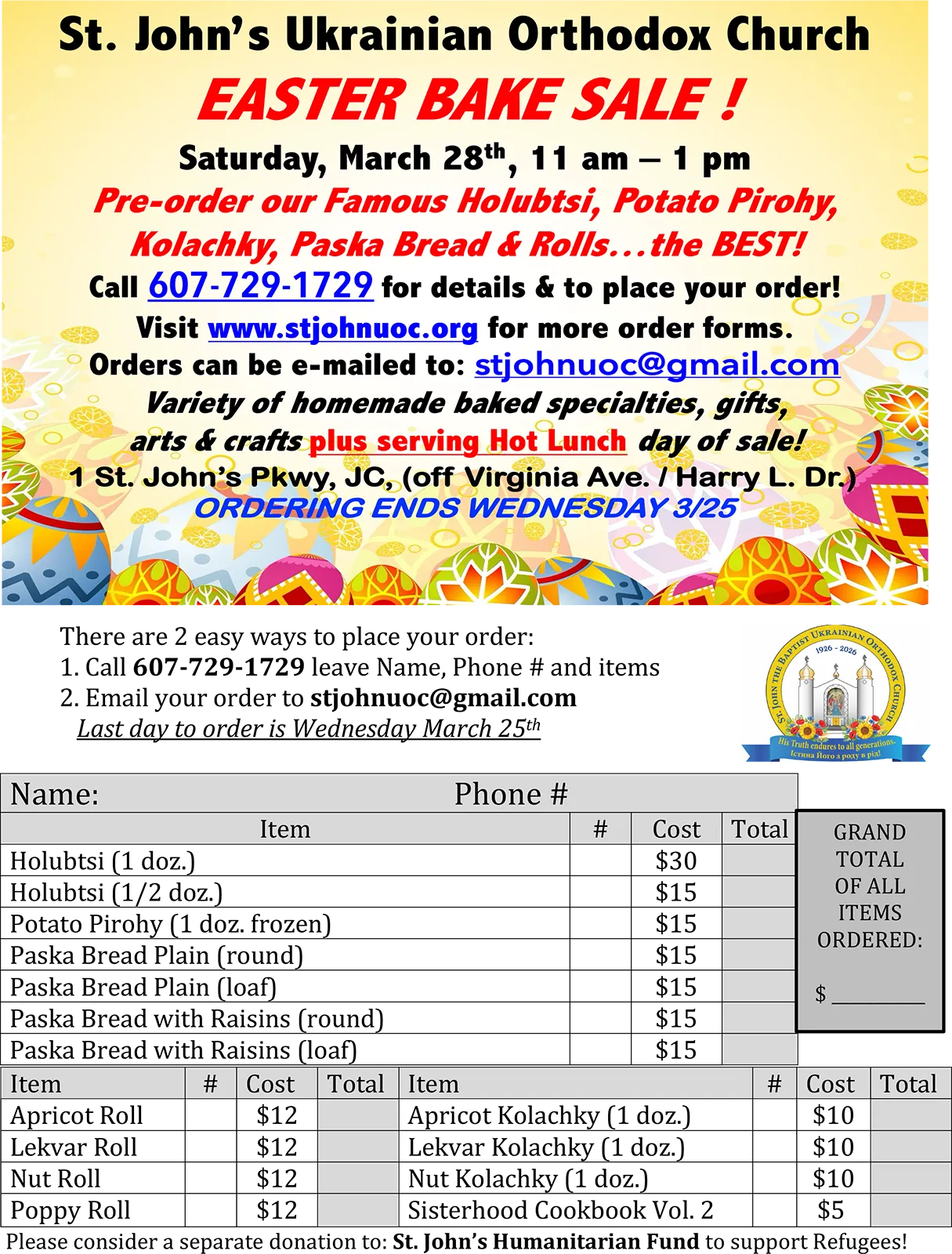
Easter Bake Sale - March 28, 11am - 1PM
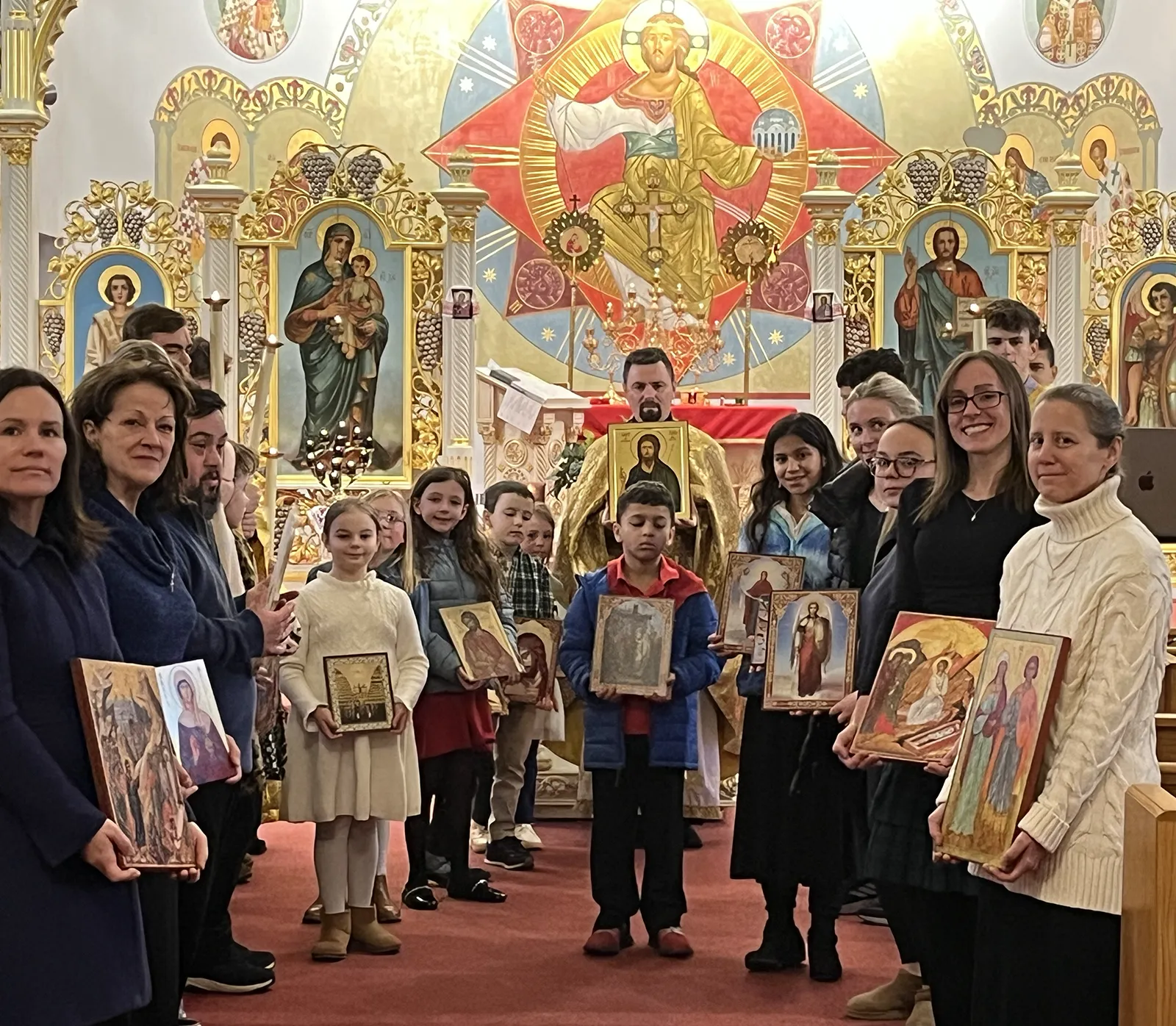
Triumph of Orthodoxy Icon procession with children.
Work Sessions
- Saturday, 3/14 8 AM - Bread Baking
- Saturday, 3/21 8 AM - Kolachky Baking
Thanks from ZOE for Life!(R) Southern Tier
We want to express our deepest thanks to all who listened to the presentation at the Sunday of Orthodoxy Vesper service, and who generously donated and volunteered to help support the work of ZOE For Life!(R) Southern Tier. Your encouraging, uplifting support is essential to our mission and the families we serve. Please continue to remember us in your prayers.
In Christ,
Matushka Marge Kappanadze
Board President
Let's Help Ukraine!

St. John's Ukrainian Humanitarian Fund is accepting donations to help Ukrainians during war. Donations will go to provide food and other humanitarian needs.
To make donation online click here
We accept checks as well.
Please make the checks to St. John Ukrainian Humanitarian Fund
Mailing address:
1 Saint John's Parkway
Johnson City NY 13790
Cash is accepted in church
Pray for Ukraine!

Prayers for Ukraine are done during each service. To see the schedule click here.
Молитви за Україну проводяться під час кожної служби. За розкладом дивіться тут.
May God bless and protect Ukraine!
Please Note!
- Only Orthodox Christians may receive Holy Communion or other Sacraments.
- If you have not been to confession in over a month, please go to confession before receiving the Holy
Gifts.
- We fast from all food and drink (including water) from bedtime (the previous night) until we receive the Holy Gifts during morning Divine Liturgy. That also means no coffee, no cigarettes, no gum, candies in the morning and during Divine Liturgy.
Happy Birthday
- March 8: Lukian Lewkowicz
- March 11: John Mihalko
- March 13: Carolyn Hatala
- March 14: Vitalii Kapytsya
- March 14: John Klodowski
* If your or someone else's birthday is missing or incorrect please let Fr. Ivan know right away.
Please Pray for the Servants of God
Benjamin, Rachel, John, Rose, Solomiia,
Bob, Melodye,
Hristos, John, Jane, Alla,
Fr. Andre, Mary, Zenna, Douglas, Ivan,
Melanie, William, Marion, Helen,
Mariann, Robert, Jean, Ronald, Brian,
Fr. James, Scott, Andriy, James, William,
Pipinos, Fr. Gabriel and PM Susan, Vasyl
Upcoming Readings
| Mon. Mar. 9 | Is. 8:13–9:7; | Gen. 6:9-22; Prov. 8:1-21; |
| Tue. Mar. 10 | Is. 9:9–10:4; | Gen. 7:1-5; Prov. 8:32–9:11; |
| Wed. Mar. 11 | Is. 10:12-20; | Gen. 7:6-9; Prov. 9:12-18; |
| Thu. Mar. 12 | Is. 11:10–12:2; | Gen. 7:11–8:3; Prov. 10:1-22; |
| Fri. Mar. 13 | Is. 13:2-13; | Gen. 8:4-21; Prov. 10:31–11:12; |
| Sat. Mar. 14 | 1 Thess. 4:13-17; | Jn. 5:24-30; |