Bulletin for May 17, 2026
May 17 – Sixth Sunday of Pascha. Tone 5
The Blind Man. Virgin-martyr Pelagia of Tarsus in Asia Minor (287). Hieromartyr Erasmus, bishop of Formia in Campania (303). Hieromartyr Albian (Olbian), bishop of Anaea in Asia Minor (304). Hieromartyr Silvanus of Gaza (311).
Acts 16:16-34; Jn. 9:1-38;
May 21 – THE ASCENSION OF OUR LORD
Вознесіння Господнє.
Holy Apostle and Evangelist John the Theologian (98-117). Ven. Arsenius the Great of Scetis (448). Ven. Arsenius the Lover of Labor (14th c.) and Pimen the Ascetic (12th c.), of the Kyiv Caves.
Acts 1:1-12; Lk. 24:36-53;
1 Jn. 1:1-7; Jn. 19:25-27; 21:24-25;
Services & Other Events
17 May, Sunday - Неділя:
- 9am – Confession / Hours
- 9:30am – Divine Liturgy - Бож. Літургія
- Memorial Service for Pani Julia Lawryk
18 May, Monday:
- 7pm – Parish Council Meeting
19 May, Tuesday:
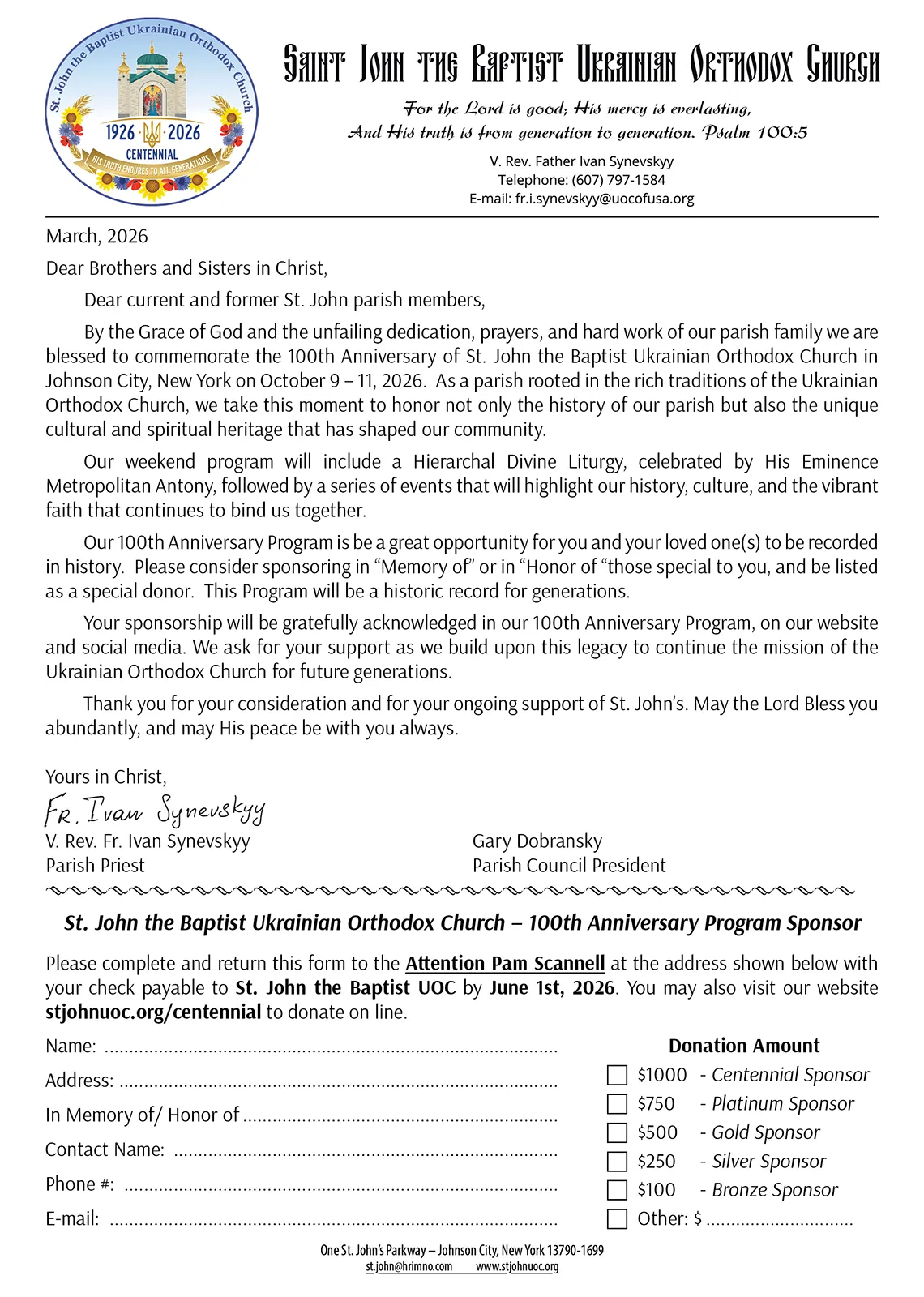
- 1-8:30pm – Pictures for Centennial
20 May, Wednesday:
- 7pm – Great Vespers - Вел. Вечірня
21 May, Ascension of Christ - Вознесіння Господнє:
- 9:00am – Divine Liturgy - Бож. Літургія
- 6:30pm – 100th Committee Meeting in MC Kitchen
23 May, Saturday - Субота:
- 5pm – Great Vespers - Вел. Вечірня
24 May, Sunday - Неділя:
- 9am – Confession / Hours
- 9:30am – Divine Liturgy - Бож. Літургія
Апостол і Євангеліє - Gospel and Epistle of the Day
From Darkness to Light
We Are All, in Some Way, Born Blind
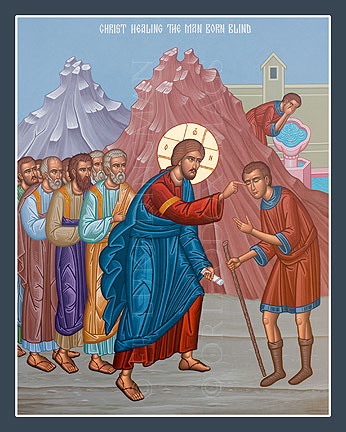
In the ninth chapter of the Gospel of John, Jesus stops before a man who has never seen light. His disciples ask the ancient question: "Who sinned, this man or his parents?" And Jesus answers in a way that reframes everything: "Neither — but this happened so that the work of God might be displayed in him" (Jn 9:3).
This answer is not merely an explanation of one man's suffering. It is an invitation to the whole human race — an invitation to stop seeing darkness as punishment and start seeing it as the place where God's glory breaks through. For two thousand years, the Orthodox saints have been meditating on this invitation. Their message, drawn from lives of prayer, struggle, and hard-won holiness, is ultimately one of profound hope: no matter how deep the blindness, the Light of Christ can reach it.
Physical Blindness:
Not the Worst Blindness
The Orthodox saints knew physical suffering firsthand. Saint Matrona was born without eyes. Saint Luke of Crimea spent decades as a surgeon restoring sight to the blind. Saints Cosmas and Damian healed the blind without payment, always saying: "It is not by our own power that we treat you, but by the power of Christ."
And yet, with one voice, the saints teach that physical blindness — as real and painful as it is — is not the deepest blindness a human being can suffer. Saint John Chrysostom makes this point with startling directness in his homily on John 9:
"Sin alone is an evil, but blindness is not an evil. What were the Jews profited by their eyes? They incurred the heavier punishment, being blinded even while they saw. And what injury had this man by his blindness? For by means of it he recovered sight."
— Saint John Chrysostom
This is not a dismissal of suffering. It is a liberation from its tyranny. The man born blind lost nothing essential. The Pharisees, who saw perfectly, lost everything — because physical sight without spiritual sight leads nowhere. Every physical healing in the life of the saints points toward this deeper healing: of the soul's vision, not only the body's.
Spiritual Blindness:
The Common Condition
If physical blindness is a misfortune, spiritual blindness is the common condition of fallen humanity. The saints describe it with urgency — not to condemn, but to cure.
It is the inability to see our own sin. Elder Cleopa of Romania, drawing on the deep stream of patristic wisdom, warned that sin accumulates gradually, dimming the soul's vision until the intellect no longer perceives good or evil, and the heart loses its capacity for spiritual feeling. The most frightening aspect of spiritual blindness is precisely that the blind person does not know they are blind.
It is the refusal to see God at work. The Pharisees of John 9 had an undeniable miracle before them — a man blind from birth, suddenly seeing — and refused to receive it. This refusal of gratitude is itself a form of blindness, and one remarkably easy to fall into: so focused on what we lack that we cannot see what God is doing.
Most dangerously, it is the pride of thinking we see when we do not. The Pharisees ask Jesus, "Are we blind also?" — and the mockery in the question is the very proof of their blindness. As Elder Cleopa preached: those who sin knowingly, having received all the gifts of the Church, cannot justify themselves with blindness — they will be judged as those who willfully disfigured themselves with darkness.
"When the feeling of God's presence became dulled and spiritual vision darkened, that is when pride entered — and the shadow of cursedness began to fall."
— Saint Nikolai Velimirovich
The Good News:
Every Blindness Can Be Healed
Here is where the Orthodox tradition pours out its deepest consolation. No blindness — not even the most severe, the most long-standing, the most self-inflicted — is beyond the reach of Christ's healing grace.
The story of Saint Paraskevi of Rome shines like a beacon. Thrown into a cauldron of boiling oil by the Emperor Antoninus for refusing to deny Christ, she emerged unharmed. When the emperor challenged her faith, she threw some of the boiling liquid at his face. He was blinded instantly. But Paraskevi did not retaliate — she prayed for him, invoked the name of Jesus, sealed his eyes with the sign of the Cross, and his sight was immediately restored. Her words to him echo across the centuries:
"Emperor, the Christian God is healing you from the blindness that was given to you as a punishment."
— Saint Paraskevi of Rome
The emperor who had persecuted Christians was healed in both body and soul simultaneously. He was converted, baptized, and ended the persecution throughout the empire. One moment of encounter with Christ — through His servant — broke the blindness of a lifetime.
And Saint Mary of Egypt, one of history's most notorious sinners, was stopped at the church door in Jerusalem by an invisible force. She had been spiritually blind for seventeen years. Yet in one moment — turning in tears to the icon of the Theotokos — her eyes were opened. She entered the desert and became one of Orthodoxy's greatest saints, a living proof that no past is too dark for grace.
"The more a person progresses in the spiritual life attending to himself, the wider the eyes of the soul open and the more clearly he discerns his mistakes and the many benefactions of God. Thus man is humbled, and then the Grace of God — divine enlightenment — comes naturally."
— Elder Paisios of Mount Athos
How the Soul's Eyes Are Opened
Humility: Admitting We Cannot See
The blind man did not argue when Jesus placed clay on his eyes. He obeyed. This simple obedience — "I cannot see, and I know I cannot see" — is the first crack through which the light enters. The willingness to say "Lord, have mercy on me" is itself the beginning of sight.
Repentance and Confession:
The Pool of Siloam
Christ sent the blind man to wash in Siloam. The saints consistently identify this with the sacrament of Confession — the place where the soul's accumulated blindness is cleansed. Elder Cleopa preached: "We are required to free the eyes of our soul from passions and wash them in the water of Siloam, through the bath of confession." Many who return to regular confession report the same experience: the world becomes brighter, other people more bearable, God more tangible. This is the literal opening of the soul's eyes.
The Jesus Prayer:
Crying Out Like the Blind Men
Two blind men on the road cried out to Christ: "Son of David, have mercy on us!" They did not wait politely. They cried out. The Church's great prayer — Lord Jesus Christ, Son of God, have mercy on me, a sinner — is this same cry. It is the prayer of one who knows he cannot see, addressed to the One who is Light itself.
The Summit: Seeing the Uncreated Light
The Orthodox tradition does not stop at the removal of blindness. It points toward something far more magnificent: the actual vision of the Uncreated Light of God — the same light that shone on Mount Tabor.
Saint Gregory Palamas, the great fourteenth-century defender of Hesychasm, teaches that the Transfiguration was not a spectacle created for the occasion. It was the unveiling of what Christ always is. And quoting Saint John of Damascus:
"Christ is transfigured, not by putting on some quality He did not possess previously, but by revealing to His disciples what He truly was — in opening their eyes and in giving sight to those who were blind."
— Saint John of Damascus
The Apostles had walked with God-made-flesh for years, yet their eyes could not yet bear what He truly was. On Tabor, for a moment, they saw. And Saint Gregory Palamas teaches that this same vision is available to every soul that pursues repentance, prayer, and holiness — for the eyes given in Baptism, cleansed in Confession, and exercised in the Jesus Prayer are being trained for one ultimate purpose: to see God face to face.
"The grace of the Spirit takes possession of the quiet soul and gives it a taste of the unspeakable good things to come, which no passionate and negligent eye has seen, nor ear heard, neither have entered into the heart of such a man."
— Saint Gregory Palamas
He Is Still Walking Past the Blind
The blind man of John 9 did nothing to deserve his healing. He simply sat by the road in his darkness when Jesus passed by. And Jesus — moved by love — stopped, looked, and acted.
The Orthodox saints, across all their diversity of time and place, teach us this above everything: Christ has not stopped walking past the blind. He still moves through the world, still looks, still stops, still acts. The question is only whether we are willing to cry out — "Lord, have mercy on me!" — and to cooperate with whatever He then chooses to do.
Physical blindness can become, like the man of John 9, the occasion of God's glory. Spiritual blindness can be healed — gradually through repentance, or suddenly in a single moment of grace, as it was for Saint Paul, Saint Mary of Egypt, and Emperor Antoninus. And the ultimate horizon is luminous beyond all imagining: the vision of the face of Christ, the Light of the world.
"I am the light of the world. Whoever follows me will never walk in darkness, but will have the light of life."— John 8:12
Від Темряви до Світла
Ми всі, певним чином, народжені сліпими
У дев'ятому розділі Євангелія від Івана Ісус зупиняється перед людиною, яка ніколи не бачила світла. Учні задають одвічне запитання: «Хто згрішив, він чи батьки його?» І Ісус відповідає так, що все набуває нового сенсу: «Ні він не згрішив, ні батьки його, але це сталося, щоб об'явились діла Божі на ньому» (Ів. 9:3).
Ця відповідь — не просто пояснення одного людського страждання. Це запрошення до всього людського роду — запрошення перестати бачити темряву як покарання і почати бачити її як місце, де проривається Божа слава. Протягом двох тисяч років православні святі розмірковували над цим запрошенням. Їхнє послання, виплекане у молитві, боротьбі та зажди завойованій святості, є, по суті, сповненим глибокої надії: яка б не була глибока сліпота, Світло Христове може її досягнути.
Фізична сліпота: не найгірша сліпота
Православні святі знали фізичне страждання на власному досвіді. Блаженна Матрона народилася без очей. Святий Лука Кримський десятиліттями як хірург відновлював зір сліпим. Святі Косма і Даміан зцілювали сліпих безоплатно, завжди кажучи: «Не нашою силою лікуємо вас, а силою Христа.»
І все ж, одностайно святі вчать, що фізична сліпота — хоч якою реальною і болючою вона є — не є найглибшою сліпотою, яку може зазнати людина. Святий Іоанн Золотоустий висловлює це з вражаючою прямотою у своїй проповіді на дев'ятий розділ Євангелія від Івана:
"Тільки гріх є злом, а сліпота не є злом. Що корисного дали юдеям їхні очі? Вони понесли тяжче покарання, осліпши при тому, що бачили. А яка шкода була цій людині від сліпоти? Бо завдяки їй вона прозріла."
— Святий Іоанн Золотоустий
Це не применшення страждання. Це звільнення від його тиранії. Людина, сліпа від народження, не втратила нічого суттєвого. Фарисеї, які бачили чудово, втратили все — бо фізичний зір без духовного не веде нікуди. Кожне фізичне зцілення в житті святих вказує на це більш глибоке зцілення: зору душі, а не лише тіла.
Духовна сліпота: загальний стан
Якщо фізична сліпота є нещастям, духовна сліпота є загальним станом всього людства. Святі застерігають і описують її — не щоб засудити, а щоб зцілити.
Це нездатність бачити власний гріх. Старець Клеопа Румунський, черпаючи з глибокого джерела патристичної мудрості, попереджав, що гріх накопичується поступово, затьмарюючи зір душі, доки розум більше не відрізняє добра від зла, а серце втрачає здатність до духовного сприйняття. Найстрашніший аспект духовної сліпоти якраз у тому, що сліпа людина не знає, що вона сліпа.
Це відмова бачити Божі діла у житті. Фарисеї (Ін. 9) мали перед собою незаперечне диво — людину, сліпу від народження, яка раптово прозріла — і відмовились це прийняти. Ця відмова від вдячності є сама по собі формою сліпоти, в яку напрочуд легко потрапити: так зосереджені на тому, чого нам бракує, що не можемо бачити, що Бог робить.
Найнебезпечніше — це гордість думати, що ми бачимо, тоді як насправді не бачимо. Фарисеї запитують Ісуса: «Невже й ми сліпі?» — і глузування в цьому запитанні є саме доказом їхньої сліпоти. Як проповідував старець Клеопа: ті, хто грішить свідомо, отримавши всі дари Церкви, не можуть виправдати себе жодним видом сліпоти — вони будуть судимі як ті, хто навмисне спотворили себе темрявою.
"Коли відчуття Божої присутності притупилось і духовний зір потемнів, тоді ввійшла гордість — і тінь прокляття почала падати."
— Святий Миколай Велимирович
Добра новина:
кожна сліпота може бути зцілена
Ось де православна традиція виливає свою найглибшу втіху. Жодна сліпота — навіть найважча, найтриваліша, найбільш самозаподіяна — не виходить за межі досяжності Христової цілющої благодаті.
Оповідь про святу Параскеву Римську сяє, немов маяк. Кинута у казан з киплячою олією імператором Антонієм за відмову зректись Христа, вона вийшла неушкодженою. Коли імператор кинув їй виклик, вона плеснула киплячою рідиною на його обличчя. Він миттєво осліп. Але Параскева не помстилась — вона помолилась за нього, покликала ім'я Ісуса, осінила його очі хресним знаменням, і зір його відновився миттєво. Її слова до нього луною звучать крізь століття:
"Імператоре, Бог-Христос зцілює тебе від сліпоти, що була дана тобі як покарання."
— Свята Параскева Римська
Імператор, який переслідував християн, був зцілений одночасно і тілесно, і духовно. Він навернувся, хрестився й припинив переслідування по всій імперії. Одна мить зустрічі з Христом — через Його служницю — зламала сліпоту цілого життя.
А свята Марія Єгипетська, одна з найвідоміших грішниць в історії, була зупинена невидимою силою біля дверей церкви в Єрусалимі. Вона була духовно сліпою сімнадцять років. Але в одну мить — обернувшись зі сльозами до ікони Богородиці — її очі відкрились. Вона пішла в пустелю і стала однією з найвеличніших святих православ'я: живим доказом того, що жодне минуле не є надто темним для благодаті.
"Чим більше людина просувається у духовному житті, пильнуючи себе, тим ширше відкриваються очі душі і тим ясніше вона розпізнає свої помилки і численні благодіяння Бога. Так людина смириться, і тоді Благодать Божа — Боже просвітлення — приходить природньо."
— Старець Паїсій Святогорець
Як відкриваються очі душі
Смирення: визнання того, що ми не бачимо
Сліпий не сперечався, коли Ісус поклав бруд на його очі. Він послухався. Ця проста покора — «Я не бачу, і я знаю, що не бачу» — є першою щілиною, крізь яку входить світло. Готовність сказати «Господи, помилуй мене» є сама по собі початком зору.
Покаяння і Сповідь: купіль Силоамська
Христос послав сліпого умитися в купелі Силоамській. Святі постійно ототожнюють це з Таїнством Сповіді — місцем, де очищується накопичена сліпота душі. Старець Клеопа проповідував: «Нам слід звільнити очі нашої душі від пристрастей і вмити їх у воді Силоамській, через купіль сповіді.» Багато тих, хто повертається до регулярної сповіді, повідомляють про той самий досвід: світ стає яскравішим, інші люди — більш терпимими, Бог — більш відчутним. Це буквальне відкриття очей душі.
Ісусова молитва:
як волання сліпих при дорозі
Двоє сліпих на дорозі волали до Христа: «Сину Давидів, помилуй нас!» Вони не чекали ввічливо. Вони волали. Велика молитва Церкви — «Господи Ісусе Христе, Сину Божий, помилуй мене грішного» — це саме такий поклик. Це молитва того, хто знає, що не може бачити, звернена до Того, Хто Сам є Світлом.
Вершина: бачення Нествореного Світла
Православна традиція не зупиняється на усуненні сліпоти. Вона вказує на щось незрівнянно величніше: дійсне бачення Нествореного Світла Бога — того самого світла, що сяяло на горі Фавор.
Святий Григорій Палама, великий богослов ісихазму XIV ст., вчить, що Преображення не було видовищем, створеним для даного випадку. Це було відкриття того, Ким Христос завжди є. Цитуючи святого Іоанна Дамаскина:
"Христос преобразився не через те, що набув якоїсь якості, якою не володів раніше, а через те, що відкрив учням Своїм те, Ким Він насправді є — відкривши їхні очі і давши зір тим, хто був сліпим."
— Святий Іоанн Дамаскин
Апостоли роками ходили з Богом у тілі, проте їхні очі ще не могли витримати того, Ким Він насправді є. На Фаворі, на мить, вони побачили. І святий Григорій Палама вчить, що це саме бачення доступне кожній душі, яка веде життя покаяння, молитви і святості — бо очі, дані у Хрещенні, очищені на Сповіді і практиковані в Ісусовій молитві, врешті-решт тренуються для однієї мети: бачити Бога віч-на-віч.
"Благодать Духа заволодіває тихою душею і дає їй скуштувати несказанних благ майбутнього, яких не бачило жодне пристрасне і недбале око, і вухо не чуло, і на серце людини не спадало."
— Святий Григорій Палама
Він досі проходить повз сліпих
Сліпий у дев'ятому розділі Євангелія від Івана нічим не заслужив свого зцілення. Він просто сидів біля дороги у своїй темряві, коли проходив Ісус. І Ісус — зворушений любов'ю — зупинився, подивився і зцілив.
Православні святі, попри всю різноманітність часу і місця, вчать нас понад усе одному: Христос не перестав проходити повз сліпих. Він досі рухається по світу, досі дивиться, досі зупиняється, досі діє. Питання лише в тому, чи готові ми волати — «Господи, помилуй мене!» — і співпрацювати з тим, що Він тоді вирішить зробити.
Фізична сліпота може стати, як для людини з Євангелія від Івана 9, приводом для Божої слави. Духовна сліпота може бути зцілена — поступово через покаяння, або раптово в єдину мить благодаті, як це сталося зі святим Павлом, святою Марією Єгипетською та імператором Антонієм. А кінцевий горизонт є сяючим понад усяке уявлення: бачення обличчя Христа, Світла світу.
«Я — світло світу; хто іде слідом за мною, той не ходитиме в темряві, але матиме світло життя.»
— Ів. 8:12


SMILE!!!!!
Our church directory photos are this Tuesday 1pm - 8:30pm. Please be on time and check the schedule in the Memorial Center which is also where photos will be taken. Any questions please call Pam Scannell 607-760-1671

Thank You!
From the bottom of our hearts — thank you! Your hands, your time, and your dedication made our cabbage pirohy session a true labor of love. There is something beautifully sacred about gathering together to carry on this cherished Ukrainian tradition, and Ukrainian Day will be all the more special because of you.
May God bless each and every one of you for your generosity and community spirit.

Late Spring 2026 Kitchen Sessions
Preparing for Ukrainian Day · May – July 2026
Holubtsi Session — Round 1
10 BatchesHolubtsi Session — Round 2
8–10 BatchesUkrainian Day Week
July 14–18
Let's Help Ukraine!

St. John's Ukrainian Humanitarian Fund is accepting donations to help Ukrainians during war. Donations will go to provide food and other humanitarian needs.
To make donation online click here
We accept checks as well.
Please make the checks to St. John Ukrainian Humanitarian Fund
Mailing address:
1 Saint John's Parkway
Johnson City NY 13790
Cash is accepted in church
Pray for Ukraine!
Prayers for Ukraine are done during each service. To see the schedule click here.
Молитви за Україну проводяться під час кожної служби. За розкладом дивіться тут.
May God bless and protect Ukraine!
Happy Birthday
- May 18: Dr. Patrick Scannell
- May 20: Samuel Hatala
- May 20: Stamatia Dimitriou
- May 20: Dominic Marra
- May 21: Sabina Bhandari
- May 22: Mykola Kapytsia
- May 22: Melanie Klish
* If your or someone else's birthday is missing or incorrect please let Fr. Ivan know right away.
Please Pray for the Servants of God
Benjamin, Rachel, John, Peter John,
Rose, Solomiia, Bob, John, Jane, Alla,
Fr. Andre, Mary, Zenna, Douglas, Ivan,
Daniel, Melanie, William, Marion, Helen,
Mariann, Robert, Jean, Ronald, Brian,
Fr. James, Scott, Andriy, James, William,
Fr. Gabriel and PM Susan, Vasyl, Olha
Upcoming Readings
| Mon. May 18 – | Acts 17:1-15 ; | Jn. 11:47-57; |
| Tue. May 19 – | Acts 17:19-28 ; | Jn. 12:19-36; |
| Wed. May 20 – | Acts 18:22-28 ; | Jn. 12:36-47; |
| Thu. May 21 – | Acts 1:1-12; | Lk. 24:36-53; |
| Fri. May 22 – | Acts 19:1-8 ; | Jn. 14:1-11; |
| Sat. May 23 – | Acts 20:7-12; | Jn. 14:10-21 ; |