Bulletin for May 31, 2026
May 31 – PENTECOST – TRINITY SUNDAY
ДЕНЬ СВЯТОЇ ТРОЙЦІ. П'ЯТИДЕСЯТНИЦЯ.
Martyr Theodotus of Ancyra and seven virgin-martyrs: Alexandra, Tecusa, Claudia, Phaine, Euphraisa, Matrona, and Julia (303). Martyrs Peter, Dionysius, Andrew, Paul, Christina (250).
Acts 2:1-11; Jn. 7:37-52, 8:12;
June 1 – DAY OF THE HOLY SPIRIT.
ДЕНЬ СВЯТОГО ДУХА. Hieromartyr Patrick, bishop of Prusa, and his companions: Presbyters Acacius, Menander, and Polyenus (100). Martyr Acoluthus (284- 305). St. John, bishop of the Goths in Crimea (787).
Eph. 5:8-19; Mt. 18:10-20;
June 7 – 1st Sunday after Pentecost. Tone 8
ALL SAINTS. Third Finding of the Precious Head of St. John the Baptist (850). Hieromartyr Therapon, bishop of Cyprus (4th c.).
Heb. 11:33–12:2 ; Mt. 10:32-33, 37-38–19:27-30 ;
The last day before the Apostolic Fast
Services & Other Events
31 May, Pentecost Sunday - Неділя П'ятидесятниці:
- 9am – Confession / Hours
- 9:30am – Divine Liturgy - Бож. Літургія
1 June, Holy Spirit Day - День Святого Духа:
- 9:00am – Divine Liturgy - Бож. Літургія
2 June, Tuesday:
- 6:30pm – Centennial Committee Meeting
4 June, Thursday:
- 6:30pm – Building & Maintenance Meeting
6 June, Saturday - Субота:
- 5pm – Great Vespers - Вел. Вечірня
7 June, All Saints Sunday - Неділя Всіх Святих:
- 9am – Confession / Hours
- 9:30am – Divine Liturgy - Бож. Літургія
8 June - 11 July — Sts. Peter and Paul Fast
Апостол і Євангеліє - Gospel and Epistle of the Day
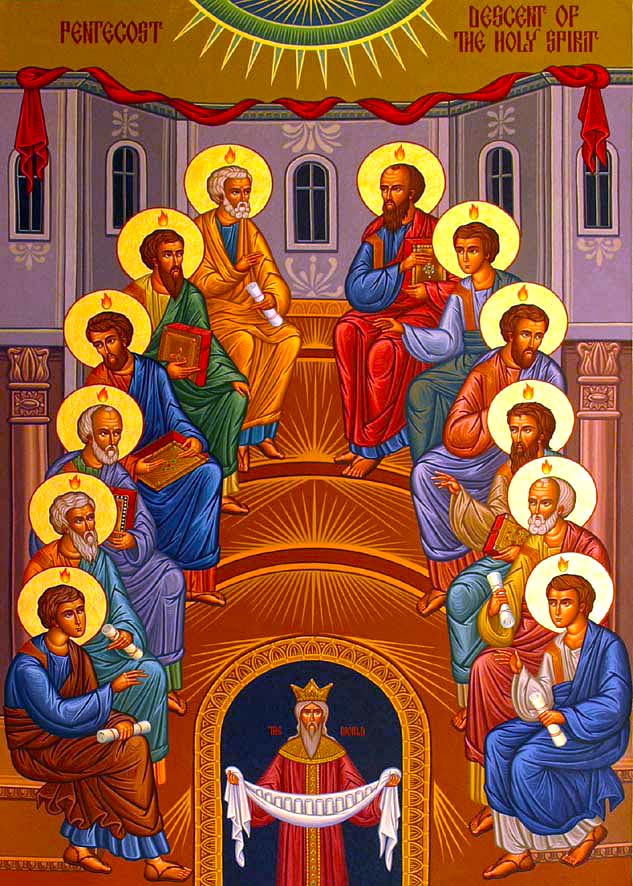
The Descent of the Holy Spirit upon the Holy Apostles
I. The Promise Fulfilled
The descent of the Holy Spirit upon the holy Apostles on the day of Pentecost stands as one of the most sublime and transformative events in the history of salvation. Recorded in the second chapter of the Acts of the Apostles, this event is understood in Orthodox Christianity not merely as a historical occurrence but as the very birthday of the Church, the living continuation of the Incarnation, and the seal of the New Covenant between God and humanity. The Orthodox Church celebrates this day with exceptional solemnity, proclaiming it the completion and crown of all the saving feasts of the Lord.
The Lord Jesus Christ, before His glorious Ascension, promised His disciples: "And I will pray the Father, and He will give you another Helper, that He may abide with you forever—the Spirit of truth" (John 14:16–17). This promise, proclaimed throughout His farewell discourses in the Gospel of John, was fulfilled ten days after the Ascension, on the fiftieth day after Pascha—the ancient Jewish feast of Shavuot—when the disciples were gathered together in the Upper Room in Jerusalem.
The Orthodox Patristic tradition, stretching from the Apostolic Fathers through the great theologians of the fourth and fifth centuries to the Byzantine and later teachers, has reflected deeply upon the nature, significance, and effects of this divine event. This article draws upon that rich tradition to present a coherent theological account of the Pentecostal descent of the Holy Spirit.
II. The Biblical Account and Its Patristic Reception
The Acts of the Apostles describes the event with characteristic precision and awe: "And suddenly there came a sound from heaven, as of a rushing mighty wind, and it filled the whole house where they were sitting. Then there appeared to them divided tongues, as of fire, and one sat upon each of them. And they were all filled with the Holy Spirit and began to speak with other tongues, as the Spirit gave them utterance" (Acts 2:2–4).
The two central signs—wind and fire—are deeply significant in Patristic exegesis. The Fathers consistently identify them as theophanic symbols with deep roots in the Old Testament. Wind (pneuma in Greek, ruach in Hebrew) evokes the Spirit of God moving over the waters at creation (Genesis 1:2) and the breath breathed into Adam to give him life (Genesis 2:7). Fire recalls the burning bush, the pillar of fire in the wilderness, and above all the fire that descended upon Mount Sinai when the Commandments were given.
St. John Chrysostom on Wind and Fire
St. John Chrysostom, in his Homilies on the Acts of the Apostles, draws a profound parallel between Sinai and Pentecost. He observes that just as the Old Covenant was inaugurated with fire and the sound of trumpets upon Sinai, so the New Covenant is inaugurated with fire and the sound of wind at Pentecost. But the contrast is equally instructive: at Sinai, Moses alone ascended to receive the Law; at Pentecost, the Spirit descends upon all who are gathered, making each believer a living temple of God.
"At Sinai, the fire was on the mountain, and the people stood afar off. But now the fire divides itself and rests upon each one of them. This is no longer a fire that terrifies but a fire that illumines, transforms, and deifies the soul that receives it."
— St. John Chrysostom, Homilies on Acts, Hom. IV
St. Cyril of Jerusalem on the Signs of the Spirit
St. Cyril of Jerusalem, in his celebrated Catechetical Lectures delivered to candidates for Baptism, devotes considerable attention to the Holy Spirit and the event of Pentecost. He interprets the wind as symbolizing the universal scope of the Spirit's activity: just as wind cannot be confined to one place, so the Holy Spirit cannot be limited by human boundaries, whether of race, language, or culture. The fire, for Cyril, signifies both the purifying and illuminating power of the Spirit: it burns away the dross of sin and kindles the soul with divine love.
"The Holy Spirit is great and omnipotent and wonderful in His gifts. Consider how many of you are here present, how many souls of us are collected together, and how great a work He is able to accomplish; for He breathes where He wills, and the sound of His coming is heard, but no one knows from where He comes or where He goes."
— St. Cyril of Jerusalem, Catechetical Lectures, XVI
III. The Theology of the Holy Spirit in Orthodox Tradition
The Holy Spirit as the Third Person of the Holy Trinity
Orthodox theology, drawing upon the Cappadocian Fathers—St. Basil the Great, St. Gregory the Theologian (Nazianzus), and St. Gregory of Nyssa—insists that the Holy Spirit is fully God, consubstantial and co-eternal with the Father and the Son. This was definitively proclaimed at the First Council of Constantinople in 381 AD, in the final form of the Niceno-Constantinopolitan Creed, which confesses the Holy Spirit as "the Lord, the Giver of Life, Who proceeds from the Father, Who together with the Father and the Son is worshipped and glorified, Who spoke through the prophets."
St. Basil the Great, in his foundational treatise On the Holy Spirit, argues from the liturgical doxology and from Holy Scripture that the Spirit must receive equal honor and equal glory with the Father and the Son. He employs the concept of "common energy" (koinē energeia) to describe the inseparable operation of the Three Persons in all divine works, while insisting that each Person acts in a manner proper to His hypostasis.
"The Holy Spirit is not separated from the Father and the Son in faith, nor in the order of divine names, nor in acts of worship. For our Lord has united the Spirit to the Father and to Himself in the command for Baptism, saying: baptize in the name of the Father, and of the Son, and of the Holy Spirit."
— St. Basil the Great, On the Holy Spirit, Ch. X
The Procession of the Holy Spirit
A point of cardinal importance in Orthodox theology is the procession of the Holy Spirit exclusively from the Father. This teaching, grounded in the Lord's own words in the Gospel of John—"when the Helper comes, whom I shall send to you from the Father, the Spirit of truth who proceeds from the Father" (John 15:26)—was preserved intact in the Eastern Orthodox tradition. The Western addition of the Filioque ("and from the Son") to the Creed was vigorously contested by St. Photios the Great, Patriarch of Constantinople in the ninth century, who wrote exhaustively on the theological errors this innovation introduced.
St. Gregory Palamas, the great fourteenth-century defender of Hesychasm and Orthodox mystical theology, further developed the distinction between the divine essence (ousia) and the divine energies (energeiai). He taught that while the divine essence remains utterly transcendent and unknowable, God truly communicates Himself to creatures through His uncreated energies—and the Holy Spirit, as the hypostasis of these energies sent to dwell in the Church, makes possible the genuine deification (theosis) of the faithful.
IV. The Descent as the Inauguration of the Church
St. Irenaeus of Lyons
St. Irenaeus of Lyons, writing in the late second century, connects the Pentecostal gift of the Spirit directly to the mission of the Church and the recapitulation (anakephalaiosis) of all things in Christ. For Irenaeus, the Spirit is the "life of life," and where the Spirit is, there is the Church and all grace. The descent of the Spirit upon the Apostles is the moment when the new humanity, gathered in Christ, receives the animating power to proclaim salvation to all nations.
"Where the Church is, there is the Spirit of God; and where the Spirit of God is, there is the Church, and every kind of grace. But the Spirit is truth. Therefore those who do not partake of the Spirit are not nourished into life from the mother's breasts, nor do they receive that most limpid fountain which proceeds from the body of Christ."
— St. Irenaeus of Lyons, Against Heresies, III.24.1
St. Gregory the Theologian
St. Gregory Nazianzus, in his magnificent Oration on Holy Pentecost, reflects upon the pedagogical progression of divine revelation: the Old Testament revealed the Father clearly and the Son obscurely; the New Testament revealed the Son clearly and hinted at the divinity of the Spirit; and the present age—the age of the Church—reveals the Spirit dwelling openly among us. Thus Pentecost marks the fullness of trinitarian revelation and the beginning of the Spirit's dwelling in the community of believers.
"The Old Testament proclaimed the Father openly, and the Son more obscurely. The New Testament manifested the Son, and suggested the deity of the Spirit. Now the Spirit Himself dwells among us, and supplies us with a clearer demonstration of Himself. For it was not safe, when the Godhead of the Father was not yet acknowledged, plainly to proclaim the Son; nor when that of the Son was not yet received, to burden us further with the Holy Spirit."
— St. Gregory Nazianzus, Oration XLI, On Holy Pentecost
V. The Gift of Tongues and the Reversal of Babel
Among the most theologically rich aspects of the Pentecostal event is the gift of speaking in foreign tongues (glossolalia), whereby the Apostles were heard speaking by people of many nations, each in his own language. Orthodox Patristic exegesis consistently interprets this as a deliberate reversal and healing of the confusion of tongues at Babel (Genesis 11).
St. John Chrysostom notes that at Babel, humanity's pride led to the fragmentation of language and the scattering of peoples. At Pentecost, the humility and unity of the Apostles, gathered in prayer around the Mother of God, becomes the vessel through which the Spirit unites what was divided. The diversity of tongues at Pentecost does not represent fragmentation but rather the catholicity of the Church: the Gospel is for all nations, and the Spirit overcomes all barriers of language and culture.
"The Spirit was poured out upon all flesh, not only upon the Jews who had believed, but also upon those of every nation. For He came to gather into one all that was scattered, and to heal the ancient wound of division, making those who were estranged from one another into one body through the bond of the Spirit."
— St. Sophronius of Jerusalem, Sermon on Holy Pentecost
VI. Pentecost and the Theosis of the Human Person
In Orthodox theology, the ultimate purpose of the descent of the Holy Spirit is the deification (theosis) of the human person—the participation in the divine life and the transformation of the believer into the likeness of God. This theme, central to Eastern Christian spirituality, is articulated most fully by St. Athanasius of Alexandria with his famous formulation: "God became man so that man might become God."
St. Symeon the New Theologian, the great mystic of the tenth and eleventh centuries, insists that the experience of the Holy Spirit is not confined to the apostolic age but is the birthright of every sincere Christian. He describes in vivid terms his own experience of the divine light—the uncreated light of God, identical with the light of Tabor—which the Holy Spirit communicates to those who purify themselves through repentance, ascetic struggle, and humble prayer.
"He who possesses the Spirit within himself possesses God Himself; and he who has God lives forever and shall not see death for eternity. For God is life and light and love, and those who participate in the Spirit participate in all these things. This is the mystery of Pentecost renewed in every soul that opens itself in love to the Divine."
— St. Symeon the New Theologian, The Discourses, VII
VII. The Role of the Theotokos at Pentecost
Orthodox iconographic and liturgical tradition assigns a place of singular honor to the Most Holy Theotokos in the event of Pentecost. While the Acts of the Apostles mentions that "Mary the mother of Jesus" was present with the disciples in the Upper Room (Acts 1:14), the theological significance of her presence has been profoundly developed in Byzantine hymnography and patristic commentary.
In many Orthodox Pentecost icons, the Theotokos is depicted at the center and at the top of the gathering, symbolizing that she is the Throne of God and the living ark of the new covenant. Just as the Holy Spirit overshadowed her at the Annunciation to bring forth the incarnate Son of God, so at Pentecost she presides over the new birth of the Church, the mystical body of her Son, through the same Spirit.
St. Andrew of Crete and St. Germanus of Constantinople, in their homilies on the feasts of the Theotokos, speak of her as "the living throne of the All-Holy Spirit," whose intercessions before the throne of her Son are always efficacious. Her presence at Pentecost is thus both historical and typological: she embodies the Church's perfect receptivity to the Spirit.
VIII. The Sacramental Dimension: Chrismation and the Gift of the Spirit
Orthodox sacramental theology connects the Pentecostal descent of the Holy Spirit directly to the Mystery of Chrismation (Confirmation), administered immediately after Holy Baptism. The newly baptized Christian receives the anointing of Holy Myron (chrism) with the words "The Seal of the Gift of the Holy Spirit"—words that echo the promise of Pentecost and the apostolic practice described in Acts 8:14–17 and Acts 19:1–6.
St. Cyril of Jerusalem, in his Mystagogical Catecheses, explains that just as the Father anointed Christ with the Holy Spirit at His Baptism in the Jordan, so every Christian receives the anointing of the same Spirit in Chrismation. The believer becomes, in a real sense, a "christ" (anointed one), sharing in the royal, prophetic, and priestly offices of the Messiah.
"Having been baptized into Christ, and put on Christ, you have been made conformable to the Son of God; for God having predestinated us unto the adoption of children, has conformed us to the glorious body of Christ. Having therefore become partakers of Christ, you are properly called Christs, and of you God said: Touch not My Christs, or anointed. Now you were made Christs, by receiving the antitype of the Holy Spirit."
— St. Cyril of Jerusalem, Mystagogical Catechesis III
IX. The Gifts of the Holy Spirit in Patristic Teaching
The Orthodox Patristic tradition enumerates the gifts of the Holy Spirit primarily on the basis of Isaiah 11:2–3 (the sevenfold gifts: wisdom, understanding, counsel, fortitude, knowledge, piety, and the fear of the Lord) and 1 Corinthians 12 (the charismata). These gifts are not given for personal spiritual aggrandizement but for the "edification of the Church" and the sanctification of the world.
St. Gregory Palamas synthesizes the earlier Patristic tradition on the gifts of the Spirit with his theology of the uncreated energies. For him, the charismata—whether the gift of healing, prophecy, discernment, or tongues—are not created effects produced in the soul by an absent God, but genuine participations in the divine life, communicated through the Holy Spirit who truly and personally indwells the Church and the sanctified human person.
X. Pentecost as Ongoing Mystery
The Orthodox Church does not treat Pentecost as a closed historical event but as an ever-present and living mystery. The Holy Spirit, Who descended upon the Apostles in the Upper Room, continues to dwell in the Church, to inspire Holy Scripture and Holy Tradition, to act through the Sacraments, and to work in the hearts of the faithful. Every Liturgy is, in a sense, a new Pentecost; every act of genuine prayer is a cry to the Spirit; every experience of divine grace is a participation in the Pentecostal gift.
St. Seraphim of Sarov, the beloved nineteenth-century elder, summarized the entire Christian life as "the acquisition of the Holy Spirit." In his celebrated conversation with Nicholas Motovilov, he explained that the goal of the Christian is not merely to follow commandments or perform good deeds, but to become a vessel of the Spirit—to be transformed, illumined, and deified by the very fire that descended upon the Apostles at Pentecost.
"Prayer, fasting, vigil and all other Christian activities, however good they may be in themselves, do not constitute the aim of our Christian life, although they serve as the indispensable means of reaching this end. The true aim of our Christian life consists in the acquisition of the Holy Spirit of God."
— St. Seraphim of Sarov, Conversation with Nicholas Motovilov
This teaching crowns the entire Patristic witness: from Irenaeus to Chrysostom, from Basil to Gregory Palamas, from Cyril to Symeon the New Theologian, the unanimous voice of Orthodoxy proclaims that the descent of the Holy Spirit upon the Apostles was not an isolated miracle but the opening of the floodgates of divine grace to all humanity. The Church lives by this Spirit; the faithful are sanctified by this Spirit; and in the age to come, the kingdom of God will be the eternal dwelling of all who have received and cherished this gift.
Зіслання Святого Духа на Святих Апостолів
І. Здійснення Обітниці
Зіслання Святого Духа на святих Апостолів у день П'ятидесятниці є однією з найвеличніших і найбільш значущих подій в історії спасіння. Описана в другому розділі книги Дії Святих Апостолів, ця подія в православному християнстві розуміється не тільки як історична подія, але в істинному сенсі як день народження Церкви, живе продовження Втілення і печать Нового Заповіту між Богом і людством. Православна Церква святкує цей день з особливою урочистістю, проголошуючи його завершенням і вінцем усіх Господських свят.
Господь Ісус Христос перед Своїм преславним Вознесінням обіцяв учням: «І Я умолю Отця, і дасть вам іншого Утішителя, що буде з вами повік, Духа істини, Якого світ не може прийняти, бо не бачить Його і не знає Його; а ви знаєте Його, бо Він з вами перебуває і у вас буде.» (Ів. 14:16-17). Ця обіцянка, проголошена у прощальних бесідах Євангелія від Івана, здійснилася через десять днів після Вознесіння, на п'ятдесятий день після Пасхи, коли учні зібрались разом у вищій кімнаті в Єрусалимі.
Православна патристична традиція, що сягає від апостольських отців через великих богословів четвертого і п'ятого століть до візантійських і пізніших вчителів, глибоко розмірковувала природу, значення і наслідки цієї божественної події. Ця стаття спирається на цю багату традицію для створення цілісного богословського викладу підчас Зіслання Святого Духа.
ІІ. Біблійний опис і його патристичне сприйняття
Діяння святих апостолів описує цю подію з характерною точністю і зворушливістю: «І раптом стався шум з неба, ніби від сильного вітру, і наповнив увесь дім, де вони знаходились. І з'явились їм розділені язики, мов вогненні, і почили по одному на кожному з них. І сповнилися всі Духа Святого, і почали говорити іншими мовами, як Дух давав їм провіщати.» (Дії 2:2–4).
Два центральні знаки — вітер і вогонь — надзвичайно значущі в патристичній традиції. Святі одноголосно визнають їх богоявленними символами, що мають глибоке коріння в Старому Заповіті. Вітер («пневма» - дух по-грецьки, «руах» з івриту) викликає Духа Божого, що носився над водами при створенні (Бут 1:2) і дихання, вдухнуте в Адама для дарування йому життя (Бут 2:7). Вогонь нагадує про палаючий кущ, вогняний стовп, і насамперед — про вогонь, що зійшов на гору Синай, коли було дано Заповіді Божі.
Святий Іван Золотоустий про вітер і вогонь
Святий Іван Золотоустий у своїх Бесідах на Діяння Святих Апостолів проводить глибоку паралель між Синаєм і П'ятидесятницею. Він зазначає, що так само, як Старий Заповіт був урочистий вогнем і звуком труб на Синаї, так і Новий Заповіт засновується вогнем і шумом вітру на П'ятидесятниці. Однак контраст також повчальний: на Синаї лише Мойсей зійшов на гору, щоб отримати Закон; на П'ятидесятниці ж Дух зходить на всіх присутніх, роблячи кожного віруючого живим храмом Божим.
"На Синаї вогонь був на горі, а люди стояли вдалині. Тепер ж вогонь розділяється і спочиває на кожному з них. Це вже не вогонь, що лякає, але вогонь, що просвітлює, перетворює і обожнює душу, що його приймає."
— Святий Іван Золотоустий, Бесіди на Книгу Дій, Бес. IV
Святий Кирило Єрусалимський про знаки Духа
Святий Кирило Єрусалимський у своїх прославлених Катехизичних навчаннях, виголошених до кандидатів до Хрещення, приділяє значну увагу Святому Духу і П'ятидесятниці. Вітер для Кирила символізує всесвітній характер діяльності Духа: як вітер не можна обмежити одним місцем, так і Святий Дух не можна обмежити людськими межами. Вогонь для Кирила означає очищуючу і просвітлюючу силу Духа: він спалює шлак гріха і розпалює душу Божественною любов'ю.
"Святий Дух великий, і всемогутній, і дивовижний в Своїх дарах. Подивіться лиш скільки з вас тут присутні, скільки душ зібралося разом, яку велику роботу Він спроможний здійснити. Бо Дух дише, де хоче, і звук його приходу чутно, але ніхто не знає, звідки він приходить або куди відходить."
— Святий Кирило Єрусалимський, Катехизичні навчання, XVI
ІІІ. Богослов'я Святого Духа в православній традиції
Святий Дух як третя особа Святої Трійці
Кападокійські отці — святий Василій Великий, святий Григорій Богослов (Назіанзин), святий Григорій Ниський — наполягають, що Святий Дух є повністю Богом, єдиносущним і рівновічним з Отцем і Сином. Це було остаточно проголошено на Першому Константинопольському Соборі 381 року, де було затверджено Символ віри з ісповіданням: «Святого Духа, Господа Животворчого, що від Отця походить, що Йому з Отцем і Сином однакове поклоніння і однакова слава, що говорив через пророків.»
Святий Василій Великий у своєму фундаментальному трактаті «Про Святого Духа», спираючись на літургійне славослів'я та Святе Письмо, доводить, що Дух має отримувати рівну честь і рівну славу з Отцем і Сином. Він використовує поняття «спільної енергії» (koinē energeia) для опису нероздільної дії Трьох Осіб у всіх божественних ділах, водночас наголошуючи, що кожна Особа діє у спосіб, властивий Її іпостасі.
"Святий Дух не відділяється від Отця і Сина в вірі, ані в порядку Божественних імен, ані в актах поклоніння. Бо Господь зв'язав Духа з Отцем і з Собою в заповіді про Хрещення: хрестіть в ім'я Отця, і Сина, і Святого Духа."
— Святий Василій Великий, Про Святого Духа, гл. X
Зіслання Святого Духа
Ключовим питанням православного богослов'я є Зіслання Святого Духа виключно від Отця. Це вчення, що грунтується на власних словах Господа у Євангелії від Івана — «Коли ж прийде Утішитель, Якого Я пошлю вам від Отця, Дух істини, Який від Отця ісходить» (Ів. 15:26) — було збережене в незмінному вигляді у східній православній традиції. Західний додаток Філіокве (Filioque — «і від Сина») до Символу віри рішуче оскаржувався святим Фотієм Великим, патріархом Константинопольським у IX столітті, який детально писав про богословські помилки, принесені цим нововведенням.
Святий Григорій Палама, великий захисник ісихазму та православного містичного богослов'я XIV століття, глибше розробив розрізнення між божественною сутністю (ousia) та божественними енергіями (energeiai). Він навчав, що хоча божественна сутність залишається абсолютно пресущою та непізнаваною, Бог справді подає Себе створінням через Свої нестворені енергії — а Святий Дух, як іпостась цих енергій, посланий перебувати в Церкві, робить можливим справжнє обоження (theosis) вірних.
ІV. Зіслання як заснування Церкви
Святий Іреней Ліонський
Святий Іреней Ліонський, пишучи наприкінці другого століття, пов'язує п'ятидесятницький дар Духа безпосередньо з місією Церкви і з рекапітуляцією (анакефалайосис) усього в Христі. Для Іренея Дух є «життям життя», і де є Дух, там є Церква і всяка благодать. Зіслання Духа на Апостолів — це момент, коли нове людство, зібране в Христі, отримує життєдайну силу, щоб засвідчити про спасіння всім народам.
"Де є Церква, там є Дух Божий; і де є Дух Божий, там є Церква і всяка благодать. Дух і є істина. Тому ті, хто не бере участі в Дусі, не живляться від грудей матері, і не отримують пречистого джерела, що витікає з Тіла Христового."
— Святий Іреней Ліонський, Проти єресей, III.24.1
Святий Григорій Богослов
Святий Григорій Богослов (Назіанзін) у своєму величному «Слові на святу П'ятидесятницю» розмірковує про педагогічну поступовість божественного одкровення: Старий Завіт ясно відкривав Отця і приховано — Сина; Новий Завіт ясно відкрив Сина і натякнув на божество Духа; а нинішній вік — епоха Церкви — являє Духа, Який відкрито перебуває серед нас. Таким чином, П'ятидесятниця знаменує собою повноту троїчного одкровення та початок перебування Духа у спільноті вірних.
"Старий Завіт відкрито проповідував Отця, а Сина — більш приховано. Новий Завіт явив Сина і вказав на божество Духа. Нині ж Сам Дух перебуває серед нас, подаючи нам ясніше об'явлення Себе. Бо було небезпечно, коли божество Отця ще не було визнане, відкрито проповідувати Сина; і так само, коли [божество] Сина ще не прийняли, обтяжувати нас ще й Святим Духом."
— Святий Григорій Назіанзин, Слово XLI, Про Святу П'ятдесятницю
V. Дар мов і зцілення вавилонського змішання
Однією з найбільш багатих на богословський зміст аспектів п'ятидесятницької події є дар говоріння іноземними мовами (глоссолалія), завдяки якому Апостоли були чуті людьми з багатьох народів, кожний з яких чув їх своєю мовою. Православне патристичне вчення стало трактує це як свідоме скасування і зцілення змішання мов при Вавилоні (Бут 11).
Святий Іван Золотоустий зазначає: при Вавилоні горделивість людства спричинила роздроблення мазі й розсіяння народів; на П'ятидесятниці ж смирення і єдність Апостолів, зібраних у молитві довкола Матері Божої, стають сосудом, через який Дух з'єднує розділене. Різноманітність мов у день П'ятидесятниці означає не роздробленість, а, скоріше, соборність Церкви: Євангеліє призначене для всіх народів, і Дух долає будь-які мовні та культурні бар'єри.
"Дух вилився на всяку плоть — не лише на юдеїв, які увірували, але й на тих, хто з кожного народу. Бо Він прийшов, щоб зібрати в одне все розсіяне і зцілити давню рану розділення, роблячи тих, хто був відчужений один від одного, єдиним тілом через союз Духа."
— Святий Софроній Єрусалимський, Слово на святу П'ятидесятницю
VI. Свята П'ятидесятниця і обоження людської особи
У православному богослов'ї, кінцева мета Зіслання Святого Духа — це обонення (теозис) людської особи — участь у Божественному житті і перетворення віруючого в подобу Божу. Цю тему, центральну для східньохристиянської духовності, особливо викладає святий Афанасій Александрійський у своїй знаменитій цитаті: «Бог став людиною, щоб людина стала Богом».
Святий Симеон Новий Богослов, великий містик десятого і одинадцятого століть, впевнює, що досвід Святого Духа не обмежується апостольською добою, а є богоданим правом кожного справжнього християнина. Він описує в яскравих виразах із свого власного досвіду Божественного світла — нествореного світла Божого, тотожнього зі світлом Таворським, який Святий Дух подає тим, хто очищує себе покаянням, подвижництвом і смиренною молитвою.
"Хто має Духа в собі, має Самого Бога; і хто має Бога, живе вічно і не побачить смерті на віки вічні. Бо Бог є життя, і світло, і любов, і ті, хто бере участь в Дусі, беруть участь в усьому цьому. Це таїнство П'ятидесятниці, що оновлюється в кожній душі, яка у любові відкривається до Божественного."
— Святий Симеон Новий Богослов, Бесіди, VII
VII. Роль Богородиці на Пїятдесятниці
Православна іконографічна та літургійна традиція відводить особливе почесне місце Пресвятій Богородиці в події П'ятидесятниці. Хоча в «Діяннях Апостолів» згадується, що «Марія, Мати Ісуса» перебувала разом з учнями у горниці (Дії 1:14), богословське значення її присутності було глибоко розкрите у візантійській гімнографії та патристичних коментарях.
У багатьох православних іконах П'ятидесятниці Богородиця зображується в центрі та на чолі зібрання, що символізує її як Престол Божий та живий кивот нового завіту. Подібно до того, як Святий Дух осінив її під час Благовіщення, щоб народився втілений Син Божий, так і в день П'ятидесятниці вона головує при новому народженні Церкви — містичного тіла її Сина — через того самого Духа.
Святитель Андрій Критський та святитель Герман Константинопольський у своїх проповідях на Богородичні свята називають її «живим престолом Всесвятого Духа», чиє заступництво перед престолом Сина є завжди дієвим. Її присутність на П'ятидесятниці є водночас історичною та типологічною: вона втілює в собі досконалу сприйнятливість Церкви до Духа.
VIII. Таїнство Миропомазання та Дар Святого Духа
Православне богослов'я про таїнства пов'язує зішестя Святого Духа на П'ятидесятницю безпосередньо з Таїнством Миропомазання, яке звершується одразу після Святого Хрещення. Новохрещений християнин отримує помазання Святим Миром зі словами: «Печать дару Духа Святого» — словами, що відлунюють обітницю П'ятидесятниці та апостольську практику, описану в Діяннях (8:14–17 та 19:1–6).
У своїх «Тайноводственних повчаннях» святитель Кирил Єрусалимський пояснює цей зв'язок як Отець помазав Христа Святим Духом під час Його Хрещення в Йордані, так і кожен християнин отримує помазання тим самим Духом у Миропомазанні. Вірянин стає, у реальному сенсі, «христом» (помазаником), долучаючись до царського, пророчого та священничого служіння Месії.
" У Христа хрестившись і в Христа зодягнувшись (Гал. 3: 27), ви стали подібними до образу (Рим. 8: 29) Сина Божого. Оскільки Бог, Який наперед визначив (Еф. 1: 5) вас для усиновлення, вчинив подібними тілу Христової слави (Флп. 3: 21). Ставши причасниками Христа (Євр. 3: 14), ви достойно називаєтеся християнами, тобто помазаними, і про вас Бог сказав: «Не доторкайтеся до помазаних Моїх» (Пс. 104: 15). Помазаними ви стали, коли прийняли подобообразність Святого Духа "
— Святий Кирило Єрусалимський, Третє тайноводче повчання
IX. Дари Святого Духа у повчаннях святих отців
Православна святоотцівська традиція перелічує дари Святого Духа, спираючись насамперед на текст Ісаї 11:2–3 (семикратні дари: мудрість, розум, порада, сила, знання, благочестя та страх Господній) та 1-ше послання до Коринфян 12 (харизми). Ці дари даються не для особистого духовного звеличення, а для «збудування Церкви» та освячення світу.
Святитель Григорій Палама синтезує ранню святоотцівську традицію про дари Духа зі своїм богослов'ям нестворених енергій. Для нього харизми — чи то дар зцілення, пророцтва, розрізнення духів чи дар мов — це не створені наслідки, що виникають у душі під впливом «відсутнього» Бога, а справжня причетність до божественного життя що передаються через Святого Духа, який істинно й особисто перебуває в Церкві та в освяченій людській особистості.
IX. П'ятидесятниця як триваюче Таїнство
Православна Церква розглядає П'ятидесятницю не як завершену історичну подію, а як вічно присутнє і живе таїнство. Святий Дух, Який зійшов на апостолів у Світлиці, продовжує перебувати в Церкві, надихати Святе Письмо і Святе Передання, діяти через Таїнства та працювати в серцях вірних. Кожна Літургія є, у певному сенсі, новою П'ятидесятницею; кожен акт щирої молитви — це заклик до Духа; кожен досвід божественної благодаті — це причетність до дару П'ятидесятниці.
Преподобний Серафим Саровський, улюблений старець XIX століття, підсумував усе християнське життя як «стяжання (набуття) Духа Святого». У своїй знаменитій бесіді з Миколаєм Мотовиловим він пояснив, що мета християнина полягає не просто у виконанні заповідей чи добрих справ, а в тому, щоб стати сосудом Духа — преобразитися, просвітитися і обожитися тим самим вогнем, що зійшов на апостолів у день П'ятидесятниці.
"Молитва, піст, бдіння та всі інші християнські подвиги, якими б добрими вони самі по собі не були, не становлять мети нашого християнського життя, хоча й служать необхідними засобами для її досягнення. Справжня мета нашого християнського життя полягає у стяжанні Духа Божого Святого."
— Святий Серафим Саровський, Бесіда з М.О. Мотовиловим
Це вчення вінчає все святоотцівське свідчення: від Іринея до Золотоустого, від Василія до Григорія Палами, від Кирила до Симеона Нового Богослова — одностайний голос Православ'я проголошує, що зішестя Святого Духа на апостолів не було ізольованим чудом. Це було відкриття шлюзів божественної благодаті для всього людства. Церква живе цим Духом; віруючі освячуються цим Духом; і в майбутньому Царство Боже стане вічною оселею всіх, хто прийняв і зберіг цей дар.
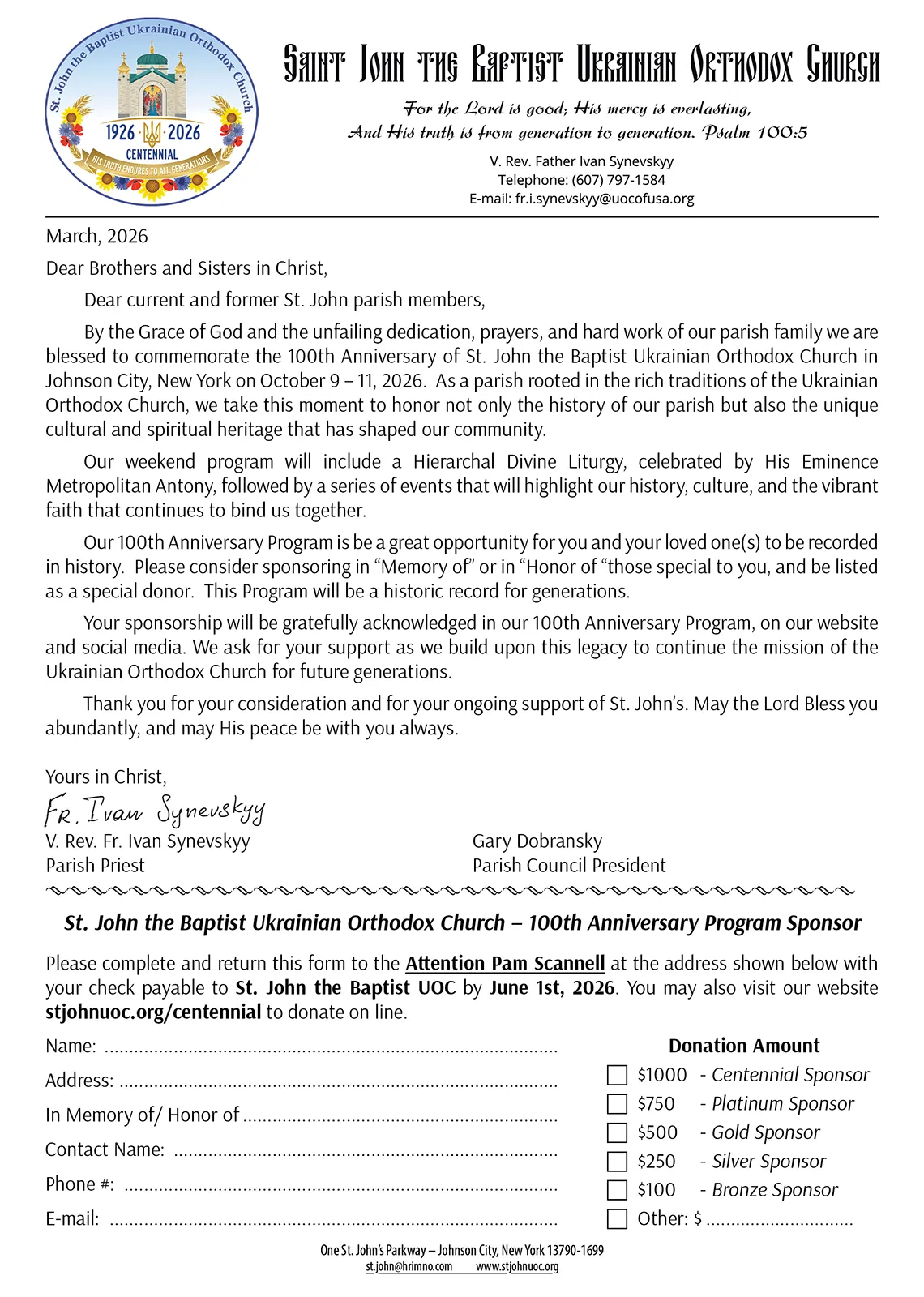
Special Parish Body Meeting - May 31
Sunday, May 31st, Parish Body Meeting after Divine Liturgy to vote on Memorial Center Hall and Kitchen air conditioning, church roof project.
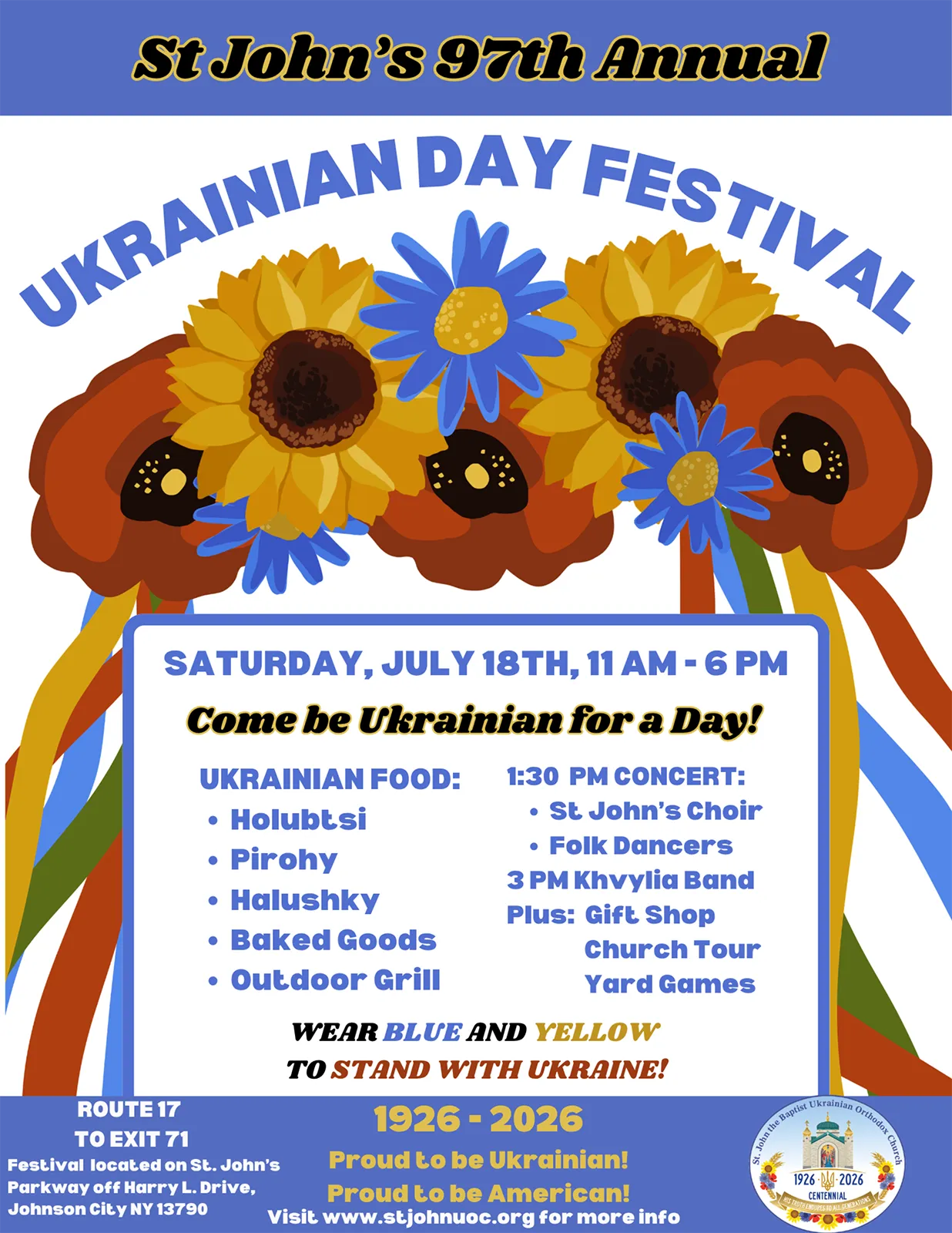
Ukrainian Day Festival - July 18, 2026 - Український Фестиваль - 18 липня
Late Spring 2026 Kitchen Sessions
Preparing for Ukrainian Day · May – July 2026
Holubtsi Session — Round 2
8–10 BatchesUkrainian Day Week
July 14–18Let's Help Ukraine!
St. John's Ukrainian Humanitarian Fund is accepting donations to help Ukrainians during war. Donations will go to provide food and other humanitarian needs.
To make donation online click here
We accept checks as well.
Please make the checks to St. John Ukrainian Humanitarian Fund
Mailing address:
1 Saint John's Parkway
Johnson City NY 13790
Cash is accepted in church
Pray for Ukraine!
Prayers for Ukraine are done during each service. To see the schedule click here.
Молитви за Україну проводяться під час кожної служби. За розкладом дивіться тут.
May God bless and protect Ukraine!
Happy Birthday
- June 2: Laurel Presti
- June 4: Hrisanthi Dimitriou
- June 5: Tracy Gooley
- June 6: Meghan Lepkowski
* If your or someone else's birthday is missing or incorrect please let Fr. Ivan know right away.
Please Pray for the Servants of God
Daniel, John, Peter John, Rose,
Solomiia, Bob, John, Jane, Alla,
Fr. Andre, Mary, Zenna, Douglas,
Ivan, Melanie, William, Marion,
Mariann, Robert, Jean, Ronald, Brian,
Fr. James, Scott, Andriy, James, William,
Vasyl, Olha
Upcoming Readings
| Mon. June 1 – | Eph. 5:8-19; | Mt. 18:10-20; |
| Tue. June 2 – | Rom. 1:1-7, 13-17 ; | Mt. 4:25–5:13; |
| Wed. June 3 – | Rom. 1:18-27; | Mt. 5:20-26; |
| Thu. June 4 – | Rom. 1:28–2:9 ; | Mt. 5:27-32; |
| Fri. June 5 – | Rom. 2:14-29 ; | Mt. 5:33-41; |
| Sat. June 6 – | Rom. 1:7-12; | Mt. 5:42-48 ; |