Bulletin for May 24, 2026
May 24 – Seventh Sunday of Pascha. Tone 6
Afterfeast of the Ascension. Sunday of the Holy Fathers of the First Ecumenical Council. Hieromartyr Mocius (Mucius) (295). Holy Equals-to-the-Apostles Methodius (885) and Cyril (869), first teachers of the Slavs. Ven. Sophronius, recluse of the Kyiv Caves (13th c.).
Acts 20:16-18, 28-36; Jn. 17:1-13 ;
Heb. 7:26–8:2 ; Mt. 5:14-19;
May 31 – PENTECOST – TRINITY SUNDAY
ДЕНЬ СВЯТОЇ ТРОЙЦІ. П'ЯТИДЕСЯТНИЦЯ.
Martyr Theodotus of Ancyra and seven virgin-martyrs: Alexandra, Tecusa, Claudia, Phaine, Euphraisa, Matrona, and Julia (303). Martyrs Peter, Dionysius, Andrew, Paul, Christina (250).
Acts 2:1-11; Jn. 7:37-52, 8:12;
Services & Other Events
24 May, Sunday - Неділя:
- 9am – Confession / Hours
- 9:30am – Divine Liturgy - Бож. Літургія
- Memorial Service for Veterans (on the cemetery if not raining)
26 May, Tuesday:
- 7pm – Building & Maintenance Meeting
30 May, Pentecost Soul Saturday - Заупокійна Субота:
- 4:15pm – General Memorial Service
- 5pm – Great Vespers - Вел. Вечірня
31 May, Pentecost Sunday - Неділя П'ятидесятниці:
- 9am – Confession / Hours
- 9:30am – Divine Liturgy - Бож. Літургія
1 June, Holy Spirit Day - День Святого Духа:
- 9:00am – Divine Liturgy - Бож. Літургія
2 June, Tuesday:
- 6:30pm – Centennial Committee Meeting
Апостол і Євангеліє - Gospel and Epistle of the Day
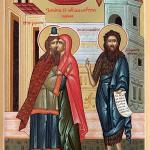
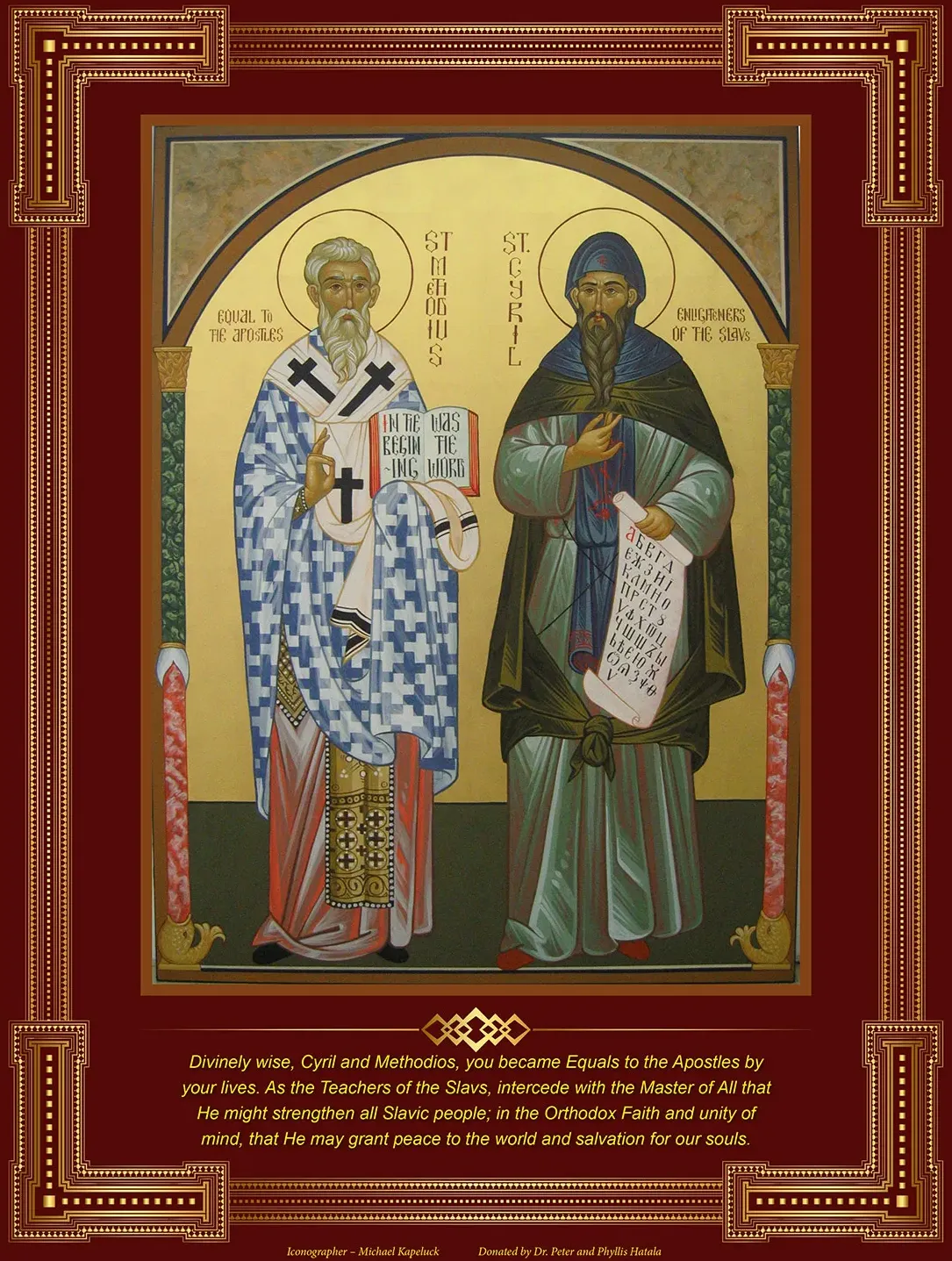
Holy Equals-to-the-Apostles Cyril and Methodius
First Teachers and Enlighteners of the Slavs
Saint Cyril († 869) · Saint Methodius († 885)
Among the saints most beloved by the Slavic peoples are the holy brothers Cyril and Methodius, honored by the Orthodox Church as "Equals-to-the-Apostles" for their labors in bringing the light of the Gospel to the Slavs in their own tongue. Their feast is celebrated together on May 11 (May 24 on the civil calendar), with their separate commemorations falling on February 14 for Saint Cyril and April 6 for Saint Methodius.
Origins and Early Life
The brothers were born in the city of Thessalonica (Solun) in Macedonia, a region where many Slavs dwelt, so that from childhood they were familiar with the Slavic language. Their father, named Leo, was a high-ranking military officer of the Byzantine Empire, and the family raised seven sons in piety. Methodius, the eldest, was the firstborn, while Constantine — who took the name Cyril upon receiving the monastic schema near the end of his life — was the youngest.
Methodius first followed a military and administrative career, governing a Slavic principality for about ten years. He later withdrew from worldly affairs and became a monk at a monastery on Mount Olympus in Asia Minor. Constantine, by contrast, distinguished himself early by his remarkable gifts of mind. He studied in Constantinople under the finest teachers of the age, mastering the learning of his time so thoroughly that he was given the name "the Philosopher." He was ordained and served as librarian at the great church of Hagia Sophia, and afterward taught philosophy in the capital.
Early Missionary Labors
Constantine was sent by the Church on missions of faith, including to the Saracens and later to the Khazars, where he disputed in defense of the Christian faith. On the way to the Khazars he visited Cherson, where, according to tradition, he discovered the relics of the holy Hieromartyr Clement, Pope of Rome. Throughout these journeys his brother Methodius accompanied and assisted him, and the two became inseparable in their service to the Church.
The Mission to Moravia and the Slavic Letters
Around the year 862, envoys came to Constantinople from Prince Rostislav of Great Moravia, asking for teachers who could instruct his people in the Christian faith in a language they could understand. The Emperor and the Patriarch chose the brothers for this work. Before setting out, Saint Cyril devoted himself to prayer and fasting and, with God's help, composed an alphabet for the Slavic language. With this new alphabet the brothers began to translate the Holy Scriptures and the books needed for divine services from Greek into Slavonic.
In Moravia the brothers preached, taught disciples, and celebrated the services of the Church in the Slavic tongue. This was a labor of immense significance: for the first time the Slavic peoples could hear the Word of God and pray in their own language. Their work, however, met with strong opposition from those who held that worship was permissible only in Hebrew, Greek, and Latin — the so-called "trilingual heresy."
In Rome and the Repose of Saint Cyril
To answer these objections, the brothers traveled to Rome, bringing with them the relics of Saint Clement. There the Slavic books and the celebration of services in the Slavic language received approval, and the brothers were honored. While in Rome, Constantine fell gravely ill. Foreseeing his death, he received the monastic schema and the name Cyril, and reposed in peace on February 14, 869, at the age of forty-two. Before his death he exhorted his brother to continue their common task, charging him not to abandon the work of enlightening the Slavs. Saint Cyril was buried in the Church of Saint Clement in Rome.
The Continued Labors and Repose of Saint Methodius
Faithful to his brother's charge, Methodius returned to the Slavic lands and was consecrated Archbishop of Moravia and Pannonia. He continued to labor amid great difficulties, suffering slander, imprisonment, and persecution from those who opposed Slavic worship, yet he endured all with patience. In his final years, with the help of disciples, he completed the translation into Slavonic of nearly all the books of the Holy Scriptures, along with a collection of Church laws and other writings.
Saint Methodius reposed on April 6, 885. His disciples carried the work of the holy brothers onward, spreading Slavic letters and the Christian faith among the Bulgarians, Serbs, and other Slavic peoples, and in time among the people of Rus'.
Their Legacy
The Orthodox Church venerates Saints Cyril and Methodius as Equals-to-the-Apostles because, like the apostles of old, they brought entire nations to the knowledge of Christ. Through their gift of the Slavic alphabet and the translation of the sacred books, they laid the foundation of Slavic Christian literature and worship. The peoples who received the faith through their labors have never forgotten them, honoring them as their first teachers and the fathers of their written language and faith.
Holy Equals-to-the-Apostles Cyril and Methodius, pray to God for us!
Святі рівноапостольні Кирило і Мефодій
Першовчителі та просвітителі слов'ян
Святий Кирило († 869) · Святий Мефодій († 885)
Серед святих, найбільш шанованих слов'янськими народами, — святі брати Кирило і Мефодій, яких Православна Церква вшановує як «рівноапостольних» за їхню працю з просвітлення слов'ян світлом Євангелія їхньою рідною мовою. Спільна пам'ять святих братів святкується 11 травня (24 травня за цивільним календарем); окремо ж святого Кирила вшановують 14 лютого, а святого Мефодія — 6 квітня.
Походження та ранні роки
Брати народилися у місті Солунь (Фессалоніки) в Македонії — краї, де мешкало багато слов'ян, тож від дитинства вони добре знали слов'янську мову. Їхній батько, на ім'я Лев, був високопосадовим військовим офіцером Візантійської імперії; родина виховала сімох синів у благочесті. Мефодій був найстаршим, а Константин — який прийняв ім'я Кирило, приймаючи схиму наприкінці життя, — був наймолодшим.
Мефодій спочатку обрав військову та адміністративну службу і близько десяти років управляв слов'янським князівством. Згодом він залишив світські справи та став ченцем у монастирі на горі Олімп у Малій Азії. Константин же зрання вирізнявся незвичайними розумовими здібностями. Він навчався у Константинополі у найкращих учителів свого часу і так досконало оволодів науками, що дістав прізвисько «Філософ». Його було висвячено, і він служив бібліотекарем при храмі Святої Софії, а потім викладав філософію у столиці.
Перші місіонерські праці
Церква посилала Константина з місіями віри — до сарацинів, а потім до хозар, де він вів суперечки на захист християнської віри. По дорозі до хозар він побував у Херсоні, де, за переказом, знайшов мощі святого священномученика Климента, папи Римського. Під час усіх цих подорожей брат Мефодій супроводжував і допомагав йому, і двоє братів стали нерозлучними у служінні Церкві.
Місія до Моравії та слов'янська абетка
Близько 862 року до Константинополя прибули посли від моравського князя Ростислава з проханням прислати вчителів, які навчили б його народ християнської віри зрозумілою для нього мовою. Імператор і Патріарх обрали для цієї справи святих братів. Перед вирушенням святий Кирило віддався молитві та посту і з Божою допомогою уклав абетку для слов'янської мови. З цією новою абеткою брати почали перекладати Святе Письмо та богослужбові книги з грецької мови на слов'янську.
У Моравії брати проповідували, навчали учнів і здійснювали богослужіння слов'янською мовою. Це була праця величезного значення: уперше слов'янські народи могли чути Слово Боже та молитися рідною мовою. Проте їхня праця наразилася на сильний опір тих, хто вважав, що богослужіння допустиме лише єврейською, грецькою та латинською мовами — так звана «тримовна єресь».
У Римі та упокоєння святого Кирила
Щоб відповісти на ці закиди, брати вирушили до Риму, взявши з собою мощі святого Климента. Там слов'янські книги та богослужіння слов'янською мовою були схвалені, а братів ушановано. Перебуваючи в Римі, Константин тяжко занедужав. Передбачивши свою смерть, він прийняв схиму та ім'я Кирило і мирно впокоївся 14 лютого 869 року у віці сорока двох років. Перед смертю він закликав брата продовжити спільну справу та не покидати просвітлення слов'ян. Святого Кирила поховали в храмі святого Климента в Римі.
Подальші праці та упокоєння святого Мефодія
Вірний заповіту брата, Мефодій повернувся до слов'янських земель і був висвячений на архієпископа Моравії та Паннонії. Він продовжував працювати серед великих труднощів, зазнаючи наклепів, ув'язнення та переслідувань від тих, хто противився слов'янському богослужінню, проте все терпеляче зносив. У останні роки за допомогою учнів він завершив переклад на слов'янську мову майже всіх книг Святого Письма, а також збірки церковних законів та інших писань.
Святий Мефодій упокоївся 6 квітня 885 року. Його учні продовжили справу святих братів, поширюючи слов'янську писемність та християнську віру серед болгар, сербів та інших слов'янських народів, а з часом і серед народу Русі.
Їхня спадщина
Православна Церква вшановує святих Кирила і Мефодія як рівноапостольних, бо, як і апостоли давнини, вони привели цілі народи до пізнання Христа. Дарувавши слов'янам абетку та переклавши священні книги, вони заклали основу слов'янської християнської писемності та богослужіння. Народи, які прийняли віру завдяки їхній праці, ніколи про них не забували, вшановуючи їх як своїх першовчителів і батьків рідної писемності та віри.
Святі рівноапостольні Кирило і Мефодію, моліть Бога про нас!
We Go to Where We Belong
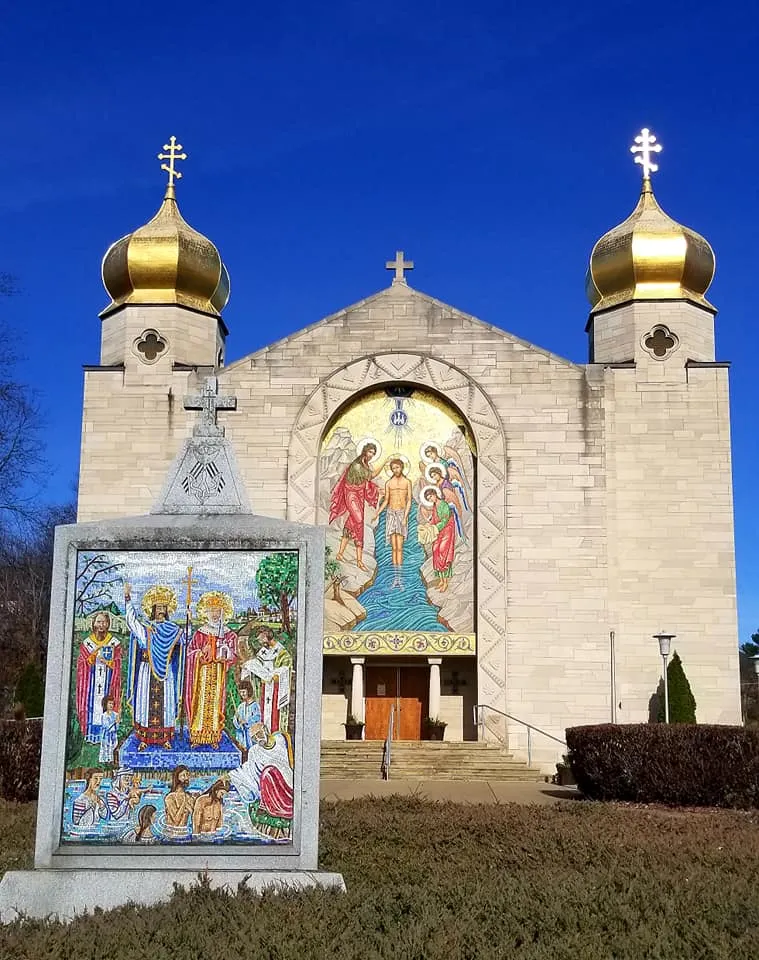
Each Sunday, as God's people, we gather around the One who loves us. Each Sunday, we come to Him to whom we belong. We gather in the place where we belong: in church under His presence. If we do not come to church, we are acknowledging that we do not belong to Him. We may belong to money, to golf, to fishing, to hunting, to football, to TV. We may belong to the world, but not to God. We come to church each Sunday to acknowledge whose we are and where we belong. Just as at the end of each day we go to where we belong-home—so on the Lord's day we go to where we belong—church. We gather to worship and bend the knee and the heart to the Pantocrator Christ.
This is why Jesus said that at the Resurrection there will be a separation of the lambs from the goats, i.e., people will gravitate to where they have always belonged, either toward the presence of God or away from the presence of God, either toward heaven or hell.
From Daily Vitamins by Anthony M. Coniaris
WHY WE CELEBRATE MEMORIAL DAY

Memorial Day is the American holiday set aside to honor and mourn the military personnel who died while serving in the United States Armed Forces. It's observed on the last Monday of May each year, which this year falls on May 25th.
The holiday has its roots in the aftermath of the Civil War, which left an enormous number of dead on both sides and created a need for places to bury and honor them. In the years following the war, communities across the country began holding springtime tributes to fallen soldiers, decorating their graves with flowers and reciting prayers. Because of this practice, the day was originally known as "Decoration Day."
A man named General John A. Logan, leader of an organization of Union veterans, is often credited with formalizing the observance. In 1868 he called for a nationwide day of remembrance to be held on May 30th, a date chosen partly because it didn't fall on the anniversary of any particular battle. Over time, especially after World War I, the holiday expanded from honoring just Civil War dead to commemorating Americans who died in all wars.
The name gradually shifted from Decoration Day to Memorial Day, and in 1971 Memorial Day was declared a national holiday for the United States of America by an Act of Congress. This annual American Holiday was established to be celebrated on the last Monday of the month of May.
Memorial Day is a day of remembering the military men and women who died while serving our nation.
On Memorial Day, the American Flag is traditionally raised in the morning to the top of the staff and then lowered to the half-staff position where it remains until 12:00 Noon. It is then raised to the full-staff for the remainder of the day. The half-staff position is a tribute and remembers the more than 1 Million men and women who died to preserve our freedoms we have today in the United States of America. At 12:00 Noon, their memory is raised by the living, who resolve not to let their sacrifices be in vain but to continue the flight for liberty and justice for all.
It's worth noting that Memorial Day is distinct from Veterans Day. Memorial Day specifically honors those who died in service, while Veterans Day (in November) honors all who have served in the military, living and deceased. Common traditions include visiting cemeteries and memorials, flying the flag at half-staff until noon, and a National Moment of Remembrance at 3 p.m. local time.
We honor those who died in any war while serving with the United States.
In our parish alone, we have a number of veterans who have served and protected our country during World War 1 & 2 and other wars or tribulation times. Therefore, join us at our parish cemetery (if raining - in the church) following Divine Liturgy for Memorial Service for the departed Veterans.
UAV Swearing In Ceremony
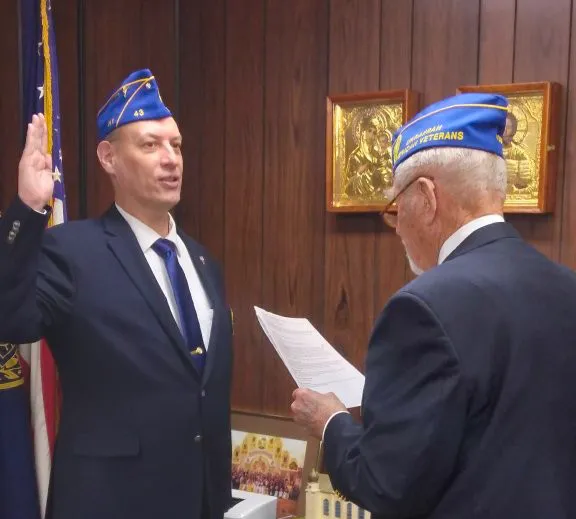
James Glass taking the office of his promotion as Vice Commander of our local UAV Post 43, Johnson City, NY
Sacred Sites Open House 2026
Last Sunday, St. John's participated in the annual New York State Landmarks Conservancy and the Preservation Association of the Southern Tier's Sacred Sites Program for the twelfth consecutive year. We extend our sincere thanks to Fr. Ivan for his support, our greeters and guides including Pani Linda Oryhon, Stamatia Dimitriou, Sophia Synevskyy, and Hunter Harenza, and our program coordinator Carol Wasylko. Through our participation in this program, we aim to share the history of our Holy Ukrainian Orthodox Church, the workings of our parish in Johnson City, and shine a light on the current plight of our ancestral homeland, Ukraine, for our neighbors and friends.
Our Condolences
We extend our sincere condolences to the family and friends of Helen Kaspryk, who reposed in the Lord on the 18th of May, in the year of our Lord 2026, at the age of 96 years.
Вічна пам'ять! † VYCHNA PAMYAT! † MEMORY ETERNAL!
Special Parish Body Meeting - May 31
Sunday, May 31st, Parish Body Meeting after Divine Liturgy to vote on Memorial Center Hall and Kitchen air conditioning.
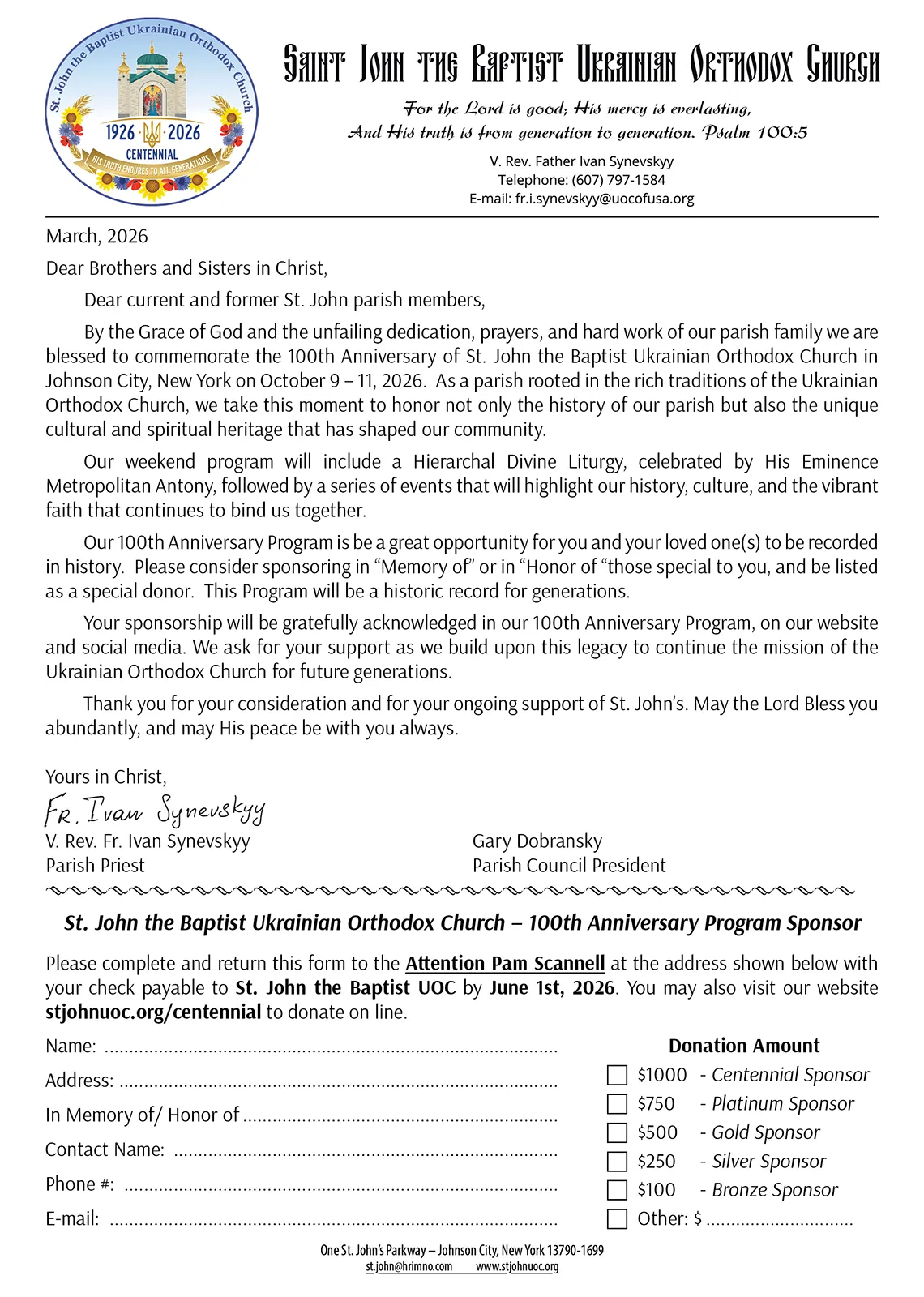
Late Spring 2026 Kitchen Sessions
Preparing for Ukrainian Day · May – July 2026
Holubtsi Session — Round 1
10 BatchesHolubtsi Session — Round 2
8–10 BatchesUkrainian Day Week
July 14–18
Let's Help Ukraine!
St. John's Ukrainian Humanitarian Fund is accepting donations to help Ukrainians during war. Donations will go to provide food and other humanitarian needs.
To make donation online click here
We accept checks as well.
Please make the checks to St. John Ukrainian Humanitarian Fund
Mailing address:
1 Saint John's Parkway
Johnson City NY 13790
Cash is accepted in church
Pray for Ukraine!
Prayers for Ukraine are done during each service. To see the schedule click here.
Молитви за Україну проводяться під час кожної служби. За розкладом дивіться тут.
May God bless and protect Ukraine!
Happy Birthday
- May 25: Patricia Wasyliw
- May 25: Maxwell Hatala
- May 29: Yuliia Vozniuk
- May 30: Ava Cardarelli
* If your or someone else's birthday is missing or incorrect please let Fr. Ivan know right away.
Please Pray for the Servants of God
Daniel, John, Peter John, Rose,
Solomiia, Bob, John, Jane, Alla,
Fr. Andre, Mary, Zenna, Douglas,
Ivan, Melanie, William, Marion,
Mariann, Robert, Jean, Ronald, Brian,
Fr. James, Scott, Andriy, James, William,
Vasyl, Olha
Upcoming Readings
| Mon. May 25 – | Acts 21:8-14; | Jn. 14:27–15:7; |
| Tue. May 26 – | Acts 21:26-32 ; | Jn. 16:2-13; |
| Wed. May 27 – | Acts 23:1-11; | Jn. 16:15-23; |
| Thu. May 28 – | Acts 25:13-19; | Jn. 16:23-33; |
| Fri. May 29 – | Acts 27:1-44 ; | Jn. 17:18-26 |
| Sat. May 30 – | Acts 28:1-31 ; | Jn. 21:15-25 ; |