Bulletin for August 30, 2026
Aug. 30 – 13th Sunday after Pentecost. Tone 4
Afterfeast of the Dormition. Martyr Myron of Cyzicus (250). Martyrs Thyrsus, Leucius, and Coronatus, with others at Caesarea in Bithynia (250). Martyrs Paul and his sister Juliana of Syria (273). Martyr Patroclus of Troyes (3rd c.). Martyrs Straton, Philip, Eutychian, and Cyprian of Nicomedia (303). Ven. Alypius the Iconographer of the Kyiv Caves (1114).
1 Cor. 16:13-24; Mt. 21:33-42
Sep. 6 – 14th Sunday after Pentecost. Tone 5
Hieromartyr Eutychius (1st c.), disciple of St. John the Theologian. Martyr Tation 305). Virgin-martyr Cyra of Persia (558). Ven. George Limniotes the Confessor of Mt. Olympus (716).
2 Cor. 1:21–2:4; Mt. 22:1-14 ;
Services & Other Events
30 August, Sunday - Неділя:
- 9am – Confession / Hours
- 9:30am – Divine Liturgy - Бож. Літургія
- 40th Day Memorial Service for John Klodowski
5 September, Saturday - Субота:
- 5pm – Great Vespers - Вел. Вечірня
6 September, Sunday - Неділя:
- 9am – Confession / Hours
- 9:30am – Divine Liturgy - Бож. Літургія
- One-year Memorial Service for Phyllis Hatala
15 September, Tuesday:
- 6:30pm – Building and Maintenance & Church Restoration meeting
Апостол і Євангеліє - Gospel and Epistle of the Day
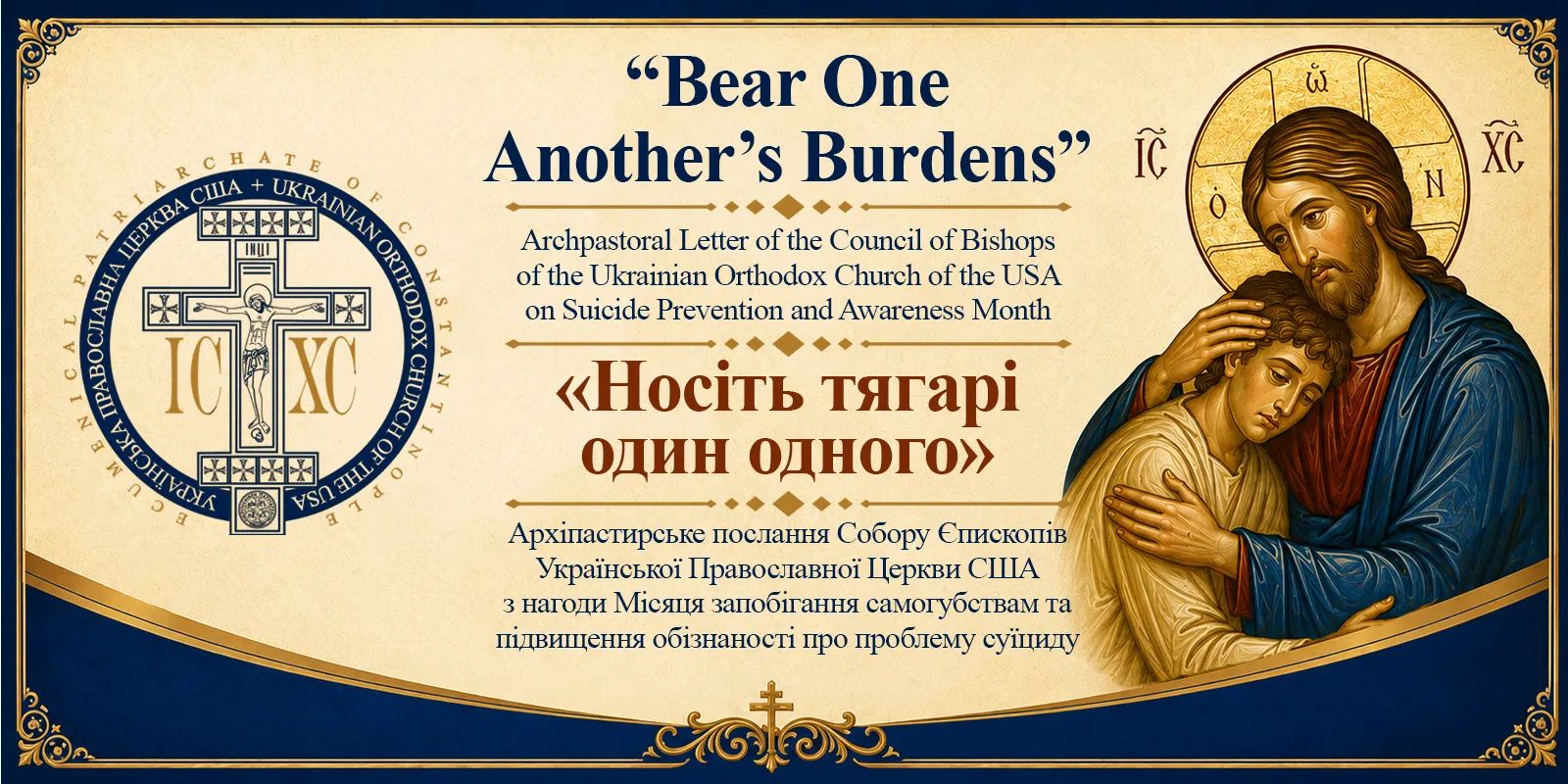
"Bear One Another's Burdens"
Archpastoral Letter of the Council of Bishops of the Ukrainian Orthodox Church of the USA on Suicide Prevention and Awareness Month
To the Reverend Clergy, Monastics, and Faithful of the Ukrainian Orthodox Church of the USA:
Beloved Brothers and Sisters in Christ: Christ is among us!
As we enter the month of September, observed throughout our nation as Suicide Prevention and Awareness Month, we address you as your archpastors and spiritual fathers with a profound sense of pastoral responsibility, Christian compassion, and abiding hope in the life-giving mercy of our Lord and Savior Jesus Christ.
The human person encounters many forms of suffering during the course of earthly life. Some wounds are visible and readily recognized; others remain concealed within the depths of the human heart. Illness may afflict the body, the mind, the emotions, or the spirit. At times, loneliness becomes overwhelming, grief appears unbearable, fear obscures the future, and despair so burdens the human person that he or she may no longer perceive a path forward.
Into such darkness, the Church proclaims the words of our Lord: "I have come that they may have life, and that they may have it more abundantly." (John 10:10)
The Orthodox Christian understanding of human existence begins with the unwavering affirmation that human life is sacred because it is the gift of God. We are not the authors of our own existence. We receive life from our Creator as both a blessing and a sacred stewardship. Every human person is created according to the image and likeness of God, and Saint Paul reminds us that our bodies are called to be "the temple of the Holy Spirit" (1 Corinthians 6:19).
For this reason, the Church has always proclaimed and defended the sanctity of human life. Yet this proclamation cannot be limited merely to the condemnation of actions that bring life to an end. To affirm the sacredness of life also requires us to accompany, protect, encourage, and care for those for whom the burden of continuing life has become extraordinarily difficult.
Orthodox Christian anthropology does not regard the body and soul as unrelated dimensions of human existence. The human person is a psychosomatic unity - a living communion of body and soul called to sanctification and transfiguration in Christ. Consequently, physical illness may affect our emotional and spiritual life, just as psychological trauma, prolonged grief, depression, anxiety, exhaustion, addiction, isolation, and other forms of suffering may affect the body, the mind, relationships, prayer, and even a person's capacity to perceive hope.
Our pastoral tradition therefore calls us to approach those who suffer not first with judgment, but with compassion, discernment, patience, and presence.
The Church is not a community of those who have escaped woundedness. Rather, she is the sacred place in which wounded humanity encounters Christ, the Divine Physician of our souls and bodies.
Through her sacramental and ascetical life, the Church offers the faithful the means of spiritual healing and strengthening: prayer, Holy Confession, participation in the Holy Eucharist, fasting, the reading of Holy Scripture, spiritual direction, repentance, works of mercy, Christian fellowship, and the sustaining life of the parish community.
At the same time, recourse to appropriate medical, psychological, or psychiatric care must never be interpreted as evidence of insufficient faith. The knowledge and skill of physicians, psychologists, psychiatrists, counselors, social workers, and other properly trained professionals may serve as instruments through which God's providential care is manifested. The spiritual ministry of the Church and responsible professional care should not be placed in opposition to one another; rather, when appropriately integrated, they may contribute to the healing and restoration of the whole human person.
Suicide is a painful and tragic reality that touches individuals, families, parishes, schools, workplaces, and entire communities. Its consequences extend far beyond the person who dies, leaving parents, spouses, children, siblings, friends, clergy, and parish communities to confront profound grief and questions that may remain unanswered in this earthly life.
For this reason, the Apostle Paul commands us: "Bear one another's burdens, and so fulfill the law of Christ." (Galatians 6:2)
To bear the burden of another requires, first of all, that we become attentive to one another.
As Orthodox Christians, we must cultivate a spirit of vigilance - not a vigilance characterized by suspicion, but one born of love. We must become attentive to significant changes in the behavior and disposition of those around us: expressions of hopelessness or worthlessness; statements concerning death or the desire not to live; withdrawal from family, friends, parish life, or ordinary activities; dramatic changes in sleep, behavior, or mood; increased substance use; reckless behavior; agitation; or expressions of unbearable emotional pain.
Such signs must never become occasions for gossip, condemnation, or labeling. They must become occasions for compassionate attention and responsible action.
When we perceive that someone is struggling, we must have the courage to approach that person with humility and care. We must listen patiently, without immediately attempting to explain away the suffering or offer simplistic answers. We must encourage those in distress to speak with their priest, family members, physicians, counselors, or other qualified professionals. When there is reason to believe that a person is in immediate danger of self-harm, the situation must be treated with the seriousness of an emergency, and appropriate professional assistance must be sought without delay.
There are moments when Christian love is expressed most powerfully not through many words, but through the simple assurance: "You do not have to carry this burden alone. We will remain with you and seek help together."
+++++
We address with particular pastoral love those among our faithful who may presently be experiencing profound despair, thoughts of self-harm, or the temptation to end their earthly life.
The suffering that you experience is real, and the Church does not dismiss or minimize it. Yet no moment of darkness, however overwhelming it may appear, possesses the authority to determine the ultimate meaning or value of your life.
If you cannot presently perceive a way forward, permit another person to walk beside you until the path becomes visible again.
Speak with your priest. Speak with a trusted family member or friend. Seek appropriate medical or mental-health assistance. If you believe that you may harm yourself, tell someone immediately and do not remain alone.
To seek assistance is not a sign of spiritual failure. It is an act of courage and an affirmation of the sacred gift of life entrusted to you by God.
You are created according to His image. You are a member of the Body of Christ. Your life possesses a dignity that suffering cannot erase. Even when your heart cannot perceive His presence, Christ remains near.
As the Psalmist declares: "The Lord is near to the brokenhearted, and saves the crushed in spirit." (Psalm 33/34:18)
+++++
During the month of September, we call upon every parish of the Ukrainian Orthodox Church of the USA and all our faithful to give intentional pastoral attention to suicide prevention, mental-health awareness, and the Christian responsibility to care for those experiencing profound emotional and spiritual suffering. Our entire issue of the Ukrainian Orthodox Word is dedicated to Suicide Prevention. Please be sure to read this asset on the Church's website: www.uocofusa.org
We encourage our clergy, parish councils, church schools, youth ministries, sisterhoods, brotherhoods, and other parish organizations to provide appropriate opportunities for prayer, reflection, education, and conversation concerning mental and emotional well-being.
Particular attention should be given to educating our faithful regarding recognized warning signs of suicide and the importance of timely intervention. Trustworthy resources should be made available concerning professional mental-health care and crisis assistance. Age-appropriate educational opportunities should be offered for parents, teenagers and young adults, seniors, veterans, caregivers, and others who may experience particular forms of grief, isolation, trauma, or distress.
We especially ask our clergy and parish leaders to examine the pastoral culture of our communities.
Are our parishes places where a person experiencing depression, anxiety, addiction, grief, marital difficulty, financial distress, loneliness, or psychological illness can seek assistance without fear of condemnation?
Do our children and young people know that the adults of the Church will listen to them seriously and compassionately?
Do our elderly and homebound faithful know that they remain integral members of the Body of Christ and have not been forgotten?
Do those who grieve know that there is a place for their sorrow within the life of the Church?
And do our clergy themselves recognize that seeking assistance when burdened by the spiritual, emotional, and physical demands of pastoral ministry is not weakness, but responsible stewardship of the life and vocation entrusted to them by God?
The Church must continually cultivate the spiritual attentiveness necessary to perceive suffering that is often concealed behind outward appearances.
With profound compassion, we also remember those whose earthly lives have ended through suicide.
The Church entrusts every human person to the perfect justice, immeasurable mercy, and unfathomable love of God. We must therefore refrain from presuming to know completely the interior condition of another person during the final moments of earthly life. The spiritual, psychological, emotional, and physiological circumstances surrounding such a death may be extraordinarily complex and are ultimately known in their fullness to God alone.
At the same time, we turn with particular pastoral concern toward those who remain - the parents who mourn a child, children who have lost a parent, husbands and wives who have lost a spouse, brothers and sisters who have lost a sibling, friends who carry unanswered questions, clergy who mourn members of their spiritual flock, and parish communities wounded by unexpected tragedy.
Grief following suicide may be accompanied by sorrow, anger, confusion, guilt, regret, and profound questions of faith. Those who carry such grief must never be left to bear it in isolation. They require the prayer, patience, compassion, and sustained presence of the Church.
Saint Paul reminds us: "If one member suffers, all suffer together." (1 Corinthians 12:26)
These words describe not merely a theological principle, but the very nature of our ecclesial responsibility toward one another.
Beloved in Christ, we may not possess the ability to remove every burden from another person's shoulders, but we can help to carry it.
We may not have an answer to every painful question, but we can listen.
We may not possess the power to heal every wound, but we can accompany the wounded person toward Christ and toward those whom God has equipped with the knowledge and skill necessary to assist in the work of healing.
We cannot always immediately dispel another person's darkness, but we can refuse to abandon our brother or sister within it.
Let every parish of our Holy Ukrainian Orthodox Church become a community in which the sacredness of human life is proclaimed not only in words, but through compassionate presence and concrete acts of love.
May every person who enters our churches know: Your life is sacred. Your suffering is not invisible. You are a member of the Body of Christ. You need not carry your burden alone. The Church will pray with you, walk beside you, and assist you in seeking the path toward healing and renewed hope.
Prayer for Those Who Struggle and Those Who Mourn
O Lord Jesus Christ, Physician of our souls and bodies, Fountain of life and Giver of every good gift, look with mercy and compassion upon Your servants who struggle beneath the weight of sorrow, loneliness, fear, illness, grief, and despair.
Where darkness has entered the heart, kindle the light of hope. Where loneliness has become unbearable, send faithful companions. Where confusion has clouded the mind, grant clarity and peace. Where fear has taken hold, bestow courage. Where illness afflicts the body or mind, grant healing according to Your holy will and bless those entrusted with the sacred work of medicine, counseling, and compassionate care.
Strengthen, O Lord, those who believe that they can no longer continue their earthly journey. Preserve them from every danger. Place beside them compassionate and discerning people who will recognize their suffering, hear their cry, and accompany them toward safety, healing, and renewed hope. Remind them through the ministry of Your Holy Church that their lives remain precious before You.
Remember also, O merciful Lord, those whose earthly lives have ended amid profound suffering and despair. You alone know the hidden movements of every human heart and the burdens borne in silence. We entrust them to Your perfect judgment and immeasurable mercy. Comfort their parents, spouses, children, relatives, friends, clergy, and communities who continue to bear the wounds of their loss.
Grant unto us, Your servants, wisdom to recognize suffering, courage to approach those who withdraw, patience to listen without judgment, discernment to seek appropriate assistance, and love sufficient to remain beside those whose burdens have become difficult to bear.
Through the intercessions of our Most Holy Lady, the Birth-Giver of God and Ever-Virgin Mary, shelter Your people beneath her protecting veil. Lead those who despair into hope, those who are isolated into communion, those who are wounded toward healing, and all of us from the darkness of this fallen world into the unwaning light of Your Kingdom.
For You are the Resurrection and the Life, and unto You we ascribe glory, together with Your Father without beginning, and Your All-Holy, Good, and Life-Giving Spirit, now and ever and unto the ages of ages. Amen.
With archpastoral love and prayers in Christ,
+ ANTONY
Metropolitan of the Ukrainian Orthodox Church of the USA
+ DANIEL
Archbishop of the Ukrainian Orthodox Church of the USA
Успіння Пресвятої Владичиці нашої Богородиці і Приснодіви Марії
Слово «успіння» можна перекласти як «сон» або «смерть» — так у Церкві називають день смерті Пресвятої Богородиці.
Святе Письмо нічого не говорить нам про життя Пресвятої Богородиці після Воскресіння Христового, тому про Успіння Богородиці ми знаємо із двох латинських трактатів V століття й із послання Псевдо-Діонісія Ареопагіта. Церква вірує, що ці джерела зберігають основу того Передання, яке жило в ранній Церкві.
Згідно з Переданням Церкви, Матір Божа перед Своїм Успінням жила в Єрусалимі, проповідуючи Господа нарівні з апостолами. Одного разу під час молитви Діва Марія побачила Архангела Гавриїла, який колись сповістив Їй велику радість, що Їй судилося стати Матір'ю Спасителя світу. Цього разу Архангел повідомив, що через три дні Вона відійде до Христа.
Три дні потому в будинку апостола Іоанна, де жила Марія, зібралися й інші апостоли, які проповідували Євангеліє в різних країнах. Дивовижним чином вони були перенесені до Єрусалима, щоб попрощатися з Дівою Марією. Не було тільки Фоми, який прийшов до Єрусалима лише на третій день після поховання.
Апостоли стали свідками блаженної кончини Святої Діви. Сам Христос, оточений безліччю ангелів, з'явився, аби прийняти душу Своєї Пречистої Матері і взяти Її до раю.
Тіло Богородиці апостоли поховали в Гефсиманії, де знаходився Гроб Господній і де поховані були батьки Діви Марії та Її наречений чоловік, праведний Іосиф. Супроводжуючи гроб, апостоли й інші жителі Єрусалима несли світильники і співали псалми.
Іудейський священник Афоній, якого дратувало шанування Іісусової Матері, штовхнув гроб, бажаючи перевернути його, — і тут же був позбавлений кистей обох рук. Їх відсік ангел, який невидимо стояв поруч. «Тепер ти бачиш, що Христос є істинний Бог», — сказав Афонієві апостол Петро. Той одразу покаявся — і руки зрослися.
На третій день до гробниці Божої Матері прибув апостол Фома. Вхід в печеру відкрили, але тіла Богоматері там не було: лежали тільки Її поховальні пелени.
Того ж дня, зібравшись на спільну трапезу, апостоли почули спів ангелів. Подивившись вгору, вони побачили Пресвяту Діву, Яка, оточена ангелами, йшла по повітрю в сяйві небесного світла. Вона звернулася до них зі словами: «Радійте! Тепер Я завжди з вами».
За вченням Церкви, Христос підніс Пресвяту Богородицю у плоті у Своє Небесне Царство і поставив вище всіх ангельських сил.
Нагадаємо, що Успіння Пресвятої Богородиці є останнім двунадесятим святом церковного року. Церковне новоліття святкується 14 вересня (1 вересня за старим стилем), тож першим святом року є Різдво Богородиці, а останнім є Її Успіння. Отже, весь рік вибудовується відповідно до подій життя Божої Матері.
Святу Успіння передує двотижневий Успенський піст, який за суворістю можна порівняти з Великим постом.
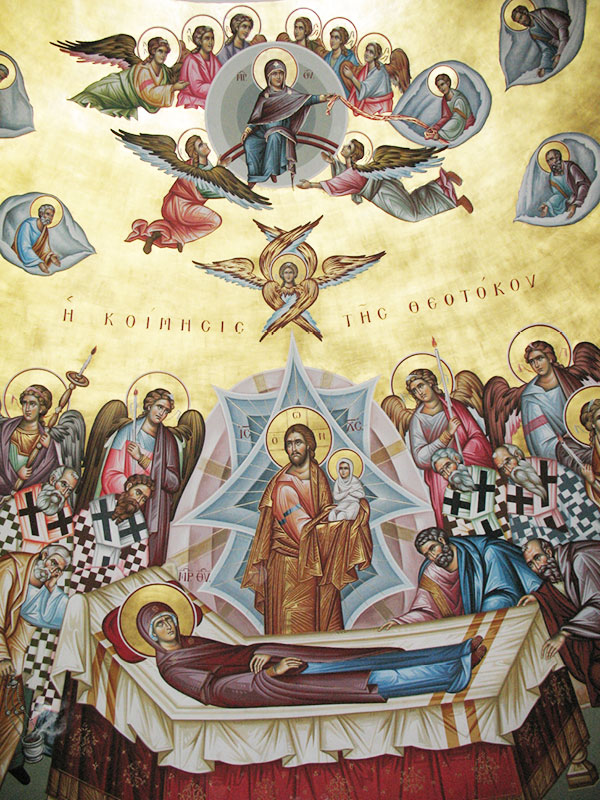
The Dormition of Our Most Holy Lady the Mother of God and Ever-Virgin Mary
The word "Dormition" can be translated as "sleep" or "death" — this is what the Church calls the day of the death of the Most Holy Theotokos - Mother of God.
Holy Scripture tells us nothing about the life of the Most Holy Theotokos after the Resurrection of Christ, so we know about the Dormition of the Theotokos from two Latin treatises of the 5th century and from an epistle of Pseudo-Dionysius the Areopagite. The Church believes that these sources preserve the essence of the Tradition that lived in the early Church.
According to Church Tradition, before Her Dormition the Mother of God lived in Jerusalem, preaching about the Lord alongside the apostles. Once during prayer the Virgin Mary saw the Archangel Gabriel, who had once announced to Her the great joy that She was destined to become the Mother of the Savior of the world. This time the Archangel informed Her that in three days She would depart to Christ.
Three days later, in the house of the Apostle John, where Mary lived, the other apostles gathered as well — those who had been preaching the Gospel in various countries. In a miraculous way they were carried to Jerusalem to bid farewell to the Virgin Mary. Only Thomas was absent; he arrived in Jerusalem only on the third day after the burial.
The apostles became witnesses to the blessed repose of the Holy Virgin. Christ Himself, surrounded by a multitude of angels, appeared in order to receive the soul of His Most Pure Mother and take Her to paradise.
The apostles buried the body of the Theotokos in Gethsemane, where the Lord's Sepulchre was located and where the parents of the Virgin Mary and Her betrothed husband, the righteous Joseph, had been buried. Accompanying the tomb, the apostles and other residents of Jerusalem carried lamps and sang psalms.
A Jewish priest named Athonius, irritated by the veneration of Jesus's Mother, pushed against the coffin, wishing to overturn it — and immediately had both his hands cut off at the wrists. They were severed by an angel who stood invisibly nearby. "Now you see that Christ is the true God," the Apostle Peter said to Athonius. He immediately repented — and his hands were restored.
On the third day, the Apostle Thomas arrived at the tomb of the Mother of God. The entrance to the cave was opened, but the body of the Theotokos was not there: only Her burial wrappings lay there.
That same day, as the apostles gathered for a common meal, they heard the singing of angels. Looking up, they saw the Most Holy Virgin, who, surrounded by angels, was moving through the air in the radiance of heavenly light. She addressed them with the words: "Rejoice! Now I am always with you."
According to the teaching of the Church, Christ raised the Most Holy Theotokos in the flesh into His Heavenly Kingdom and set Her above all the angelic powers.
Let us recall that the Dormition of the Most Holy Theotokos is the last of the twelve great feasts of the church year. The church new year is celebrated on September 14 (September 1 by the old calendar), so the first feast of the year is the Nativity of the Theotokos, and the last is Her Dormition. Thus, the entire year is structured around the events of the life of the Mother of God.
The Feast of the Dormition is preceded by a two-week Dormition Fast, which in strictness can be compared to Great Lent.
Священномученик Мирон Кизицький, пресвітер
Священномученик Мирон був пресвітером в Ахаїї (Греція), жив у III столітті. Пресвітер був лагідним і милостивим до людей, але водночас і мужнім у захисті своїх чад.
Одного разу у свято Різдва Христового він звершував богослужіння. До храму увійшов місцевий правитель Антипатр з воїнами, аби схопити молільників і повести їх на муки. Бачачи це, святий Мирон став палко заступатися за паству, викриваючи правителя в жорстокості.
Святий був підданий катуванню. Його повісили і стругали тіло залізними гребенями. Потім пресвітера кинули в розпечену піч, але Господь зберіг мученика; водночас ті, хто стояв поруч, до ста п'ятдесяти осіб, були обпалені вогнем, що вирвався з печі.
Тоді правитель став примушувати мученика поклонитися ідолам. Отримавши від святого Мирона тверду відмову, Антипатр наказав різати ремені із його шкіри. Святий Мирон узяв один із ременів і кинув його в обличчя мучителю. Розлютившись, Антипатр велів стругати святого Мирона залізом по обдертому тілу. Потім він віддав мученика на поталу звірам, проте звірі його не чіпали. Відчуваючи себе переможеним, Антипатр у безсилій люті наклав на себе руки.
Святого Мирона відвели до міста Кизик, де йому відсікли голову мечем. Він прийняв мученицьку кончину в 250 році.
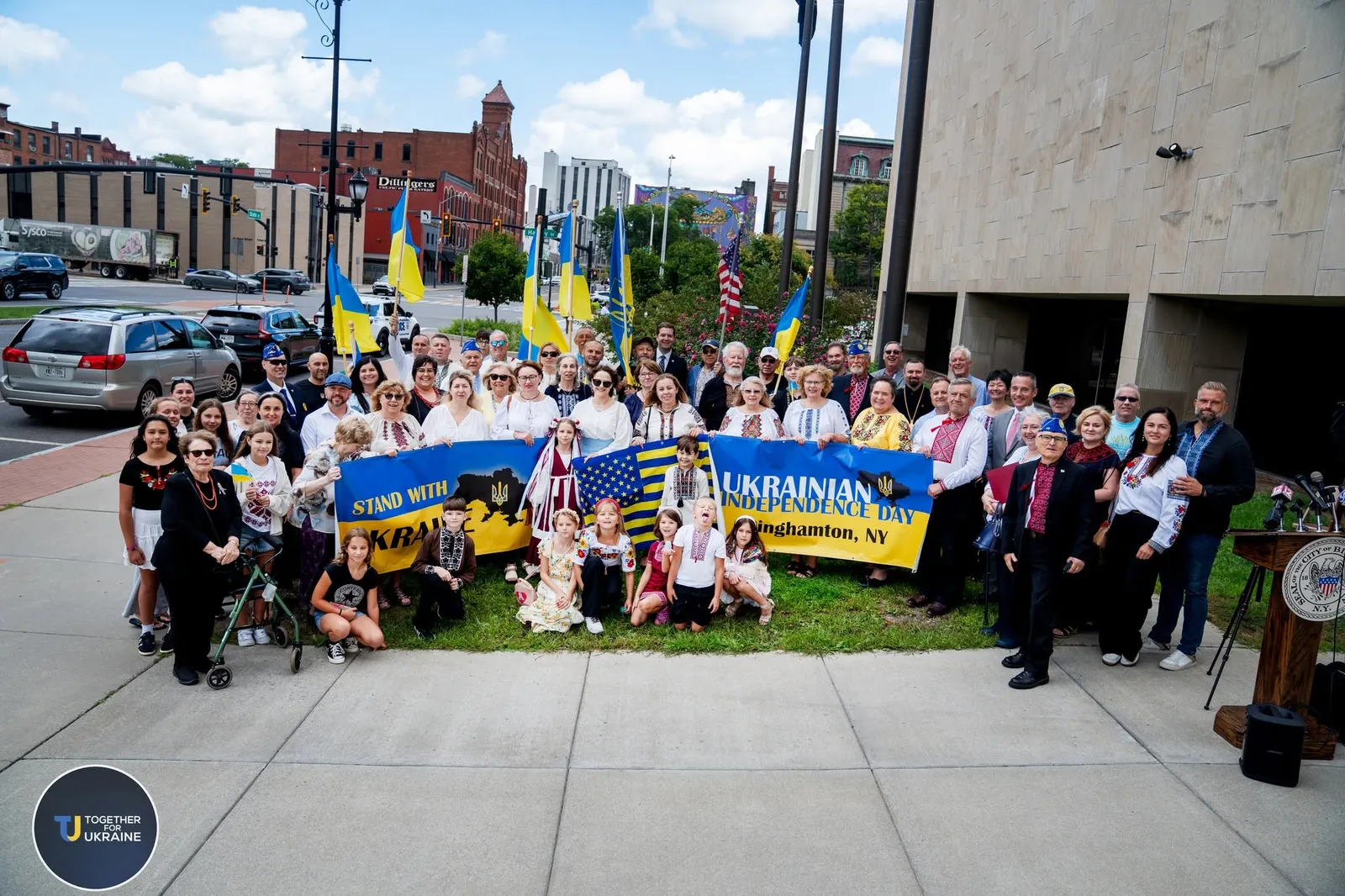
Ukrainian Flag Raising Ceremony –
August 24, 2026
Let's Help Ukraine!
St. John's Ukrainian Humanitarian Fund is accepting donations to help Ukrainians during war. Donations will go to provide food and other humanitarian needs.
To make donation online click here
We accept checks as well.
Please make the checks to St. John Ukrainian Humanitarian Fund
Mailing address:
1 Saint John's Parkway
Johnson City NY 13790
Cash is accepted in church
Pray for Ukraine!
Prayers for Ukraine are done during each service. To see the schedule click here.
Молитви за Україну проводяться під час кожної служби. За розкладом дивіться тут.
May God bless and protect Ukraine!
Happy Birthday
- August 31: John Haluska
* If your or someone else's birthday is missing or incorrect please let Fr. Ivan know right away.
Please Pray for the Servants of God
Metropolitan Antony, Peter John, John, Rose,
Solomiia, Bob, John, Jane, Alla,
Fr. Andre, Mary, Zenna, Douglas,
Ivan, Melanie, William, Marion,
Mariann, Robert, Jean, Ronald, Brian,
Fr. James, Scott, Andriy, James, William,
Olha, Solder Olexiy, Tamara
Upcoming Readings
| Mon. Aug. 31 – | 2 Cor. 12:10-19; | Mk. 4:10-23; |
| Tue. Sep. 1 – | 2 Cor. 12:20–13:2 ; | Mk. 4:24-34; |
| Wed. Sep. 2 – | 2 Cor. 13:3-13; | Mk. 4:35-41 ; |
| Thu. Sep. 3 – | Gal. 1:1-10, 20 – 2:5; | Mk. 5:1-20; |
| Fri. Sep. 4 – | Gal. 2:6-10 ; | Mk. 5:22-24, 35 – 6:1; |
| Sat. Sep. 5 – | 1 Cor. 4:1-5 ; | Mt. 23:1-12 ; |