Bulletin for June 28, 2026
June 28 – 4th Sunday after Pentecost. Tone 3
Prophet Amos (8th c. B.C.). Martyrs Vitus, Modestus, and Crescentia at Lucania (303). Martyr Dulas of Cilicia (305-313). Ven. Dulas the Passion-bearer of Egypt. St. Jerome (Hieronymus) of Stridonium (420). Blessed Augustine, bishop of Hippo (430). St. Michael, first metropolitan of Kyiv (992).
Rom. 6:18-23; Mt. 8:5-13 ;
Heb. 13:17-21; Jn. 10:9-16;
July 5 – 5th Sunday after Pentecost. Tone 4
Hieromartyr Eusebius, bishop of Samosata (380). Martyrs Zeno and his servant Zenas of Philadelphia (304). Martyrs Galacteon, Juliana, and Saturninus of Constantinople.
Rom. 10:1-10; Mt. 8:28–9:1;
Services & Other Events
28 June, Sunday - Неділя:
- 9am – Confession / Hours
- 9:30am – Divine Liturgy - Бож. Літургія
- Special Parish Meeting
- Humanitarian Committee Meeting in Memorial Center
30 June, Tuesday:
- 6:30pm – Centennial Committee Meeting
2 July, Thursday:
- 6:30pm – Building and Maintenance Committee Meeting
4 July, Saturday - Субота:
- 5pm – Great Vespers - Вел. Вечірня
5 July, Sunday - Неділя:
- 9am – Confession / Hours
- 9:30am – Divine Liturgy - Бож. Літургія
6 July, Monday:
- 7pm – Great Vespers - Вел. Вечірня
7 July, Nativity of St. John the Baptist:
- 9am – Divine Liturgy - Бож. Літургія
Апостол і Євангеліє - Gospel and Epistle of the Day
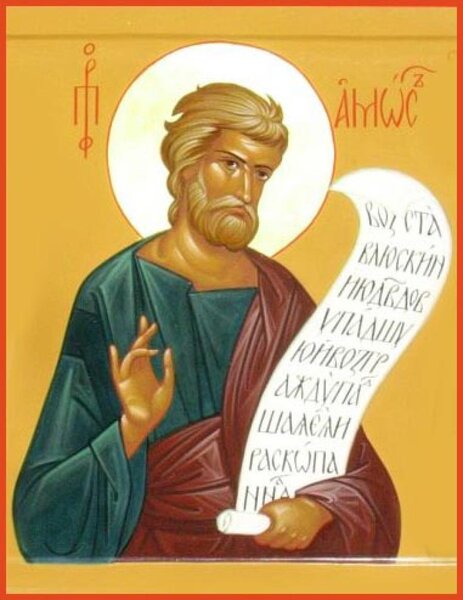
Prophet Amos
The Holy Prophet Amos, the third of the Twelve Minor Prophets,¹ lived during the eighth century before Christ. He was from Judah, born at Tekoa, a village in the Judean hills about six miles south of Bethlehem.² His feast day in the Orthodox Church is celebrated on June 15/28.
Historical Background
At that time the Hebrew nation was divided into two kingdoms: Judah in the south, and Israel in the north. King Uzziah ruled in Jerusalem, while the ten northern tribes were ruled by Jeroboam II, an idolater. At Bethel and Dan stood golden calves before which the people worshipped, turning from the true God — a cult originally set up generations earlier by Jeroboam I (1 Kings 12:28–29) and still flourishing, unchecked, under Jeroboam II.
Jeroboam II's long reign (roughly 786–746 B.C.) was, politically, a golden age for Israel. He recovered territory lost to Syria and presided over a period of peace, military success, and commercial prosperity. But that prosperity was lopsided: landowners and merchants grew wealthy while the poor were exploited, courts were corrupted, and religious observance had become showy ritual disconnected from justice or mercy. It was into this gap between outward success and inward corruption that Amos was sent to speak. Assyria, the power that would eventually destroy the northern kingdom in 722 B.C., was temporarily weakened by internal troubles — a lull that allowed Israel's complacency to grow, even as Amos warned that judgment was coming from that very direction.
Amos himself notes that his prophetic activity took place "two years before the earthquake" (Amos 1:1) — a major tremor remembered for centuries afterward (it is referenced again in Zechariah 14:5). Modern scholars generally place his active ministry around 760–750 B.C., somewhat earlier than the traditional date given for his death below.
Call and Mission
Simple and uneducated, yet fervent in his faith and zealous for the glory of God, this former shepherd of sheep and goats, and dresser of sycamore trees (Amos 7:14–15), was chosen by the Lord for prophetic service. He insisted he was no professional prophet nor a prophet's son, but a herdsman whom the Lord had taken "from following the flock" (7:14) — a claim that marks an important moment in the development of biblical prophecy, distinguishing his calling from the guild-prophets of his day.
He was sent to the Kingdom of Israel — a foreigner from the south, preaching mainly at the royal sanctuary of Bethel — to denounce King Jeroboam's impiety and that of the Israelites generally. Amos was a contemporary of the prophets Hosea, Isaiah, and Micah, though probably the earliest of the four to commit his oracles to writing; tradition holds he is the first of the Minor Prophets whose words were set down, even though his book is placed third in the canon.
The Five Visions
The Book of Amos centers on five visions of judgment given to the prophet:
- Locusts consuming the land's crops (7:1–3)
- Fire devouring the land (7:4–6)
- A plumb line, showing Israel measured and found crooked (7:7–9)
- A basket of summer fruit, a pun in Hebrew signaling that Israel's "time is ripe" for judgment (8:1–3)
- The Lord beside the altar, commanding the sanctuary's destruction (9:1–4)
Between and around these visions runs his central message: that worship without justice is worthless to God, and that the Lord demands "justice [rolling] down like waters, and righteousness like an ever-flowing stream" (5:24). He condemned the oppression of the poor, corrupt courts and commerce, and complacent ritual religion (5:21–24), and warned that the popularly hoped-for "Day of the Lord" would bring darkness and judgment rather than deliverance (5:18–20). The book opens with oracles of judgment against Israel's neighboring nations before turning that same judgment on Israel itself — a rhetorical trap that would have caught his original hearers off guard.
Confrontation with Amaziah
The Prophet predicted great misfortunes which would befall Israel because of its ungodliness. As a result of his denunciations, Amos repeatedly endured beatings and torture. Amaziah, the priest of the royal sanctuary at Bethel, hated Amos and reported him to King Jeroboam as a threat to the kingdom (7:10–13). Amos, in turn, prophesied that Amaziah's own family would not escape the coming catastrophe: that the land would be conquered, that the king and Amaziah's children would fall by the sword, that Amaziah's wife would become a harlot, and that Amaziah himself would die in an unclean land — all because Amaziah had led the people into idolatry (7:17). Amaziah, furious, had Amos beaten — yet all of these prophecies were said to be fulfilled.
Death
According to later tradition (preserved outside Scripture, in works such as the Lives of the Prophets), Amos was struck on the head with a club — in some accounts by Uzziah, son of the priest Amaziah; in others, the killer is identified simply as a pagan priest of Bethel, or the blow is attributed to the advancing Assyrians whom Amos himself had foretold. Wounded, he was carried back to his native village of Tekoa in Judah and died there two days later, traditionally dated around 787 B.C. (modern scholarship would place this somewhat later, closer to the mid-eighth century). He is not to be confused with Amoz, father of the Prophet Isaiah — a similar name, but a different man entirely.
Iconography
In iconography Amos is depicted as an old man with a pointed beard. His scroll reads: "It is he who builds his ascent up to Heaven" (Amos 9:6).
¹ The terms "major" and "minor" prophets refer to the length of their books, not their individual importance or prominence. Although Amos is ranked third among the Minor Prophets, tradition holds his prophecy was the first to be recorded in writing.
² Some older accounts of his life place his birth "in the land of Zebulun" — but this appears to be a confusion, since Tekoa, his well-attested home (Amos 1:1), lay within the territory of Judah, not the northern tribal territory of Zebulun.
Пророк Амос
Святий пророк Амос, третій із дванадцяти малих пророків¹, жив у VIII столітті до Христа. Він був із Юдеї, народився в Текої — селищі в землі Юдиній, приблизно за 10 кілометрів на південь від Вифлеєма.
У ті часи єврейський народ був поділений на два царства: Юдею на півдні та Ізраїль на півночі. У Єрусалимі царював Озія, а іншими десятьма племенами Ізраїля правив Єровоам II, ідолопоклонник. У Бетелі стояв ідол у вигляді золотого тельця — встановлений ще кількома поколіннями раніше Єровоамом I, — якому народ і досі вклонявся, відвернувшись від істинного Бога.
Простий і неосвічений, але палкий у вірі та сповнений ревності до слави Божої, цей колишній пастух овець і кіз та збирач плодів сикомори (Амос 7:14–15) був обраний Господом до пророчого служіння. Він був посланий до Ізраїльського царства, щоб викрити безбожність царя Єровоама, а також самих ізраїльтян. Пророк передбачив великі біди, що мали впасти на Ізраїль через його безбожність. Унаслідок своїх викривальних слів Амос неодноразово зазнавав побиття й переслідувань.
Амація, головний священник царського святилища в Бетелі, ненавидів Амоса, який пророкував, що язичники завоюють Ізраїль; що вони вб'ють царя, а також дітей Амації; що дружина Амації стане блудницею; і що сам Амація помре на чужій, язичницькій землі — бо він повів народ до зради через ідолів (7:17). Амація, розгнівавшись, наказав побити Амоса, але всі ці пророцтва здійснилися.
За пізнішим переданням, Амоса вдарили палицею — за деякими джерелами, це зробив Озія, син священника Амації, — і він був тяжко поранений. Його віднесли до рідного села Текоя в Юдеї, де він помер через два дні. Традиційно цю подію датують приблизно 787 роком до Христа, хоча сучасні дослідники схиляються до дещо пізнішого датування, ближчого до середини VIII століття до Христа. Його не слід плутати з Амоцом, батьком пророка Ісаї — попри подібність імен, це різні особи.
В іконографії Амоса зображують як старця з гострою бородою. На його звитку написано: «Це Він будує Свої сходи на небо» (Амос 9:6).
¹ Терміни «великі» та «малі» пророки стосуються довжини їхніх книг, а не значущості самих пророків. Хоча Амос посідає третє місце серед малих пророків, за переданням саме його пророцтво було записане першим.
Patron Saint Day Celebration
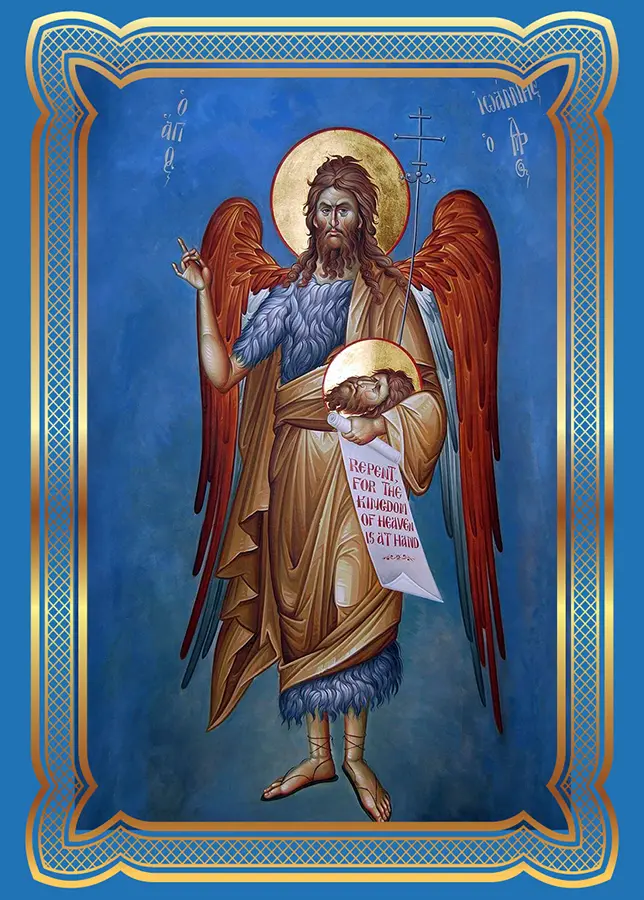
Please join us for a luncheon to celebrate our Patron Saint, St. John The Baptist, on Sunday July 12th after Divine Liturgy in the Memorial Center.

Our Ukrainian Day Festival scheduled for Saturday, July 18th from 11am - 6pm is growing near!
Dear St. John's Family,
Below are a few reminders to make our Festival a success:
PRE-FESTIVAL WORK SESSIONS are scheduled in the KITCHEN for Tuesday and Wednesday morning at 9:00am and Thursday morning at 7:30am. TENT and HALL setups are scheduled for Wednesday starting at 5:30 pm. BAKE SALE prep is scheduled for Friday at 3:00pm. WE NEED YOUR HELP!
BAKE SALE: Please make and bake your fabulous "Specialties" for our bake sale. Please drop off FRIDAY-BEST or Saturday by 9am. Thank you bakers!!
BASKETS RAFFLE: Please create your wonderful baskets for this year's Ukrainian Day Festival. Please drop off wrapped baskets NOW through Wednesday, July 15th. Thanks so much for your creativity! We have the BEST baskets of any local festival!
THE SIGN-UP BOARD is waiting for you to "fill in the blanks" and spend the day working, laughing, praying and enjoying each other as "One Parish Family". Please volunteer… this is a FULL WORK DAY for our Parish… try something new…honor your times… have fun!
SELL YOUR RAFFLE TICKETS: A great way to raise money and get your friends, family and neighbors to attend our Festival! Please turn in your tickets, both sold and unsold, no later than Saturday by 11am to the Raffle Booth / Baskets Raffle area.
PLEASE DONATE to offset our expenses. This message is for all who are out of town, unable to volunteer, as well as for those who give 110% to our Festival and Church! We can always use your kind and generous donations! Donate through stjohnuoc.org website!
PLEASE SHARE with your Facebook audience (if on Facebook). This increases our reach tremendously.
PLEASE RETURN any borrowed tables, chairs and kitchen trays/supplies by Tuesday, July 14th. Thank you!
WE NEED A GROUNDS/TRASH CHAIRPERSON. Contact Me with any leads. In addition, if you see a full trash can, empty it and place a new bag from the bottom of the can. TYSM
May God Bless you all and pray for great weather and attendance!
Mark Hatala, Chairperson, 607-779-8597

We Need Your Support!
This is a significant investment in our community, and we are humbly asking for your help in offsetting the cost of the Air Conditioning. Every contribution — large or small — makes a meaningful difference and brings us closer to our goal.
If you feel led to give, please make your check payable to St. John the Baptist UOC and write "HVAC" in the memo line so your donation is applied directly to this project. Online giving options are also available.
Thank you for your continued generosity and commitment to our parish family. Together, we can make this a reality!
Basket Chair
Thank you Tia Dimitriou for accepting Baskets Chair along with Hrisanthi Dimitriou and Eva Dimitriou-Novak as committee members!
Save the Date - October 10
Our Centennial Celebration is scheduled for October 10, 2026. More info is coming...
Ukrainian Day Festival - July 18, 2026 - Український Фестиваль - 18 липня

Let's Help Ukraine!

St. John's Ukrainian Humanitarian Fund is accepting donations to help Ukrainians during war. Donations will go to provide food and other humanitarian needs.
To make donation online click here
We accept checks as well.
Please make the checks to St. John Ukrainian Humanitarian Fund
Mailing address:
1 Saint John's Parkway
Johnson City NY 13790
Cash is accepted in church
Pray for Ukraine!

Prayers for Ukraine are done during each service. To see the schedule click here.
Молитви за Україну проводяться під час кожної служби. За розкладом дивіться тут.
May God bless and protect Ukraine!
Happy Birthday
- June 29: Milana Burdyliak
- June 29: Matvii Burdyliak
- June 30: Thomas Lomonaco
- June 30: Thomas Skojec
- June 30: Jane Ellsworth
- July 02: Julieanne Marra
- July 04: Robert Holicky
* If your or someone else's birthday is missing or incorrect please let Fr. Ivan know right away.
Please Pray for the Servants of God
John, Peter John, Rose,
Solomiia, Bob, John, Jane, Alla,
Fr. Andre, Mary, Zenna, Douglas,
Ivan, Melanie, William, Marion,
Mariann, Robert, Jean, Ronald, Brian,
Fr. James, Scott, Andriy, James, William,
Vasyl, Olha
Upcoming Readings
| Mon. June 29 – | Rom. 12:4-5, 15-21; | Mt. 12:9-13; |
| Tue. June 30 – | Rom. 14:9-18; | Mt. 12:14-16, 22-30; |
| Wed. July 1 – | Rom. 15:7-16 ; | Mt. 12:38-45; |
| Thu. July 2 – | Rom. 15:17-29; | Mt. 12:46–13:3 ; |
| Fri. July 3 – | Rom. 16:1-16; | Mt. 13:3-9; |
| Sat. July 4 – | Rom. 8:14-21; | Mt. 9:9-13; |