Bulletin for September 27, 2026
Sep. 27 – 17th Sunday after Pentecost. Tone 8
THE UNIVERSAL EXALTATION OF THE PRECIOUS AND LIFE-GIVING CROSS
ВОЗДВИЖЕННЯ ЧЕСНОГО І ЖИВОТВОРЯЩОГО ХРЕСТА ГОСПОДНЬОГО
1 Cor. 1:18-24; Jn. 19, 6-11, 13-20, 25-28, 30-35;
Fast Day
Oct. 4 – 18th Sunday after Pentecost, after Exaltation. Tone 1
Apodosis of the Exaltation of the Cross. Apostle Quadratus of the Seventy (130). Hieromartyr Hypatius, bishop of Ephesus, and his presbyter Andrew (730). Sts. Isaacius and Meletius, bishops of Cyprus. Martyr Eusebius of Phoenicia (2nd c.) and Martyr Priscus of Phrygia. Uncovering of the relics (1752) of St. Demetrius, metropolitan of Rostov (+1709).
1 Cor. 1:18-24; Jn. 19, 6-11, 13-20, 25-28, 30-35;
Fast Day
Services & Other Events
27 September, EXALTATION OF THE CROSS:
- 9am – Confession / Hours
- 9:30am – Divine Liturgy - Бож. Літургія
28 September, Monday:
- 9:00am – Visitation Hour
- 10:00am – Funeral Service for Marion Kaspryk
2 October, Friday:
- 7:30am – Potatoes;
- 10am-12noon – Make pirohy balls, Kitchen/hall setup. Setup guide top shelf by cooler.
3 October, Saturday - Субота:
- 7:30am Finish set-up;
- 8am - 12noon Pinching pirohy, Lunch after
- 5pm – Great Vespers - Вел. Вечірня
4 October, Sunday - Неділя:
- 9am – Confession / Hours
- 9:30am – Divine Liturgy - Бож. Літургія
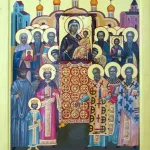
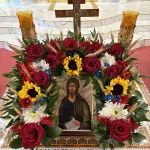
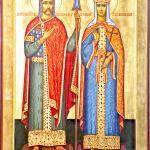
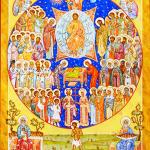
- Blessing of Centennial Icons
7 October, Wednesday:
- 7pm – Choir Rehearsal
Апостол і Євангеліє - Gospel and Epistle of the Day
The Universal Exaltation of the Precious and Life-Giving Cross
The Feast and Its History
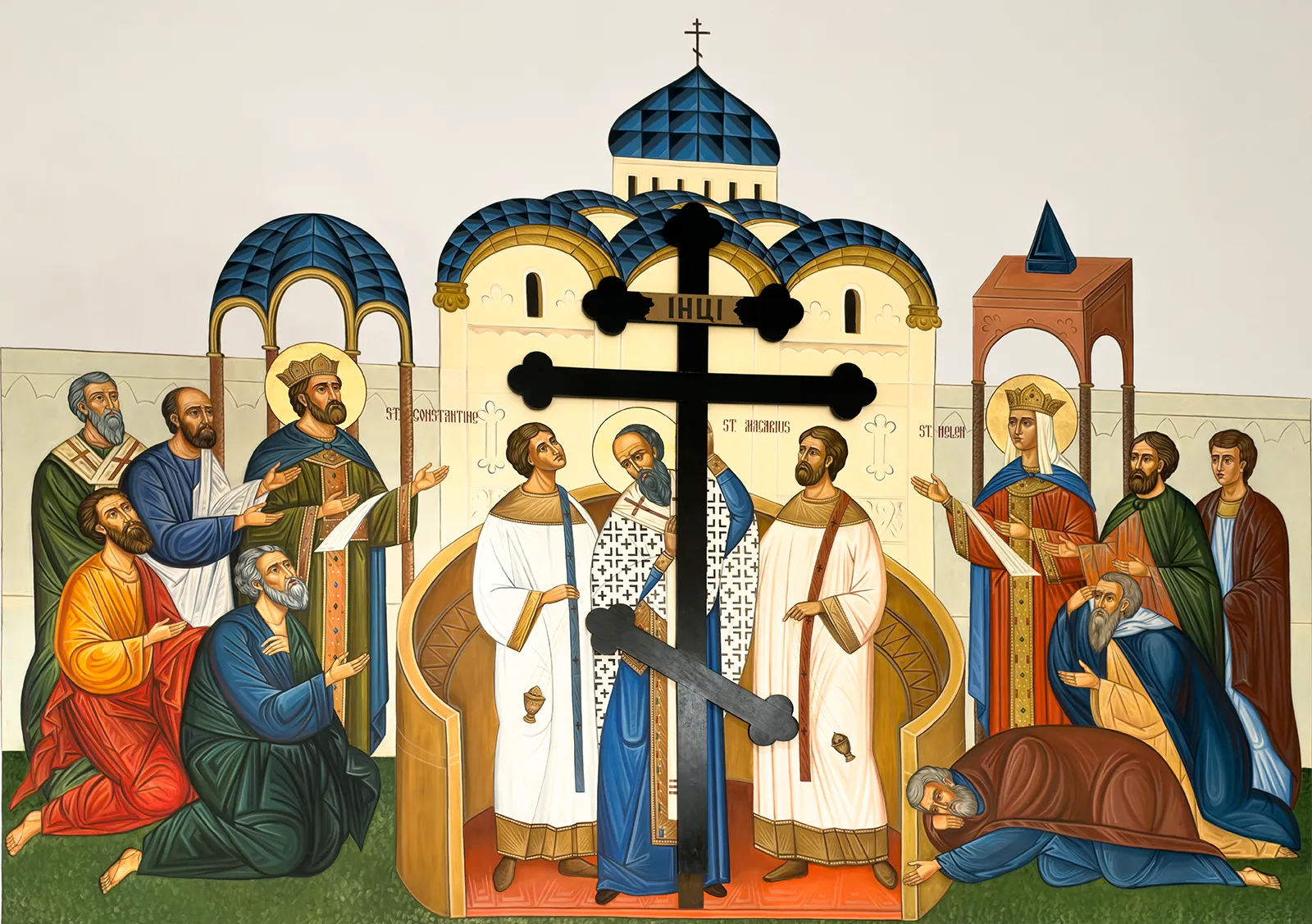
The Universal Exaltation of the Precious and Life-giving Cross is one of the Twelve Great Feasts of the Orthodox Church. It is the only one of them that is kept as a strict fast day, for although it is a feast, its content is the Passion of the Lord. On this day the Church does not merely remember a historical event; she lifts up before the whole world (hence "universal") the instrument of our salvation, so that all may see it and bow before it.
The feast unites several events. Around the year 326, the holy Empress Helena, Equal-to-the-Apostles, mother of St. Constantine the Great, travelled to Jerusalem to seek the place of the Lord's crucifixion. Beneath the pagan temple that had been built over Golgotha, three crosses were uncovered. According to the tradition preserved in the Lives of the Saints, the true Cross of Christ was revealed when it was laid upon a gravely ill woman (in some accounts, upon a dead man carried past), who was immediately restored. Patriarch Macarius of Jerusalem then stood upon an elevated place and raised the Cross high so that the multitude could see it, and the people cried out again and again, "Lord, have mercy!" This is the origin of the solemn rite of the elevation of the Cross, performed in cathedrals at Matins on this day, with the hundredfold "Lord, have mercy" sung toward the four directions of the world.
On September 13, 335, the great Church of the Resurrection (the Holy Sepulchre), built by St. Constantine over Golgotha and the Tomb, was consecrated, and the Cross was venerated on the following day. In the seventh century a second event joined the commemoration: the Persians had carried the Cross away from Jerusalem in 614, and after his victory the Emperor Heraclius returned it in 630. Tradition relates that he was unable to carry it up to Golgotha while dressed in imperial splendor, and could do so only after he took off his royal garments and walked barefoot in humility, as Christ Himself had walked. The Church also recalls the vision of the Cross granted to St. Constantine before his battle at the Milvian Bridge in 312, with the words "By this sign conquer."
St. Nikolai of Ohrid and Žiča (Velimirović), in his Prologue, draws the moral of Heraclius's story: the Cross cannot be carried in pride. Only the humble, who have stripped themselves of vainglory, can bear it to the place where it belongs.
"The Word of the Cross Is the Power of God"
1 Corinthians 1:18–24
St. Paul writes to a Church in Corinth that was proud of eloquence and divided into parties. He places before them the one thing that no human wisdom could have invented: a crucified God. To the Jews, who expected a Messiah of power and miraculous signs, a crucified Messiah was a scandal, for the Law declared cursed everyone who hangs upon a tree (Deut. 21:23). To the Greeks, who sought philosophy, the idea that the Creator of all would die the shameful death of a slave was madness.
St. John Chrysostom, in his Fourth Homily on First Corinthians, shows that this is precisely where the divine power is revealed. The apostles were unlearned fishermen and tentmakers, preaching a message that seemed absurd, to a world ruled by philosophers and emperors, and yet they persuaded the world. If the Cross had been only foolishness, it could never have conquered. The fact that simple men, proclaiming a crucified Man, overcame the wisdom of Greece and the might of Rome is itself, says Chrysostom, the clearest proof that the Cross is the power of God. The weakness of the preachers and the apparent weakness of the message make the victory unmistakably God's own.
The Holy Fathers note that St. Paul does not say the Cross is "wise" to believers, but that it is "power." The Cross is not first an idea to be admired but an energy that saves, heals and transforms. St. Theophylact of Ohrid, following Chrysostom, explains that the word of the Cross shows its power in those who accept it: the believer experiences in himself death to sin and the beginning of new life, and therefore does not need to be convinced by clever argument.
The Apostle's phrase "to us who are being saved" also reminds us that salvation is a path. The same Cross that is foolishness to the proud becomes power to the humble. The difference lies not in the Cross but in the heart that receives it.
The Theology of the Cross in the Holy Fathers
St. John of Damascus
In An Exact Exposition of the Orthodox Faith (Book IV, ch. 11), St. John of Damascus teaches that every work and miracle of Christ is great and divine, but the most marvellous of all is His precious Cross. Nothing else has abolished death, loosed the sin of our forefather, despoiled Hades, granted resurrection and given us the power to despise this present life and even death itself. By the Cross, he says, all things have been set right. He adds that the Cross was given to us as a sign upon our foreheads, as circumcision was given to Israel, and that we venerate even the image of the Cross, not honouring the wood for its own sake but for the sake of Christ who was crucified upon it.
St. Athanasius the Great
In On the Incarnation (ch. 25), St. Athanasius asks why the Lord chose death on a cross rather than any other death. He answers that only on the cross does one die with arms outstretched, and so Christ stretched out one hand to draw the ancient people and the other to draw the Gentiles, uniting both in Himself. He was lifted up in the air in order to cleanse the air of the evil powers and open for us the way to heaven. Thus the very shape of the Cross proclaims the universal reach of salvation.
St. Cyril of Jerusalem
Preaching his Catechetical Lectures in the very church built over Golgotha, only a few years after the finding of the Cross, St. Cyril (Lecture 13) urges the newly-illumined never to be ashamed of the Crucified. He tells them to make the sign of the Cross boldly upon their foreheads and over everything: over bread and cup, when coming in and going out, before sleep and on rising, on the road and at rest. The Cross, he says, is a great protection, given freely, a grace from God, a sign for the faithful and a terror to demons. He also notes that pieces of the wood of the Cross had already spread throughout the whole world, a witness that the Crucified is truly risen.
Bow down to the Cross
On this feast the Church lifts the Cross high, and we bow down to the ground before it, singing: "Before Your Cross we bow down, Master and Your Holy Resurrection we glorify." The Cross and the Resurrection are never separated. The Cross without the Resurrection would be only tragedy; the Resurrection without the Cross would be unexplained. Together they are the whole Gospel.
The Cross was once an instrument of shame; now it shines on the domes of churches, hangs on the breast of every Orthodox Christian and is traced upon our bodies in prayer. What the world counted as foolishness has become the wisdom of God; what seemed to be weakness has become the power of God. Let us, therefore, not be ashamed of the Cross, but glory in it with the Apostle: "God forbid that I should glory, save in the cross of our Lord Jesus Christ, by whom the world is crucified unto me, and I unto the world" (Gal. 6:14).
Воздвиження Чесного і Животворчого Хреста Господнього
Свято та його історія
Всесвітнє Воздвиження Чесного і Животворчого Хреста Господнього — одне з дванадцяти великих свят Православної Церкви. Це єдине з великих свят, яке є днем суворого посту, бо, хоч воно й святкове, його зміст — Страсті Господні. Цього дня Церква не лише згадує історичну подію: вона підносить перед усім світом (звідси слово «всесвітнє») знаряддя нашого спасіння, щоб усі бачили його і поклонялися йому.
Свято поєднує кілька подій. Близько 326 року свята рівноапостольна цариця Олена, мати святого Костянтина Великого, вирушила до Єрусалима, щоб віднайти місце розп'яття Господа. Під язичницьким храмом, збудованим над Голгофою, знайшли три хрести. За переданням, збереженим у Житіях святих, справжній Хрест Христів виявився тоді, коли його поклали на тяжко хвору жінку (за іншими свідченнями — на померлого, якого проносили повз), і вона одразу зцілилася. Тоді Патріарх Єрусалимський Макарій став на підвищення і високо підніс Хрест, щоб його побачив увесь народ, а люди знову й знову вигукували: «Господи, помилуй!» Звідси походить урочистий чин воздвиження Хреста, який цього дня звершують у соборах на утрені, зі стократним «Господи, помилуй», співаним на чотири сторони світу.
13 вересня 335 року було освячено величний храм Воскресіння (Гробу Господнього), збудований святим Костянтином над Голгофою та Гробом, а наступного дня народ поклонявся Хресту. У VII столітті до спомину приєдналася ще одна подія: 614 року перси забрали Хрест з Єрусалима, а 630 року імператор Іраклій після перемоги повернув його. Передання розповідає, що він не міг донести Хрест на Голгофу, поки був одягнений у царські шати, і зміг це зробити лише тоді, коли скинув царський одяг і смиренно пішов босоніж, як ішов Сам Христос. Церква згадує також видіння Хреста, дане святому Костянтинові перед битвою біля Мільвійського мосту 312 року, зі словами: «Цим переможеш».
Святитель Миколай Сербський (Велимирович) у своєму «Охридському Пролозі» виводить повчання з історії Іраклія: Хреста не можна нести в гордості. Лише смиренні, які скинули з себе марнославство, можуть донести його туди, де йому належить бути.
«Слово про хрест — сила Божа»
1 Кор. 1:18–24
Святий апостол Павло пише до коринтської Церкви, яка пишалася красномовством і була розділена на партії. Він ставить перед нею те єдине, чого не могла б вигадати жодна людська мудрість: розп'ятого Бога. Для юдеїв, які чекали Месію сили й чудесних знамень, розп'ятий Месія був спокусою, бо Закон проголошував проклятим кожного, хто висить на дереві (Втор. 21:23). Для греків, які шукали філософії, думка, що Творець усього помре ганебною смертю раба, була безумством.
Святитель Іоанн Золотоустий у четвертій бесіді на Перше послання до коринтян показує, що саме тут і відкривається Божа сила. Апостоли були неписьменними рибалками й наметниками, які проповідували, здавалося б, безглузду звістку світові, де панували філософи й імператори, — і все ж вони переконали світ. Якби Хрест був лише безумством, він ніколи не переміг би. Те, що прості люди, проповідуючи розп'ятого Чоловіка, здолали мудрість Еллади й могутність Риму, — це, за словами Золотоустого, найясніший доказ того, що Хрест є силою Божою. Немічність проповідників і позірна немічність проповіді роблять перемогу безсумнівно Божою.
Святі Отці зауважують, що апостол не каже, ніби для віруючих Хрест є «мудрим», а каже, що він — «сила». Хрест — це насамперед не ідея, якою милуються, а енергія, що спасає, зцілює і преображає. Блаженний Феофілакт Болгарський, ідучи за Золотоустим, пояснює, що слово про Хрест виявляє свою силу в тих, хто його приймає: віруючий на собі пізнає смерть для гріха і початок нового життя, тож не потребує переконання хитромудрими доводами.
Слова апостола «для нас, хто спасається» нагадують також, що спасіння — це шлях. Той самий Хрест, що для гордих є безумством, для смиренних стає силою. Різниця не в Хресті, а в серці, яке його приймає.
Богослов'я Хреста у Святих Отців
Преподобний Іоанн Дамаскин
У «Точному викладі православної віри» (кн. IV, гл. 11) преподобний Іоанн Дамаскин навчає, що кожне діло і чудо Христове велике й божественне, але найдивовижніше з усіх — Його Чесний Хрест. Ніщо інше не знищило смерті, не розв'язало гріха праотця, не спустошило пекла, не дарувало воскресіння і не дало нам сили зневажати теперішнє життя і навіть саму смерть. Хрестом, каже він, усе виправлено. Він додає, що Хрест дано нам як знамення на чолі, як Ізраїлеві було дано обрізання, і що ми поклоняємося навіть образові Хреста, шануючи не дерево саме по собі, а Христа, Який був на ньому розп'ятий.
Святитель Афанасій Великий
У творі «Про втілення Слова» (гл. 25) святитель Афанасій запитує, чому Господь обрав смерть саме на хресті, а не якусь іншу. Він відповідає, що лише на хресті людина вмирає з розпростертими руками, — і так Христос однією рукою пригорнув давній народ, а другою — язичників, поєднавши обох у Собі. Він був піднесений у повітря, щоб очистити повітря від злих сил і відкрити нам шлях до неба. Отже, сама форма Хреста сповіщає вселенський обсяг спасіння.
Святитель Кирило Єрусалимський
Проголошуючи свої Огласительні повчання в тому самому храмі, збудованому над Голгофою, лише через кілька років після віднайдення Хреста, святитель Кирило (Повчання 13) закликає новоосвічених ніколи не соромитися Розп'ятого. Він велить їм сміливо накладати хресне знамення на чоло і на все: на хліб і на чашу, при вході й виході, перед сном і після пробудження, в дорозі й на спочинку. Хрест, каже він, — велика охорона, дана безплатно, благодать від Бога, знамення для вірних і страх для демонів. Він також зауважує, що частки древа Хреста вже розійшлися по всьому світу, свідчачи, що Розп'ятий справді воскрес.
Поклоніться Христу
Цього свята Церква високо підносить Хрест, а ми схиляємося перед ним до землі, співаючи: «Хресту Твоєму поклоняємося, Владико, і святе Воскресіння Твоє славимо». Хрест і Воскресіння ніколи не розлучаються. Хрест без Воскресіння був би лише трагедією; Воскресіння без Хреста залишилося б незбагненним. Разом вони — усе Євангеліє.
Колись Хрест був знаряддям ганьби; нині він сяє на банях храмів, висить на грудях кожного православного християнина і зображується на наших тілах у молитві. Те, що світ вважав безумством, стало премудрістю Божою; те, що здавалося немічністю, стало силою Божою. Тож не соромтеся Хреста, а хвалімося ним разом з апостолом: «А я не хочу хвалитися, хіба тільки хрестом Господа нашого Ісуса Христа, що ним для мене розп'ятий світ, а я для світу» (Гал. 6:14).
Condolences
We extend our sincere condolences to the family of Marion Kaspryk who reposed in the Lord on September 23, 2026. May her memory be eternal!
Centennial Celebration Schedule of Events
9 October, Friday:
- 6-9pm Centennial Social in the Club
10 October, Saturday:
- 9:30am – Hierarchal Greeting, Blessing of Choir Loft Icons and Holy Altar, Divine Liturgy with a group picture. No Coffee hour.
- 3pm Cocktails and music at The Binghamton Club
- Program and Banquet to follow
11 October, Sunday:
- 9:30am – Divine Liturgy with a Parish Luncheon to follow
Please Note: we will be honored to welcome His Eminence Archbishop Daniel for the Hierarchical Divine Liturgy. Please plan to arrive by 9:15 so we can greet our bishop together and witness the blessing of our new icons on choir loft and blessing of renewed Holy Altar Table. The Liturgy begins at 9:30am, and we expect a full church, so come a little early. Let's welcome our Vladyka with joy, prayer, and a full house!
Centennial Social
Hosted by St Johns Social Club
Join us on Friday, October 9th, as we kick off our historic centennial weekend.
Time : 6 - 9 pm
Serving lite bites in a casual setting. It's a wonderful opportunity to connect with current and former parish members along with treasured friends of our parish.
Cash bar featuring signature cocktails, beer, wine, and soda.
Everyone is welcome!!
Pirohy Session this week!
Friday, October 2nd:
- 7:30am - Peel potatoes / boil / make filling - All are welcome!
- 10:00am - 12 noon - Make balls… need help here too!
Saturday, October 3rd:
- 7:30am Set-up
- 8:00am - 12 noon - Pinching - coffee - donuts - conversation
- Lunch served afterwards - Yum!
There are many ways to help!! Please consider attending and making the work light and easy for all. We need help both in the kitchen and with pinching… school-age runners too!
Please call your friends and family to attend too.
If you are unable to attend, please consider a donation towards the lunch expenses.
We do need a volunteer to handle the lunch for the session too.
Thank you for your time and dedication!!!
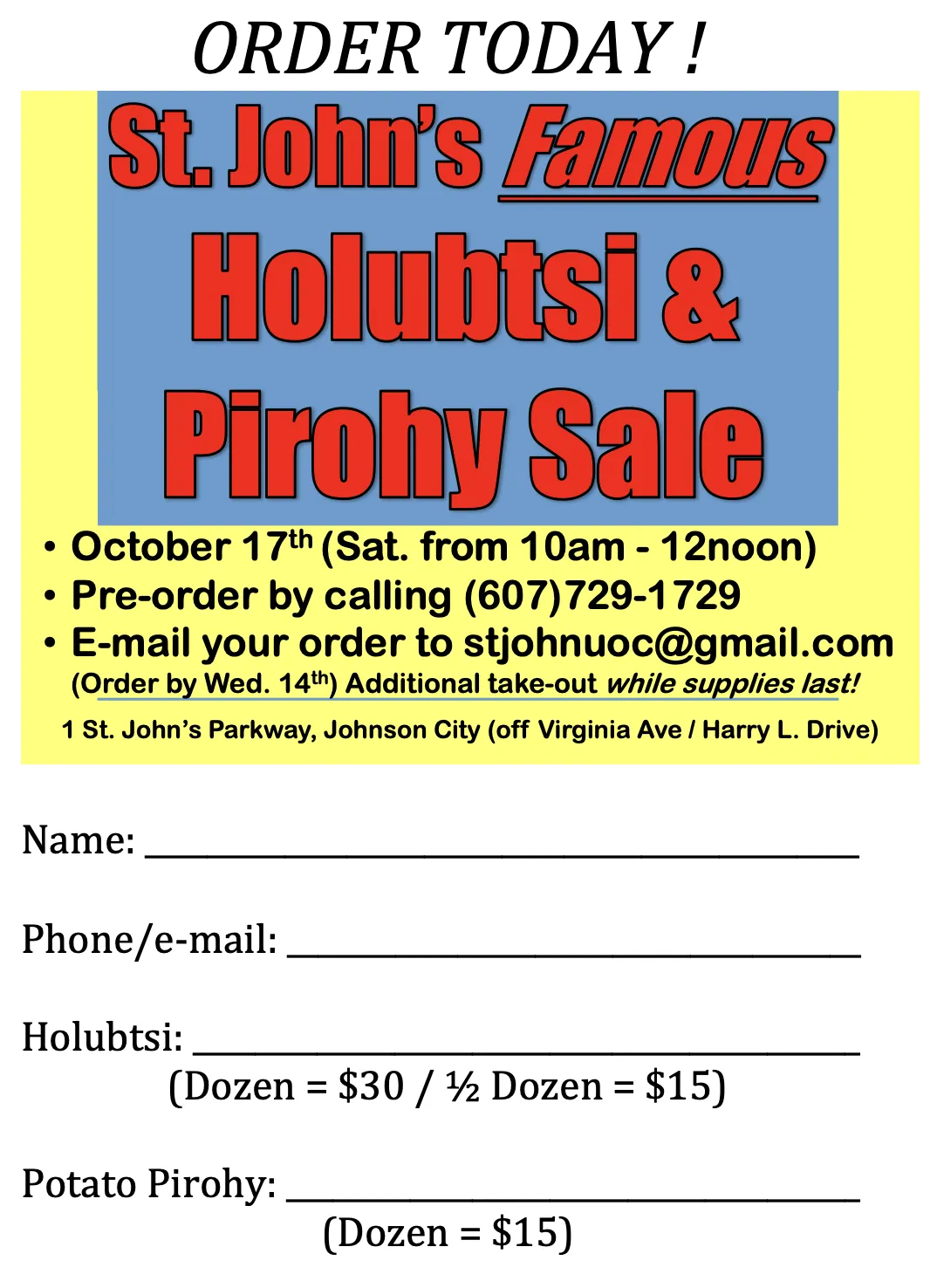
St. John's Famous Holubtsi & Pirohy Sale
Let's Help Ukraine!
St. John's Ukrainian Humanitarian Fund is accepting donations to help Ukrainians during war. Donations will go to provide food and other humanitarian needs.
To make donation online click here
We accept checks as well.
Please make the checks to St. John Ukrainian Humanitarian Fund
Mailing address:
1 Saint John's Parkway
Johnson City NY 13790
Cash is accepted in church
Pray for Ukraine!
Prayers for Ukraine are done during each service. To see the schedule click here.
Молитви за Україну проводяться під час кожної служби. За розкладом дивіться тут.
May God bless and protect Ukraine!
Happy Birthday
- September 28: Sharon Italiano
- September 29: Stephan Wasylko
* If your or someone else's birthday is missing or incorrect please let Fr. Ivan know right away.
Please Pray for the Servants of God
Metropolitan Antony, PM Kelly,
Peter John, John, Rose, Solomiia,
Bob, John, Jane, Alla,
Fr. Andre, Mary, Zenna, Douglas,
Melanie, William, Mariann,
Robert, Jean, Ronald, Brian,
Fr. James, Scott, Andriy, James, William,
Olha, Solder Olexiy, Tamara
Upcoming Readings
| Mon. Sep. 28 – | Eph. 4:25-32 ; | Lk. 3:19-22; |
| Tue. Sep. 29 – | Eph. 5:20-26; | Lk. 3:23-4:1; |
| Wed. Sep. 30 – | Eph. 5:25-33 ; | Lk. 4:1-15; |
| Thu. Oct. 1 – | Eph. 5:33-6:9; | Lk. 4:16-22; |
| Fri. Oct. 2 – | Eph. 6:18-24 ; | Lk. 4:22-3; |
| Sat. Oct. 3 – | 1 Cor. 1:26-29; | Jn. 8:21-30; |